Peter Fisher of Cedar Township Addressing the Solon City Council
SOLON — The Solon City Council received more than 50 media and members of the public in its chambers this evening. In a unanimous vote, council rejected the Johnson County ordinance to raise the minimum wage in favor of state regulations. They collapsed three required readings into this one, so the decision is final.
Seventeen speakers on multiple sides of the issue made statements and appeals to council members. In the end, everything proceeded as it must have been foreseen by the mayor and council.
My last post about mau-mauing the city council got it wrong in that everyone who spoke, and the audience generally, were well behaved and non-confrontational. It didn’t make a difference.
Here are my takes:
The presence of people who lived outside the city made matters worse. Locals are well aware of what happened in Wisconsin during the unsuccessful recall of their governor. Kevin Samek of Solon mentioned Scott Walker by name during his remarks. Council supporters made clear outsiders weren’t welcome. One person said, “It’s just like the Scott Walker recall again.” Not in a good way regarding the coalition of organizations who were present.
Business owners don’t like the publicity. This is not a shocker, but word of a potential boycott got their attention. Jay Schworn of Salt Fork Kitchen said he hadn’t wanted to get involved until word of a potential boycott spread around on Facebook.
There were no minimum wage workers present. This voice should have been heard from and wasn’t. One speaker, whose name I couldn’t understand said she knew three Solon families working minimum wage jobs and couldn’t attend because they were working. One business owner said he employed a number of high school students at $7.25 per hour and they were a problem because of the limited hours they could work. He preferred hiring mature staff at a higher wage.
If people don’t like government, they should run for office. Solon voters made this council, except for one appointment. If it is perceived as broken, only they can fix it. The filing deadline in the Solon city races is tomorrow.
Public comments were a rich soup of heartfelt words deployed in a way that doesn’t work any more when persuading elected officials. For those of us who follow politics, there are lessons to be learned. I plan to listen to every minute of the audio recording — at least twice.
RURAL JOHNSON COUNTY — A group of advocates from the county seat is expected to arrive in nearby Solon for tonight’s city council meeting at 5:30 p.m.
On the agenda is an ordinance by which the City of Solon would opt out of the county mandate to raise the minimum wage from $7.25 per hour to $10.10 by Jan. 1, 2017.
The Center for Worker Justice is leading a direct action to confront the city council about their potential decision.
“Solon Council members need to hear the real facts about raising the minimum wage and how this change strengthens our communities,” Misty Rebik, executive director, Center for Worker Justice of Eastern Iowa said in an email last night. “Take action, protect what we’ve won.”
The center is organizing a car pool to the council meeting from their facility in Iowa City.
The story is gaining corporate media attention as Fox News/KGAN2 sent correspondent Matt Hammill to Solon yesterday. Hammill interviewed Sam Lensing, owner, Sam’s Main Street Market. It is noteworthy that Lensing points to the challenge others would have.
“It isn’t the idea of increasing wages for his employees that bothers Sam Lensing,” said the report. “In fact, most of his workers already make above minimum wage. He says the mandated increase would result in many businesses having to raise their prices to customers and pass along the increase in costs and in a small commuter town, where people have choices, that could kill businesses.”
The bright shiny object in Solon is the growing number of restaurant start-ups within city limits. By my count, there are nine places to get a bite to eat on Main Street and several more located in strip malls around town. Both city councilors and advocates are aware of this aspect of city life.
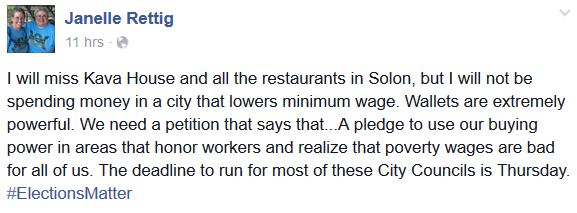
County supervisor Janelle Rettig and Iowa City resident David Goodner have suggested using the power of the pocketbook to influence the city council. Rettig made this post on Facebook:
Goodner echoes the pocketbook theme:
The approach taken by advocates for the county minimum wage ordinance is an adventure in mau-mauing the city council. Councilors are unlikely to be influenced by these tactics unless Solon residents step forward to advocate support for the county ordinance. To date, no one has done so.
The face of poverty is invisible in Solon.
Who are Solon’s minimum wage workers? We don’t really know. They may be clients of the food bank at the Methodist Church. They may be taking advantage of government programs like SNAP and Medicaid. They may be neighbors who just don’t want to talk about it.
Unless arguments for and against raising the minimum wage consider actual people who take minimum wage jobs in Solon, they are a useless political construct among people who already have had more than their share of politics. This applies equally to city councilors, business owners who have come forward, and to out of town advocates.
RURAL JOHNSON COUNTY — The nearby City of Solon is concerned about the impact of the recently passed county ordinance to raise the minimum wage. The city council doesn’t buy in, local businesses don’t buy in.
On Sept. 10, the Johnson County Board of Supervisors held the last of three readings of a new ordinance to raise the county minimum wage in $0.95 increments to $10.10 per hour by Jan. 1, 2017. The board passed the ordinance unanimously.
The Cedar Rapids Gazette reported the Solon city council is considering opting out of the new county minimum wage structure.
According to the Solon city administrator, the city council is considering just such an action.
An agenda of the council’s Sept. 2 meeting lists “discussion on minimum wage ordinance by Johnson County.” Draft minutes from the last council meeting, which have not been posted online, show council members unanimously voiced opposition to the county’s minimum wage ordinance. Local business owners also spoke out against it, saying they couldn’t afford raises for all of their employees while maintaining the same staff levels.
Doug Lindner of the Solon Economist recounted Mayor Steve Stange’s Sept. 2 survey of council members here. The council unanimously opposed raising the wage in Solon as laid out in the new ordinance.
City Attorney Jim Martinek was directed by Stange to review the proposed county law and research the city’s options and responsibilities, according to Lindner. Council is expected to take up the issue at its Sept. 16 meeting.
KCRG – TV9 interviewed local business owners Leo Eastwood and Sam Lensing in a news segment that aired Sept. 11.
Eastwood owns Eastwood’s Sports Bar and Grill. He is well known in the community and has placed political advertisements for favored Republican candidates at his place of business. His business recently moved from a strip mall at the edge of town to Main Street, where he joined a growing group of bars and restaurants in the city of 2,300 people.
“You’ve got to pass that along or you’re not going to be in business long,” Eastwood said to KCRG of a potential mandatory wage increase.
Lensing owns the most visible business on Main Street, Sam’s Main Street Market, a full service grocery store. Another of Lensing’s businesses, D & D Pizza, recently vacated its space across the street from the grocery store and Eastwood moved in.
Sam’s Main Street Market is and has been an important part of the community, sponsoring local events, collecting funds for the local food bank, and preventing the city from becoming a food desert for people with limited transportation.
“If this wage hike does increase that much where people have to raise their prices what’s it going to do for their business?” Lensing asked in the interview.
Sam’s Main Street Market competes with Fareway, Aldi, HyVee, Walmart and Costco. Because Solon is a bedroom community, people who commute to work have an easy option to buy groceries and sundries elsewhere. The convenience of his location brings customers willing to pay more rather than make a special trip to another town. KCRG didn’t report how many employees Lensing has at near minimum wage to validate his concern.
All of this seems like a tempest in a teapot, and here’s why.
The council’s concern, as reported by the news media, seems like a knee-jerk reaction to the minimum wage increase by a small number of business owners. The retail price increase a minimum wage increase may or may not require would have little impact in a community where the median household income is more than $62,000 per year — substantially higher than either the county-wide or state-wide figures. The argument about raising prices is a red herring.
How many low wage workers has the council heard from? I wasn’t at the meeting, but probably zero. In my experience covering council meetings for the Solon Economist I found councilors exercised a reasonable amount of diligence in matters like this. While the composition of the council has changed since I covered them, one hopes they will get feedback from Solon residents who work at or near the minimum wage in the city before opting out of the county ordinance. It is a voice not heard in this discussion to date.
There has been no public discussion of the impact on the Solon workforce of opting out. There are a lot of questions to be answered, including, how many near minimum wage jobs (earning below $10.10 per hour) would be affected? Where do Solon workers in near minimum wage jobs live? Would near minimum wage employees at Solon businesses seek employment at higher wages elsewhere as a result of the city opting out? How do near minimum wage workers in Solon get health insurance mandated by the Patient Protection and Affordable Care Act, and at what cost to taxpayers? Has the city council read the ordinance to understand which businesses are required to comply and which are not? At present, there are no public answers.
As I wrote on Friday, the new county ordinance does little to address the underlying causes of poverty here. It turns out getting cities like Solon to buy in will be yet another delay in pursuit of social and economic justice.
Yesterday brought a truckload of news on three important issues: nuclear non-proliferation, the Iowa caucuses and local worklife.
Democrats in the U.S. Senate blocked a vote on legislation intended to derail the process of bringing the Islamic Republic of Iran into compliance with its obligations under the Nuclear Non-proliferation Treaty. By signing and ratifying the NPT Iran is entitled to a peaceful nuclear program in the areas of medicine and electricity generation as long as they comply with treaty terms. They weren’t in compliance.
How did Iran get to the point where developing a nuclear weapon became imminent? Thank the George W. Bush administration and its laissez-faire attitude toward Iran’s uranium enrichment program. Bush wouldn’t talk to Iran, or do much to enforce its obligations under the NPT. The Obama administration changed all of that, talked to Iran, and together with the P5 +1 nations forged an agreement to bring Iran into compliance.
Republicans howled that the deal was struck. Now that the political process has run its course, they shouldn’t have much to complain about. However, they do despite the administration’s cooperation with the Congress. Or as Laura Rozen, reporter for Al-Monitor posted on twitter,
Hard to understand McConnell’s gripe. they got review, they got 60 over 30 days, they got two offers for up or down vote from Reid.
In a survey of 832 likely Iowa Democratic caucus participants, Bernie Sanders closed the gap with Hillary Clinton to within the margin of error in the new Quinnipiac University poll released yesterday. People feeling “the bern” were quick to state Sanders now leads Clinton, but it’s early and one poll doesn’t mean as much as they may hope on Sept. 10.
Nonetheless, it is good news for Sanders to poll leading Clinton, even if it is within the margin of error. Already his campaign is raising money from the poll although the long odds continue to favor Clinton as the Democratic nominee. Steve Rattner of the New York Times posted the following analysis:
In a unanimous vote, the Johnson County Board of Supervisors approved an ordinance to raise the county-wide minimum wage to $10.10 by 2017. It was cause for celebration for the Center for Worker Justice of Eastern Iowa which helped organize a demonstration supporting the ordinance prior to the vote. The first $0.95 per hour increase is effective Nov. 1, although cities within the county can nullify terms of the ordinance, which they have been waiting for the county to finalize.
In the end this ordinance does little to alleviate the issues driving poverty in our county. According to Pew Research Institute, increasing the minimum wage benefits what Pew calls “near minimum wage earners,” or people who earn less than $10.10 per hour. “The near-minimum-wage workers are young (just under half are 30 or younger), mostly white (76%), and more likely to be female (54%) than male (46%). A majority (56%) have no more than a high-school education,” according to Pew.
The Iowa Policy Project uses the Economic Policy Institute data on minimum wage. Pew says 20.6 million people nationwide would be impacted by an increase in minimum wage to $10.10 per hour. EPI puts the number at 27.8 million. It is prudent to look at both numbers, but as low wage workers understand, the primary impact of public policy is on individual lives, more than broad statistics.
I favor the analysis of local author Paul Street who used the EPI family budget calculator to break down the impact of a minimum wage increase in Johnson County. He said, “considering all this, I can be forgiven, perhaps, for not showering praise on the Johnson County Supervisors for moving forward on a proposal that would raise the county’s minimum wage from $7.25 to $10.10 an hour by 2017.”
Read Street’s guest opinion in the Sept. 7 Iowa City Press Citizen here.
Thursday was not a bad day for those paying attention. I drove to the county seat to pay my property taxes. Coming straight from the garden, I wore rolled up blue jeans, sandals and a T-shirt, funding the government for another six months.
As a child Dad would take us to the Eagles hall for a Labor Day event sponsored by his union. There were speeches and socializing, food and beverages, and one year I won a canned ham in a raffle which I proudly brought home to Mother. A lot of people attended and I got to know some of them after joining the union to work at the meat packing plant for a couple of summers while I was an undergraduate. It was an open shop, but I joined the union and still have my union retirement card.
After college, I joined the U.S. Army and was assigned to an infantry company. In the military, and in a number of government and private jobs, I was occasionally a worker, but mostly have managed people and resources over a 40-year worklife. I’ve viewed unions from multiple perspectives, with a personal stake in the union-management relationship. Two things seem most important about the changes in worklife over the years.
Work is not valued adequately. The rise of management consulting firms—that purport to help companies drive profitable growth through the effective use of compensation—have methods of assigning value to work. What they do is help companies optimize and reduce human resources costs. Private business has been working to shed people-costs for years and some believe there is an application for these skills in government as well. The growth of outsourcing, temporary job agencies and part time workers are all part of this successful-for-business movement.
What is the value of food security, a livable homelife and a strong social support network? People who do the work to provide these things are taken for granted.
Compensation is a murky endeavor at best. At a job interview in 2014, the district manager of an international service organization emphasized there were no benefits in his company which employed more than 20,000 workers. The work was part-time, and under the Patient Protection and Affordable Care Act, companies who employed people more than 30 hours per week are required to provide health insurance. The company kept employees under 30 hours per week.
The starting hourly wage was above average for the kind of work in the area. To get health insurance mandated by the ACA, people who worked there when I did often turned to the ACA health exchanges for coverage and subsidies. My policy through the exchange costs about $1,200 per month without subsidy. There are stories of much higher premiums for families. If you take the premiums divided by the number of hours worked, it amounts to a $9.89 per hour subsidy of my worklife.
Businesses have methodologies to understand the value of benefits packages. Workers often don’t. While some appreciate the fact that an employer will provide a benefits package, few workers I know put a pencil to it. The focus is almost totally on wages that can be spent and this distorts the value of working for a company. Too, it is hard to define the value of benefits like disability insurance, life insurance, paid time off, and employee appreciation days. People who focus solely on hourly wage rates often don’t understand the broader context in which wages exist in society.
It’s a personal tradition to work on Labor Day. Even when I worked for an oil company, I drove to the office on Labor Day. Besides security, I was often the only person in the high rise office building on Michigan Avenue in Chicago.
These days the jobs I work are part time and temporary. Working on Labor Day now means finding my way to a home writing table to work on a freelance article, or making a trip to the garden to pull weeds. All of this has value, just not monetary value. Maybe that’s my point.
What is the value of living a reasonably secure life? It’s a lot higher than it feels for working people.
As we approach Labor Day, the lockout of United Steel Workers at six Allegheny Technologies plants is a sad commentary on the state of affairs of public sector unions.
“Management has locked out more than 2,000 workers in an effort to extract concessions on health and retirement benefits from union members,” according to Michael Hiltzik of the Los Angeles Times.
“ATI is demanding steep increases in out-of-pocket health care expenses and the elimination of pensions for new hires, essentially creating a two-tier wage and benefit system. In addition, ATI wants to expand the use of outside contractors and impose work rule changes that would turn workers into casual laborers, with irregular and unpredictable shift times, less access to overtime pay and worse working conditions,” according to Evan Winters of the World Socialist Web Site.
It is no secret that American business has been working to shed pension and health insurance liabilities, and for the most part has been successful during the post-Reagan era. If they had their way, companies would seek to eliminate most operational liabilities from having employees by outsourcing and using temporary, part-time workers without benefits.
That the company (through a third party) is able to offer temp workers as much as $3,000 per 84-hour week without benefits – plus a guaranteed layoff if a new contract between labor and management is signed – is a demonstration of the power of capital in this capital intensive industry. The average annual wage for a USW worker at Allegheny Technologies is $90,000, which includes mandatory overtime.
If $90,000 per year plus benefits seems like a lot, the work is physically demanding, dirty, repetitive and resoundingly dull. For long-time steel workers, it is a way of life, fraught with injury and physical deterioration. On a scale of wage justice, steel workers should be at the higher end of the range.
Yet the company can, and likely would pay a premium rate to keep the plant operating, albeit at a lower rate of efficiency, until the union contract is settled – or when the temporary workers are made replacement workers. Hiltzik called it a “race to the bottom,” and friends of labor would agree.
The union is damned if they do and damned if they don’t. On the one hand, some members believe USW leaders are too cozy with Allegheny Technologies management, according to Winters. Rank and file may or may not accept a deal presented for a vote. On the other hand, if there were no USW, management would long ago have made the changes they seek in this new contract.
In 2014, 6.6 percent of private-sector workers in the U.S. were union members, according to the Bureau of Labor Statistics. In Iowa, it is slightly higher at 6.9 percent, or 84,791 union members. As a right to work state, there are another 7,500 private-sector workers who are not union members, but work at a company where the pay and benefits are set by a union contract.
The Allegheny Technologies lockout is a case where each contract negotiation has become an opportunity to break the union, rather than to make adjustments in pay and benefits to serve both employees and the company. Because of the capital intensive nature of the steel industry, labor is required to keep plants operating. Just not workers represented by a union.
On Thursday the Los Angeles Times reported a Costco member sued the retailer on allegations that it knowingly sold frozen prawns that were the product of slave labor.
The lawsuit, filed Wednesday in U.S. District Court in the Northern District of California, alleges that Costco was aware that the prawns it purchased from its Southeast Asian producers came from a supply chain dependent on human trafficking and other illegal labor abuses.
The suit, which seeks class-action status, named seafood producers Charoen Pokphand Foods Public Co. in Thailand and C.P. Food Products Inc. in Maryland as defendants.
Based on claims of unfair competition and fraudulent practices, the lawsuit seeks a court order stopping Costco from selling prawns without a label describing its “tainted” supply chain and from buying, distributing and selling products they know or suspect to be derived from slave labor or human trafficking.
If the allegations are true, the Costco halo with regard to labor relations should dim.
More than any other large retailer, Costco is in the good graces of members of the progressive community for its labor practices.
In January 2014, President Obama choose a Costco in Lanham, Maryland to advocate for an increase in the federal minimum wage because the retailer is “acting on its own to pay its workers a fair wage.”
“To help make that case, look no further than Costco,” said Thomas Perez, secretary of labor at the event. “Costco has been proving for years that you can be a profitable company while still paying your employees a fair wage. They’ve rejected the old false choice that you can serve the interests of your shareholders, or your workers, but not both.”
“Labor union officials and backers agree,” according to an article in USA Today, “saying other retailers, such as Walmart, could learn from the way Costco treats its workers and the results.”
Costco’s example is on the left end of the retail spectrum, and is set up to be taken down a notch. Slavery in its supply chain is nothing new as their shelves have long been stocked with canned tuna derived from a Thailand based fishing trade that sources from slave vessels. The Costco halo has protected it… perhaps until now.
When in high school I enjoyed having a tuna melt sandwich at Ross’ Restaurant in Bettendorf after working on the stage crew. The warm tuna salad, with a slice of melted cheese, served on toasted bread was sensually appealing and delicious. We are not in high school any more.
We live in a society where the mere mention of symbols of 19th century slavery creates cacophonous public debate. Just look at the recent news cycles regarding use of the Confederate battle flag in public places. It was a media firestorm with the defining act arguably being removal of the Confederate flag from the South Carolina state capitol grounds. Modern day slavery? Barely a word about it.
Whether Costco’s association with slaves in its supply chain will become an issue among its members is uncertain at best. As a society don’t like to take down the symbols in our hagiography, even if all large-scale retailers, including Costco, are far from saintly. We take comfort in developing patterns and relationships with our retailers, creating a refuge from a world that seems increasingly hostile. “I like this brand,” a consumer might say.
The argument comes down to the face of the farmer. When we discover the farmer is a slave, it requires action on our part. That is, unless we concede the world is so screwed up there is no hope.
I’ve never eaten a prawn, and don’t plan to start. If the lawsuit is successful, I’m not sure it will matter among prawn-eaters or other Costco members. However, progressives should care, and stop referring to Costco as a model for labor relations until it pledges, and lives up to the pledge, to take slavery out of its supply chain.
The Johnson County Board of Supervisors set a public forum Aug. 12 to collect information regarding its proposal to increase the county-wide minimum wage to $10.10 per hour in three stages by 2017.
Something bigger than incremental hourly wage increases is at stake.
There are legal hurdles for the supervisors to jump in passing an ordinance, but to a person they are smart people and a vocal minority of the community has been supportive. State Senator Bob Dvorsky, who represents part of Johnson County, Cedar County and the City of Wilton weighed in favoring the proposal this week.
This action is indicative of local frustration with failure to act on the part of state and federal government. This is the third such prominent case where local authorities have taken things into their own hands absent governance.
The most familiar is the lawsuit initiated by the Des Moines Water Works over its increased costs of removing nitrates, mostly generated from farming operations, from the capitol city’s drinking water. Governor Branstad asked the public utility to “tone it down and start cooperating” in its criticism of the agricultural community. The water works is planning to spend $183 million for new nitrate treatment equipment because of increased levels in the Raccoon River resulting mostly from farm runoff.
Art Tate, superintendent of Davenport public schools, said he was going to break state law after the state legislature failed to provide adequate resources to his district during the most recent legislative session.
These examples present a dim picture for state governance, as each problem could be governed by the state with more effectiveness and broader impact.
Taking things into our own hands is a native impulse and very American. It is the same kind that gets small scale entrepreneurs to start businesses and community groups to form to solve local problems.
When in western Iowa a couple years back, a group of us stopped at a small diner attached to a truck stop in Missouri Valley, hoping to grab a quick breakfast before our scheduled event in Des Moines. The place was packed, but we placed our order, mindful of the time.
After about 20 minutes, a woman came from the kitchen and made an announcement, “Our cook just quit, and I’m not sure what we’re going to do about it.”
A regular patron stood up and said, “Hell, I can cook eggs, and rushed to the kitchen before anyone cold stop him.”
After ten more minutes, we tipped our server and said we had to go without eating.
The native impulse to take things into our own hands is part of what’s good about living in Iowa. What would be better is if people would connect the dots between the problems we all share and the purpose of government.
There are minimum wage earners who would spend extra money in their paycheck. Urban dwellers don’t deserve to pay for an unrecognized cost of agriculture. School children deserve the best education possible, and it’s possible to do much more than we are. Importantly, we deserve better governance.
Until people take matters into their own hands and elect men and women who will serve the electorate more than moneyed interests, we will be stuck. It is possible, using the same hands with which our country was built, we will engender democracy again by using the ballot box. It’s something sorely needed in Iowa.
The loud but small-sized movement to raise the minimum wage is made up of good people. There are not enough of them to make a difference. Their voice is amplified in corporate news outlets, but neither the federal nor state governments have acted to raise the minimum wage in a long time.
Today the Johnson County Board of Supervisors is scheduled to discuss a county ordinance to raise the minimum wage to $10.10 by 2017. Iowa City native David Goodner feels this is not enough and called for raising it to $15. As we posted yesterday, Iowa labor commissioner Michael Mauro said the ordinance Johnson County is discussing is inconsistent with Iowa law and therefore unconstitutional. The county attorney has not reported to the board on the legality of a potential ordinance.
Goodner wrote in the print edition of today’s Iowa City Press Citizen, “According to the Iowa Policy Project, a livable wage for a single worker in Iowa is $13.04 an hour. A single mom with kids needs $28.07 an hour to make ends meet. Married workers with two kids need $16.89 an hour each.”
The numbers are a familiar construct and seem reasonable to progressive readers who follow the Iowa Policy Project. Peter Fisher and Lily French’s article, “The Cost of Living in Iowa – 2014 Edition” is well researched and often quoted. “The Johnson County Board of Supervisors know what the research says. So why not $15 an hour now?” wrote Goodner. “Why should workers have to wait to earn a livable wage?”
Where is the groundswell of support from the 3.3 million U.S. workers who are at or below minimum wage to raise it? The answer is complicated, but Pew Research Center gets us started in answering the question.
People at or below the federal minimum wage are disproportionately young (50.4% are ages 16 to 24; 24% are teenagers age 16 to 19); mostly (77%) white; nearly half being white women; and largely part-time workers (64% of the total), according to Pew. They work in food preparation and serving; sales; personal care and service; office and administrative support; building and grounds maintenance; and other low-skill occupations.
Work needs doing and competitive compensation is required of businesses to get it done. If minimum wage gets the job done, and for the most part it has, there is no natural incentive to raise it.
Some try to subsist on a single minimum wage job. It is hard to tell from the Pew numbers how many people that is. What is borne out by my experience is it is unreasonable to assume people work a single minimum wage job to make household ends meet. Actually, as Iowa Policy Project research shows, it’s impossible.
At the same time, the old sawhorse of taking the current federal minimum wage of $7.25, multiplying it by 40 hours per week for a result of $290 per week gross income is essentially meaningless. It is no justification for much of anything. Minimum wage jobs are worked in a complex cultural context that matters more than the rate of pay.
From talking to dozens of low wage workers, I’ve found — in every case — taking a minimum wage or lowly paid job has been a trade-off of priorities and a temporary measure for those earning an hourly wage. What matters more is a social support network that includes income from a second job, pension or other household members; shared housing; alternative food sources; shared or public transportation; and no-cost child care from family and friends. Health care is a significant expense in terms of time off work, deductibles and co-pays. Our health care system has a long way to go to be affordable for low wage workers.
If the Johnson County supervisors decide to raise the county minimum wage, it would in part reflect a dissatisfaction with state and federal government for failing to act. People can demand what they want, and low-wage workers will take it.
People who talk about raising the minimum wage don’t get that cancer, hip replacements, divorces, incarceration, poor diet, addictions, lawsuits, sore backs, weak knees, bullying, discrimination, firearms, transportation, lack of access to health care and everything else involved in living in our society enter into the picture.
If government is going to raise the minimum wage, be quick about it. Then get on to solving more pressing problems that impact low wage workers.
In high summer, garden harvest is it. We eat a lot of fresh foods not available the rest of the year, and purchase less from outside suppliers.
Just having garden produce in the house means we eat more of it. Our plates are filled out with green beans, sauteed kale, and other dishes—our cooking is not fancy, but the results are often delicious.
Some mornings, all there is to do is harvest the day’s meals.
This week has been a challenge of work. When I began at the warehouse 18 months ago, accepting the work was partly predicated on shifts beginning at 10:30 a.m. to enable my writing.
Since our supervisor left employment about a month ago, two of us have been filling in while the corporation seeks a replacement. I don’t like the newer, 8:30 a.m. start because it pushes out creative time. It may be a temporary problem, so I’m cranking it out, writing as much as I can in the wee hours of morning before heading to the garden for the harvest.
And that’s where I’m heading as soon as I make this post.










 Journey Home
You must be logged in to post a comment.