Categories
Reviews

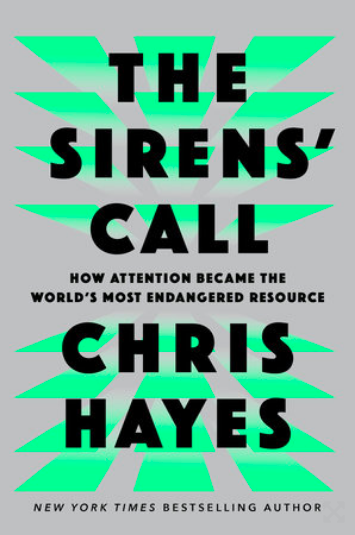
Book Review: The Sirens’ Call

In The Sirens’ Call: How Attention Became the World’s Most Endangered Resource, author Chris Hayes addresses things people in my network are experiencing and to some extent freaking out about: Why can’t I stop doom scrolling TikTok and Instagram Reels? Why can’t I read a long book any more? Or more than one book in a year? How could we have elected the attention hound who is the 47th president? Hayes says attention has become a fungible commodity in our society and people and corporations are intentionally stealing it from us, in part to monetize what we pay attention to. If readers are interested in challenges in modern society, I recommend this book.

“Attention is the substance of life,” Hayes wrote. “Every moment we are awake we are paying attention to something, whether through our affirmative choice or because something or someone has compelled it. Ultimately these instants of attention accrue into a life.” Hayes asserts things have changed, “Our dominion over our own minds has been punctured.”

Back in the day I held an overnight work meeting in Fairless Hills, Pennsylvania. For entertainment, the group voted to go to nearby Atlantic City for dinner and sightseeing. We ended up walking through the Trump Casinos before they went bankrupt. I recall signs saying something to the effect, “Don’t Disturb the Players,” referring to scattered people in a sea of slot machines dropping coin after coin into the slots. Hayes discusses this phenomenon in The Sirens’ Call.

Slot machines hold our attention by grabbing it for just a little bit while we wait for the spinning to stop, and then repeating that same brief but intense process over and over. The model is simple: Each play lasts only a few seconds. Bright lights and novel stimuli compel our attention. A moment of suspense is followed by resolution. A mystery in miniature is revealed, perhaps satisfyingly, perhaps unsatifyingly, but right there to be repeated. (The Sirens’ Call by Chris Hayes).

Hayes points out it is not the gambling that keeps players at the slots. “It is the unique attentional trance the machine’s gameplay induces,” he wrote. The casino uses players’ attention to monetize their time in the trance. That most gamblers have the same motivation is an example of making attention a fungible commodity. In this scenario, the house always wins, even if Trump himself couldn’t make a go of it.

The connection Hayes makes between slot machines and mobile devices, upon which to scroll various platforms, now seems obvious. Mobile devices garner and commoditize our attention to show us advertising, thereby monetizing our time and attention the way slot machines do. We often can feel like we are not in control of our minds.

The range of the book is broad. Hayes uses the narrative of Odysseus and the Sirens from the Odyssey throughout to tell his story. Among the topics covered are Early 19th Century newspapers, The Lincoln Douglas Debates, P.T. Barnum, alienation related to attention harvesting, and the evolution of what he calls the Attention Age. He closes the book with a chapter titled, “Reclaiming Our Minds,” asserting, “The internet is getting worse and worse.” He also offers things we can do to offset this.

Chris Hayes is not your typical writer. Because he spent ten years on cable television he has been in the thick of gaining attention in the form of ratings for his show on MSNBC. In cable T.V. gaining attention is everything. As a young father, his stories resemble ours in important ways. He has an interesting story to tell. I found the book to be a page turner. I recommend picking up a copy at a local library and reading it. Here’s a link.
Categories
Living in Society

Giving Attention to Stuff

Photo by Ola Dapo on Pexels.com

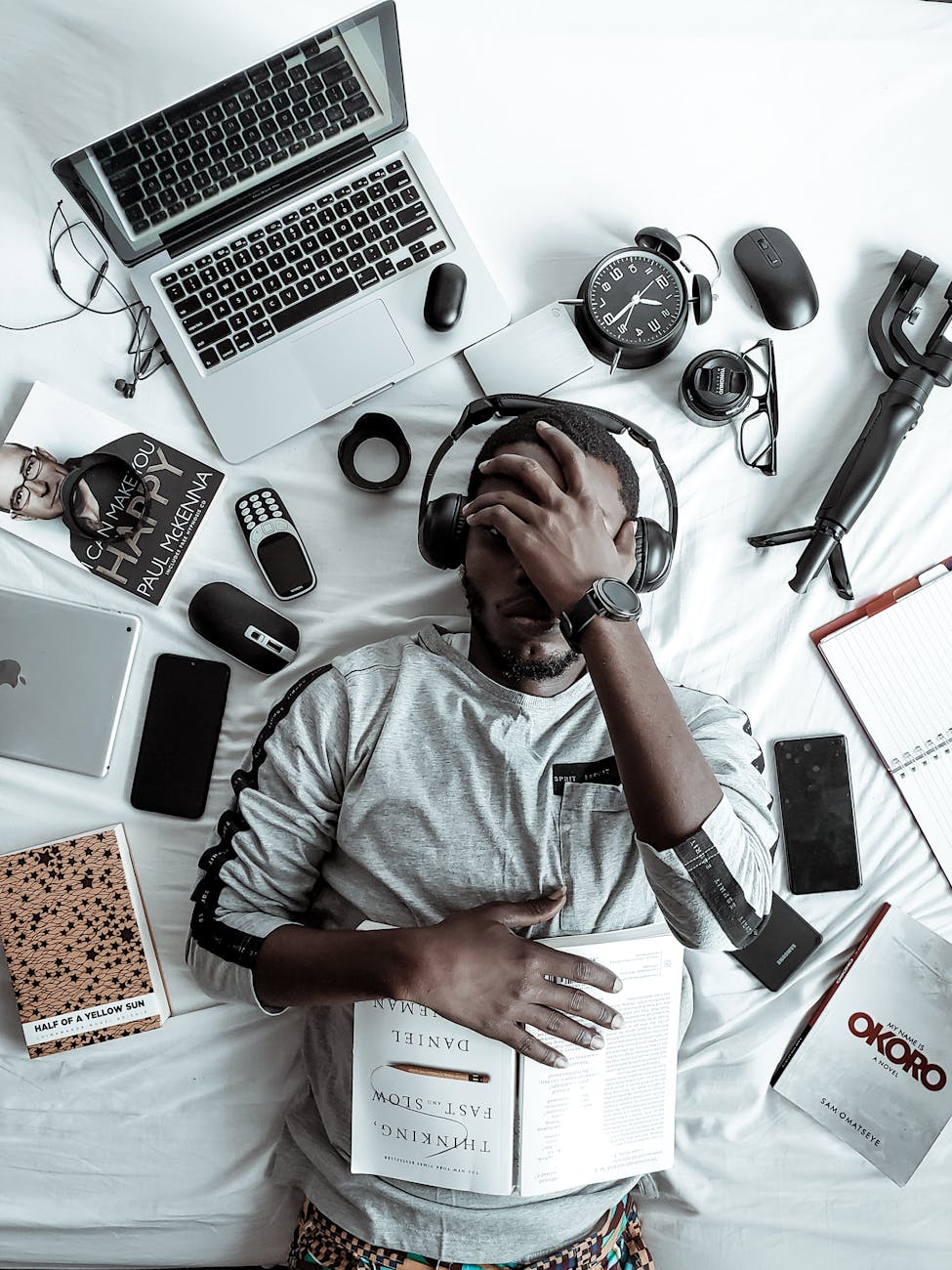
Our home is a relatively quiet sanctuary for creative work and networking with family and friends. It is easy to enter a room and “do something,” whether it be cooking, cleaning, writing, reading, or working in the garage, garden or yard. We made it this way when we designed the house and its setting. We are constantly using computers.

I recently discovered a new widget on my mobile device called Digital Wellbeing and parental controls. It tracks screen time. The results were shocking: more than six hours per day. Since then, I’ve been using the tool to reduce screen time. Last week I averaged 4 hours 24 minutes per day, which is a still a lot. I am endeavoring to do better.

What did I do about it? First I sorted my social media accounts. During the last year I reduced my social media presence, deactivating Twitter, Facebook, Instagram, and LinkedIn. I left Threads on my desktop and had BlueSky on my mobile device. This morning I removed all social media from mobile. In doing so, I removed them from my bed room and living room.

Second, I turned my mobile device into the tool it was intended to be. Instead of garnering my attention on social media feeds the way a slot machine empties one’s pockets, I time my morning exercise, read ebooks, keep up with news and email, and monitor traffic on my blog. I don’t mind the screen time if I’m getting something other than distraction in return.

Since paring back social media my human interaction increased with more telephone time and emails. As the weather warms, I expect to have more interaction with neighbors outdoors. These are positive developments.

The main thing I learned through the widget is to think about how I spend my time and focus more of it on stuff that adds value. That doesn’t just happen by itself.

Categories
Living in Society

Social Media Into 2025

Photo by Buro Millennial on Pexels.com

It’s no secret I use a mobile device. I recently discovered a metric in settings called Digital Wellbeing which tallies the number of minutes of screen time on my device. I was shocked to see I averaged 5 hours, 50 minutes of screen time per day during the previous seven days. Just by being aware of my time I reduced it from 6 hours, 30 minutes on Friday to 4 hours, 29 minutes on Saturday. I need a more organized approach to reduce screen time.

Eschewing social media completely is not a good option. I rely upon the interactions with “friends” and “followers” and the relationships they have grown into. On Threads, these are mostly people I know only through the platform. On BlueSky, these are people I know in person or others I followed during my long time on X (2007- 2023). Threads is about art, photography, and sharing each others’ work. BlueSky is about staying tuned to whatever we call the national discussion inside a liberal bubble. Facebook is still there, although I am paring that group down to people with whom I have a tangible, in-person link. In most cases, I know Facebook friends from personal interaction. I have a couple of active friends on Instagram, but mostly I view posts by people I don’t know. I also view short videos there, something I hadn’t intended yet takes a lot of my screen time today. These four programs represent the as-is situation with social media.

Six hours of screen time in a day is not acceptable. While the entertainment value it provides is already baked into our monthly budget, the cost is in how my brain accommodates the input. Without completely understanding it, I know it has a deleterious effect. That is reason enough to cut back.

Killing time is not an interest of mine. So what am I seeking from screen time? I’ll just make a list:

On Threads, I curated a feed that informs me about what our small community is doing. Mostly, we share photos of cups of coffee, and daily, regular posts which are habit forming. One person showcases a different pair of socks each day. I see photographs, works of art, and short posts about how the day is starting across multiple time zones. When I wake, the Australian and New Zealand accounts are already on morning of the next day. While I’m doing this, I make my own daily post with the outdoors ambient temperature, time, a brief composition, and a photo of my coffee cup. I drink coffee while scrolling to see what followers are doing today. We all have morning routines, and this is mine. I return for updates a couple of times each morning and afternoon. By 6 p.m. I shut my mobile device off for the day.

After the November election there was a movement of people from X to BlueSky. A lot of the folks I followed on X made the transition. Some I followed on Threads decided BlueSky was a better platform. In any case, I’m there and posting a couple of times each day. It has been easy to regulate how much time I spend there because I am less interested in any “national discussion.” Threads is my go-to.

My sights are set on reducing time on Instagram. The number of accounts I follow there is small and only a handful post regularly. It has become a site with two main functions: automatically cross post photos I upload to Facebook, and following a few accounts that offer something unique. If I reduce screen time, the largest initial share of cuts will come from Instagram. I went into settings and set a timer to notify me when I spend 90 minutes in a day on Instagram. We’ll see how that goes.

Facebook used to be great, but now it has been reduced the way a balsamic reduction is made. Besides publicizing my work, I belong to two groups: my high school class group I founded to facilitate organizing a couple of reunions, and a group I started for our home owners association. These two useful functions are likely the reason I still have a Facebook account.

The gist of this is to cut way back on Instagram time, and not dally when I’m doing something purposefully. In theory, everything I do on social media should be purposeful. I’ll give that a week or so and see if my screen time is reduced. What I would much rather be doing is spending time face-to-face with my friends. Here’s an example:

I had a chance to spend an hour with a dear friend in a deserted cafe this week. We were bathed in sunlight, although I preferred a seat that was shaded. We talked about our books, our health, and our plans. It was an oasis of calm and warmth in the increasingly turbulent world in which we live. I need more time spent like that. Likely we all could use it.