
It’s election day in the U.S. Be sure to cast your ballot!
It’s election day in the U.S. Be sure to cast your ballot!

The second No Kings Rally in Mount Vernon, Iowa, on Oct. 18, 2025, was much better attended than the previous one. I did not count yet there were at least 500 people participating. The rally started off with a gathering outdoors at the First Street Community Center, then walked a block or so to line the streets at Highway One and First Street. Here’s what the rally looked like.


About all I heard from the speaker was, “something, something, Heather Cox Richardson.”
I found some farmer friends with whom I talked about apple trees. Former Iowa House member David Osterberg was there. He represented us when we first moved to Big Grove Township. Former Congressman Dave Loebsack arrived early to get a good perch. We reminisced about his first election to the Congress in 2006. Here are Dave and Terry Loebsack with their flags.

There were hundreds of people, and many signs.


The crowd stretched for blocks.


And these…


The clear autumn day was a backdrop for everyone to feel good about standing up for our rights. A lot of work remains to take back our government for everyone. Days like this make us hopeful. The feeling is infectious.

Beef and meat prices have little immediate impact on our family of vegetarians. About the only time I noticed the price of meat was while buying some for a low-income household. My money would have gone farther if prices were not so high.
“Beef prices have climbed to record highs after cattle ranchers slashed their herds due to a years long drought in the western United States that dried up lands used for grazing and raised feeding costs,” reported Reuters. “By the beginning of the year, the herd had dwindled to 86.7 million cattle, the smallest number for the time period since 1951, according to U.S. government data.”
Sounds like the impact of the climate crisis. Just saying.
The president said he is looking at doing something. “(The price of beef is) higher than we want it, and that’s going to be coming down pretty soon too. We did something,” Trump said in typical obfuscatory language. “We are working on beef, and I think we have a deal on beef.”
When the president says he “did something,” he is fighting a fire he started. That’s one heckuva way to run a government. This is also true with the collapse of the soybean market for American farmers, and so much more.
Here’s the core of it. Many people feel meat is an important part of an American diet. Cattle supply is one thing yet the Trump tariffs are another driving up prices. “The Trump administration’s tariffs are hitting major beef suppliers such as Brazil — and are set to push prices for American consumers even higher,” reported the Washington Post.
It’s no secret livestock farming is a primary cause of the climate crisis. Farmers and scientists are seeking solutions like anaerobic manure digesters in confinement livestock operations. They capture methane released as manure is processed into liquid fertilizer and bedding material for cows. The better solution is to find other sources of nutrition than meat.
I endeavor to set aside the drama of politicians in Washington, D.C. We, as a society should reduce our consumption of meat. There are plenty of other great tasting, nutritious things to eat. Likewise we can and should address the climate crisis… before it’s too late. The meat of it is eat less meat.

In July, word came from the president he was considering a cage match wrestling event to be held on the White House lawn. As the Skydance – Paramount merger closed on Aug. 7, and UFC signed an exclusive deal with Paramount+ four days later, the UFC match to celebrate the nation’s 250th anniversary appears to be inevitable and will be aired on Paramount stations, including CBS, the former home of Edward R. Murrow and Walter Cronkite.
Trump’s affection for professional wrestling is well known, as is his induction into the WWE hall of fame in 2013. Regardless of concerns about propriety, a cage match is an expression of the president’s character. The event is expected to host some 20,000 of his closest fans on the lawn and be available to countless others via the internet. From where do cage matches come?
The American Wrestling Association (AWA) was a professional wrestling promotion based in Minneapolis from 1960 until 1991, according to Wikipedia. It was founded by Verne Gagne and Wally Karbo, originating as part of the Minneapolis Boxing & Wrestling Club. Unlike modern professional wrestlers of the WWE, Gagne was an amateur wrestling champion who was an alternate on the U.S. freestyle wrestling team at the 1948 Summer Olympics. He ran the AWA with a conservative sensibility, Wikipedia said, firmly believing that sound technical wrestling should be the basis of a pro-wrestling company. Cage matches reflect no basis in technical wrestling as Gagne had come to know it. I submit they are about the fans.
Father and we kids attended a professional wrestling match at Municipal Stadium in Davenport. The stands were not packed although because of the popular Saturday morning television program, All Star Wrestling, the event drew a good-sized crowd. Patrons were unruly, with arguments breaking out among them. I almost got into a fight after mouthing off to a stranger. That day there was a cage match during which constructing a cage of chain-link fencing was part of the spectacle. Was that real blood when one wrestler crushed another against the cage wall? It was hard to say from the bleachers. Young women would visit the motel across the river where the wrestlers stayed and attempt to accompany them on tour. Such plebeian entertainments were typical in my home town. This is a crowd that later would evolve into MAGA cult members.
Once one admits a cage wrestling match is not sports, then what kind of spectacle is it? I have to believe we could all be pursuing more constructive use of our time. It’s a free country, though, and a wrestling star is president. Celebrating professional wrestling is just one more way our culture is getting away from us as the country marks its 250th birthday.

It feels necessary for Kamala Harris to have written 107 Days. I’m glad she did. It was a quick read that touched the high points of her short presidential campaign. Hearing the story, in her voice, is important. It’s essential reading for anyone who follows presidential politics.
I make it a point to read or be familiar with every presidential memoir going back to Harry Truman, who was president when I was born. While Harris lost the 2024 election, she is part of the story of Joe Biden’s presidency and his eventual dropping out of the race for re-election. 107 days is not long enough for a modern presidential campaign and while Harris’ campaign staff worked diligently and smart in her recounting, they couldn’t get her across the finish line.
Harris chose not to make this a detailed account of her campaign. I respect that choice. It is a high level view full of her reactions to main events as they unfolded. There is value in that.
Even before it was published there were reviews out there. I don’t want to repeat, deny, or defend that work. My statement is if one is interested in U.S. presidential politics in the 21st Century, you should have 107 Days on your to be read list.

One of the items on my list to cover in politics is our local elections. This November, three Solon City Council positions and three Solon Community School District Board positions will be on the ballot. This article by Chris Umscheid in the Solon Economist summarizes the ballot:

Greg Morris seems likely to win one council seat. Through his work with the volunteer fire department he is well known in the community and a constant, positive presence. Incumbents for council have an advantage, but it could be a jump ball for their seats. Will see if any issues arise that make this a race.
I note the Cedar Rapids Gazette posted an article today saying 34 candidates in six cities and three school districts failed to meet the filing deadline with the Iowa Secretary of State. Let me guess: They are all counties with a Republican county auditor.

There is little to say about the death by gun violence of Charlie Kirk. Too many U.S. citizens die of gun violence and the Congress can, and should do something to prevent more death and destruction. On the other hand, Republicans, including gubernatorial candidate Brad Sherman, find things to say,
In a Sept. 16, “Letter to the People of Iowa,” published at The Iowa Standard, Sherman wrote in response to the shooting, “…many are waking up to the uncomfortable reality that the United States of America has been and is engaged in a long ideological war that is threatening to break out into all-out chaos.”
I’m calling malarkey.
There will only be chaos for as long as conservatives like Sherman persist in framing our lives in society that way.
When I go to the grocer, the convenience store, the hair stylist, or the hardware store there is no war going on. People are trying to live their complicated lives. For war to exist, there have to be at least two sides, and I just don’t see it in the people among whom I live. We don’t need Republican agitators like Sherman. We are better without them.
Kirk is dead. We should pay appropriate respects. Put down your inflammatory words Mr. Sherman. Any ideological war, if there ever was one, is over.
Let’s get on with making Iowa a better place to live.
~ First published as a letter to the editor on Sept. 18, 2025 at Little Village Magazine
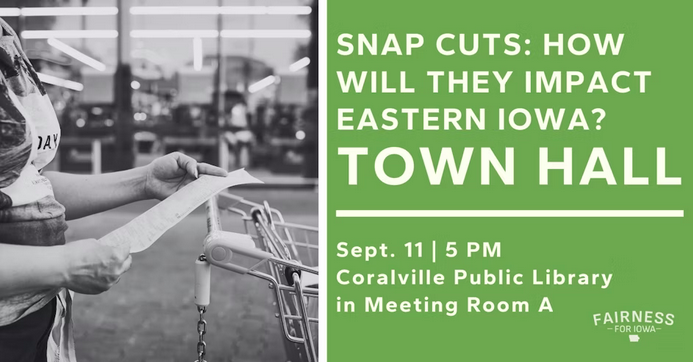
SNAP cuts: how will they impact eastern Iowa? How can our community respond?
Please join Fairness for Iowa for a Town Hall event that discusses how the $1 billion of cuts to SNAP in Iowa will impact our communities in eastern Iowa. These cuts are a direct result of the recent Trump tax bill that was voted for by all our federal representatives including Congresswoman Mariannette Miller-Meeks and Senator Joni Ernst, who prioritized tax cuts for billionaires over feeding hungry kids and community members.
At the event, attendees can hear from panelists across the local food system including Hai Huynh, Associate Director, Coralville Community Food Pantry, Sandra Komuhiimbo, Coralville Community Leader, and Nicki Ross, Executive Director, Table to Table. Learn more about local food insecurity issues and how our local food bank and pantry system is responding to the increased needs of our community as a result of the SNAP cuts.
Attendees will also have the opportunity to take further actions to push back on SNAP cuts at the federal and state level, and call out Congresswoman Miller-Meeks and Senator Joni Ernst for their votes and actions to not stand up for their constituents, and instead increase food insecurity in our communities.
Attendees are encouraged to bring a goods donation for the Coralville Food Pantry to the event. The greatest need is for:
Where: Meeting Room A, Coralville Public Library
When: Thursday Sept. 11, 5 until 6:30 p.m.
This is a chance to hear directly from community leaders and food security advocates about how this legislation could impact access to food for thousands of Iowans. Bring your questions, bring your voice, and bring a donation to help area food pantries.
Let them know you are coming at this link: https://www.mobilize.us/progressiowa/event/832997/


How does a person win an election? By getting 50 percent of the votes cast plus one. Some say there is more to it than that, but in the end, a candidate has to track his/her votes before the election, make sure there are enough of them, and then turn out those votes before or on election day. In politics there is nothing more elemental than this.
Last Thursday, while debating one of two resolutions (see below), a friend stood and addressed the county Democratic Central Committee, saying instead of this debate, we should spend more of our time working to win elections. The debate we engaged in did not win elections and took time away from that, he asserted.
It is ironic that when State Senator Janice Weiner arrived, she was praised by the committee for her leadership in winning two special elections to the state senate this year. One of those elections gained national attention. A number of people in our county helped win those elections yet Senator Weiner’s leadership contributed undeniably. While we may debate issues, she was busy winning elections.
The main reason I stayed until the end of the meeting was to hear the debate and vote on the two resolutions.
During the first presidential election after my wedding, I attended the Iowa Caucus where I was elected to the county convention as a George McGovern delegate on the platform committee. At caucus we had a discussion of political issues and made some decisions about what should and should not be on the county platform. At the county convention some of the decisions we made were overturned. I noted some delegates came to the county convention with the explicit intent to reintroduce platform planks that were voted down at the precinct. My initial experience with the county Democratic Party was soured by this experience.
In my political work in this county, I never again joined the platform committee. Most years, I don’t even read the platform. I’m not sure it is even necessary. At the same time, I see the two issues in the proposed resolutions are important and relevant to what we do as Democrats. The DEI resolution is a result of the impact of the president’s policy on the University of Iowa, which is a major regional employer. U.S. support for the Israeli government during the Hamas-Israel War was clearly divisive among Democratic voters and likely contributed to Democratic voter suppression in the 2024 general election. Talking about these two issues as a central committee won’t change the world, yet it moves the group toward alignment in our politics. Having clear positions on DEI and the Palestinian genocide is important to winning elections. After taking time to amend the language, these two resolutions were approved by the body.
Iowa Democrats stand at a distance from winning statewide elections. First, we have to know who we are. This debate helped. As one speaker said during the debate, if we are not going to stand for our values now, then when? Here is the result of our debate:
Johnson County Democrats Statement in Support of Diversity, Equity, and Inclusion (DEI):
The Johnson County Democrats support diversity, equity, and inclusion (DEI) in all walks of life and as policy at the public universities of our amazing state to help foster an open and welcoming environment for all people.
We condemn in the strongest sense President Trump’s bigoted attacks on DEI policies, diversity in our state and country, and Governor Kim Reynolds’ blatant waste of Iowa taxpayers’ resources and money by having state Attorney General Bird investigate a victimless incident at a time when Iowans are struggling with rising cancer rates, undrinkable water, and untenable increases in the cost of living.
The “Freedom to Flourish” in our great state is a freedom ALL people should enjoy regardless of race, ethnicity, gender, creed, or sexual orientation. We stand for an Iowa for ALL people and ALL Iowans.
“Our liberties we prize and our rights we will maintain.”
Resolution for an Embargo on Military Aid and Weapons Transfers to Israel
RESOLVED, That the Johnson Country Democrats support an immediate embargo on all military aid, weapons shipments and military logistical support to the Israeli government; and
BE IT FURTHER RESOLVED, That the embargo on military aid, weapons shipments and logistical support continue until Amnesty International, Human Rights Watch, and B’tselem certify that the Israeli government is no longer engaged in apartheid rule.

There is a lot of chatter in the national news media about the price of electricity. We are apparently in a war with China over dominance in artificial intelligence, which requires a lot of electricity. National Public Radio reported, “Electricity prices are climbing more than twice as fast as inflation.” We don’t hear that so much here in Iowa except on national media. Why? According to Bill McKibben, “The average Iowan will spend 39% less on electricity than the average American because it produces 57 percent of its electricity from the wind, the second-biggest wind state in the country.” If you throw solar arrays, and other renewable energy into the mix, Iowa’s total share of renewables is 64 percent.
Spoiled as I am by normally low electricity rates, when last month’s electric bill arrived it was 51 percent higher than the same period last year. What the heck? Although the total amount of the bill was comparatively low — typical for Iowa — I had to look at it.
The price per kWh of electricity from our electric cooperative has been stable and predictable. It wasn’t a rate change that caused our increase. Our monthly usage increased from 429 kWh to 745 kWh. The average American household usage is much higher than that. The reason for higher costs was this increased usage.
What happened? The average temperature increased by four degrees year over year. We likely ran the air conditioner more because of it. It was also oppressively hot this July, which meant spending more time indoors and using more electricity with the washer, dryer, stove and our electronic devices. We also had a millennial house guest for an extended stay. They did online streaming from here with a multitude of electric devices which sucked more juice. In sum, the increase was explainable.
Why are people concerned about increasing electricity costs? Donald J. Trump is president. He does not seem well educated about electricity.
On Trump’s first day in office he declared an “energy emergency” for made up reasons. The unstated reason is he extorted oil, gas and coal companies. “Candidate Trump literally told the fossil fuel industry they could have anything they want if they gave massive contributions to his campaign, and then they did,” according to McKibben. Trump’s payback for the bribe was to hobble the renewable energy industry.
The Trump administration immediately began to do absolutely everything in its power to stop this trend (to develop more sun, wind, and batteries) and replace it with old-fashioned energy—gas, and coal. They have rescinded environmental regulations trying to control fossil fuel pollution, ended sun and wind projects on federal land, cancelled wind projects wherever they could, ended the IRA tax credits for clean energy construction and instead added subsidies for the coal industry. Again—short of tasking Elon Musk to erect a large space-based shield to blot out the sun, they’ve done literally everything possible to derail the transition to cheap clean energy. (Trump is shockingly dumb about (electric) energy, Bill McKibben on Substack).
More than ninety percent of new electric generation around the world last year came from clean energy. This was not because everyone in the energy business had “gone woke,” McKibben wrote. Texas, arguably the most un-woke place in the U.S., installed more renewable capacity than any other state last year. It was because you could do it cheaply and quickly—we live on a planet where the cheapest way to make power is to point a sheet of glass at the sun.
I don’t know what happened to Republicans. Senator Chuck Grassley used to be one of the big supporters of wind energy in Iowa because of the way wind turbine arrays meshed with farm operations, giving a farmer another revenue stream.
Under Trump we have taken a step backward and let China, Europe, and literally everyone else take the lead in developing the electricity of the future which taps power directly from the sun.
We can and must do better than this as we consider our energy future.
~Written for Blog for Iowa

 Journey Home
You must be logged in to post a comment.