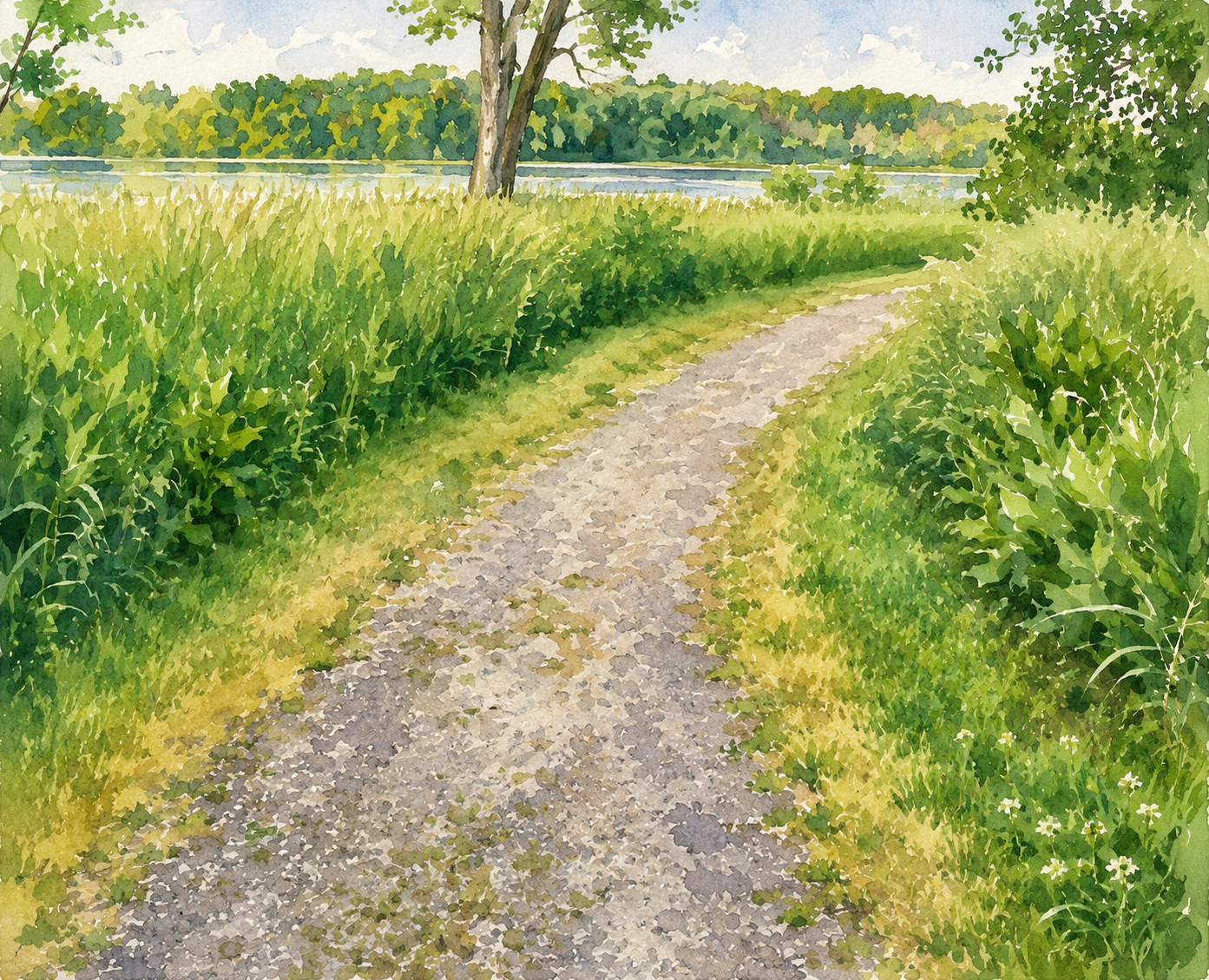
This studio...
is a place for creative endeavor
is only a studio...
a place for solace
by my declaration...
from this quiet place
that it is so.
~ Sept. 9, 1990
Tag: Poetry
The Work I Do

The work I do
is not for me
so much as it is for
the friends I have come to know.
The collages
The poems
The journal entries
The performances
Not for me.
The nuns taught us.
All for the honor and glory of God.
It is a lesson
that stuck.
~ Labor Day, 1989, Lake County, Indiana
Summer Arrives
A Chimney Sweep Swept

Black Coat, long cut, with a red flower in the lapel. Top hat rounded, and in good shape.
He hung it on the vacuum tank while he worked.
Come in.
Where is the fire place?
Move things around so there is room.
Lay out the cloth.
Bring in the drum-like vacuum pump,
Rods and brushes.
Move things out of the fireplace
Sweep, lights.
Point out problems with fireplace.
Clean up gear.
Take out gear
Sweep hearth with a hand broom.
Everything is done methodically.
Ford pickup with cover on back, ladders on top,
though he did not use them.
~ From 1984-1985
Beauteous Pigmentation

I bud with the maple tree
this Spring.
As insignificant as we seem,
come summer,
we shall grow,
and make manifest our promise.
Come first frost…
our colors will change,
our pigmentation turns beauteous,
as experience will become this adult body
into which I’ve settled.
As our days are spent,
whether as bud or as autumn leaf,
we bring ideas to fruition.
And despite the promise of this Spring,
I regret all I have now
is this bud
on a maple tree needing pruning…
In a yard someone else has landscaped.
~ From 1984-1985
Tell It Slant Poetry Festival

Fan of Emily Dickinson? You should know about this upcoming annual Tell It Slant Poetry Festival at the Emily Dickinson Museum in Amherst, Massachusetts. Online participation is enabled! Here is the direct link to learn more about the festival and sign up.
Read Frank Hudson’s post about it below.
Also, consider following Frank Hudson and The Parlando Project here.
8 Shelves of Poetry

With enough perspective, the social importance of objects is diminished.
I’ve been inside the Statue of Liberty in New York harbor, and saw it up close. It’s name, “Liberty Enlightening the World,” by sculptor Frédéric Auguste Bartholdi, simply states what it represents. Since installation it has come to mean more.
At the reopening after restoration of the statue, on July 3, 1986, President Ronald Reagan said, “…we celebrate this mother of exiles who lifts her light beside the golden door.” The golden door is a political addition, and not needed. It is a corruption. It permeates everything. It was only when I viewed the Statue of Liberty from Windows on the World atop the World Trade Center did I realize how imbued with cultural attachments it is. From my seat overlooking New York harbor, the statue seemed minuscule, less significant than the movement of boats under a clear night sky.
My belief about culture-imbued words used in poetry came from epiphanies like this. The best poets stay away from that kind of cultural insertion, instead using language to create meaning. My reading of poetry is a search for such verse, without culture bombs dropped into the text. It is hard to find.
The first books I bought after earning money delivering newspapers were collections of the poetry of Robert Frost and Carl Sandburg. I later added the poetry collection of W.B. Yeats. The books lay on a shelf at the M.L. Parker department store and spoke to me. I purchased them. Poetry did not become a key organizing principle for my home library, yet volumes were often available at a discount or given to me. The number of poetry books grew. Today, I have eight 23-inch shelves of poetry in my library.
In the late 1970s and ’80s I wrote poetry as a form of creative expression. Some of it was good, most wasn’t. A few have been posted here. It was a way to be a writer. There is a project of going through those pages, editing them and re-writing the poetry from today’s perspective. When I previously did that, results improved. There may be a book of poetry in me, yet I am a prose writer. I don’t often write it, yet do read poetry often.
Like everyone, I have favorites. I will go on reading Charles Bukowski until I’ve read every available verse. I only recently discovered Mary Oliver. Can you believe it? She’s among the best. Eventually I will get to Sven Armens’ two books purchased at a used bookstore in the county seat. Armens was my undergraduate Shakespeare teacher, a figure more suitable to being a character in Othello than poet or Shakespearean scholar. A reader needs to expand beyond favorites. That is the purpose of my eight shelves of poetry: be there when I need to consider language.
If I were a poet I would emulate characteristics of Vachel Lindsay, particularly his Rhymes to be Traded for Bread. Poetry as literal currency. I remember visiting the Vachel Lindsay house in Springfield, Illinois, and thinking how dull it must have been for Lindsay to be planted in a single location for any length of time. I see Lindsay walking into Kansas and other Midwestern places more than being planted in Springfield. I should return to reading Lindsay.
Having a wide selection of unread verse creates a go-to place when I’m stuck for what to read next. These going to poetry moments are unlikely to deliver me to re-reading Edmund Spenser’s The Faerie Queen, yet maybe I should. The use of inventories in his writing has been influential in mine. Better to list the cultural attributes one seeks to invoke rather than assume readers will understand all the references in a single, culturally well-known object as an author hopes.
A writer has to use nouns, dammit! Better that verse explores the meaning of nouns. I would rather poetry be all verbs, suggesting action and an ever-evolving thought process. One can’t escape the nouns, though. I’m not hopeful I’ll find such verse in my eight shelves of poetry. I plan to continue the search, a couple of volumes each month.
Set my skepticism regarding doctors
aside for now,
while considering
the pediatrician and poet.
Set it on that basket,
where it's shine might
illuminate this moment.
Would we have him as our physician?
Would we travel into the city with him?
Would we seek his company?
Would he have sought ours?
To have his eyes, his struggles...
his medical practice,
his practice of poetry...
It was all one.
I took the basket to the garden,
to dig potatoes,
and struggle to get out
from where I rooted with singular purpose.
~ Written in the Calumet, circa 1990.
On Retreat
I said a prayer,
then meditated.
Tea brewed with
Orange Pekoe teabags
is hot, dark, and ready.
While out for a walk,
I bought chewing gum
from a vending machine
near the main railway station.
I chewed gum all the way home.
Through the window,
children are playing.
I realize something
is bothering me.
I do not share the joy
of playing children.
Instead, I'm on retreat,
as ice cubes crack
with the heat of the tea,
before I sit at the typewriter.
~ Mainz, Germany, May 30, 1977
Something Is Missing
What is life? But then who am I to ask? I am a grown person, not married. I mastered the art of survival. I lead a good life, or so they tell me. Yet am I really living? I am not sure. The plans I make are hollow, lacking companionship. At least I am planning... My mind is active, yet something is missing. Something is missing... ~ Mainz, Germany, Jan. 14, 1979

You must be logged in to post a comment.