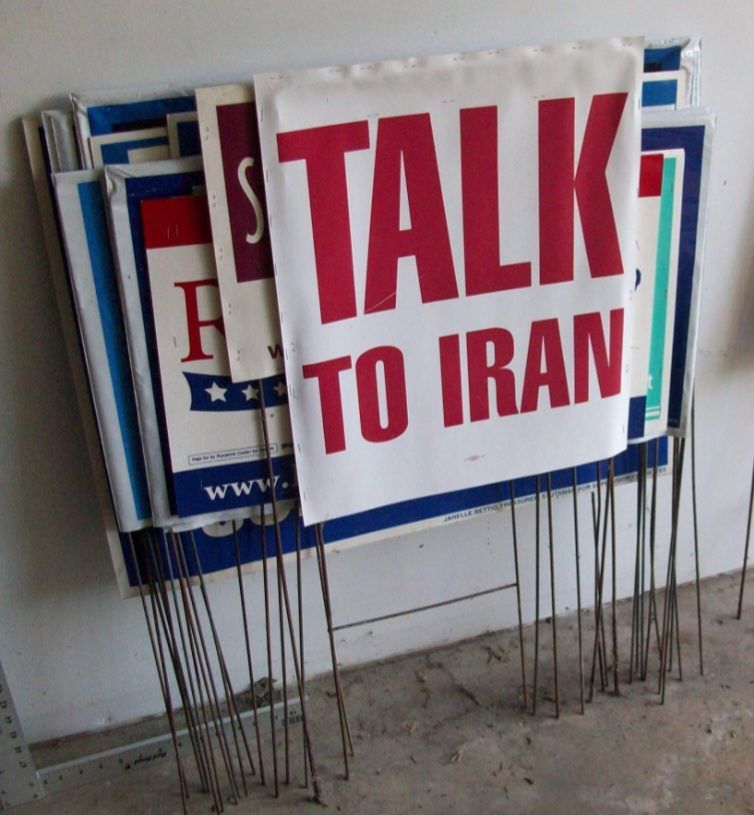
On Monday I sent emails to U.S. Senators Chuck Grassley and Joni Ernst as well as to U.S. Representative Mariannette Miller-Meeks on the subject of the U.S. aggression against Iran.
My message was simple: “I urge you to support the Kaine-Paul Senate resolution, S.J. Res. 104, the bipartisan war powers resolution that would prohibit strikes against Iran. Thank you for reading my message.” The email to Miller-Meeks referenced the House companion, the Massie-Khanna House resolution, H. Con. Res. 38.
The referenced resolutions are also simple: “Directing the President pursuant to section 5(c) of the War Powers Resolution to remove United States Armed Forces from unauthorized hostilities in the Islamic Republic of Iran.”
The vote was scheduled for Wednesday in the Senate and the votes for a simple majority were not there. The House also voted no. Now what?
Senator Grassley responded on March 6, 2026. Read his response here.
I reject the Iowa Republican position exemplified by gubernatorial candidate Brad Sherman, who wrote in part, “I support President Trump’s action against Iran. These actions are not an initiation of war, they are a response to a war already declared by Iran. This is the inevitable response to an evil regime that has openly and continually stated its goal is to destroy America and has actively sought the means to do so.” Was Iran attacking the United States? No. Is Iran an imminent threat to the United States? No. This position abandons the caution about foreign wars that once defined Iowa Republicans.
The president failed to address with the American people the reasons for attacking a sovereign country. On Monday, he said 49 top Iranian leaders had been killed, according to CBS News. The joint operation with Israel did kill key Iranian leaders. Anyone familiar with Iran’s political system knows new leadership can be approved quickly. No one I know gave the aging Ayatollahs high marks. They were easy targets for Israeli ordnance. The younger Iranian replacements will be formidable and could be worse. There has been insufficient public discussion of this.
Is the motivation to address the risk of a nuclear armed Iran with delivery systems? Give me a break. While Republican opponents of the Joint Comprehensive Plan of Action, commonly called the Iran Deal, felt it was insufficient, the agreement placed verifiable limits on Iran’s nuclear program. When the president tore up that deal, he lost standing to claim this action was about nuclear weapons.
Is the president part of God’s plan, being anointed by Jesus to light the signal fire in Iran to cause Armageddon and mark his return to Earth? The Military Religious Freedom Foundation reports receiving complaints from non-commissioned officers who say their commanders told them the Iran war is part of God’s plan and that Donald J. Trump was ‘anointed by Jesus’ to trigger Armageddon.” Read more about this here. They logged similar complaints across more than 40 different units located in at least 30 military installations. One NCO said their commander’s remarks “destroy morale and unit cohesion and are in violation of the oaths we swore to support the Constitution.” The Pentagon has not responded publicly to these allegations. Secretary of Defense Pete Hegseth should consider John Prine’s message, “Now Jesus don’t like killin’, no matter what the reason’s for. And your flag decal won’t get you into heaven any more.”
Is the Iran aggression solely to take attention away from the Epstein files? More than a few people are saying so, yet I don’t know that this war will accomplish that for the president. Maybe people in the administration can’t walk and chew gum at the same time but the American people can.
When the president admonished the people of Iran, “When we are finished, take over your government. It will be yours to take. This will be, probably, your only chance for generations,” he washed his hands of the consequences of this conflict. That is typical for Donald J. Trump.


 Journey Home
You must be logged in to post a comment.