I added a walkabout to my daily routine. Once the sun rises, and after I finish daily writing, I leave by the garage door and walk the property line of our 0.62 acre. Each day I saw something unanticipated.
The condition of trees, activities of squirrels and birds, and windblown trash deposited on our lawn. The walkabout provides an opportunity to take stock of our land and consider what needs doing, what should be left alone. I’m discovering a lot of neglected work.
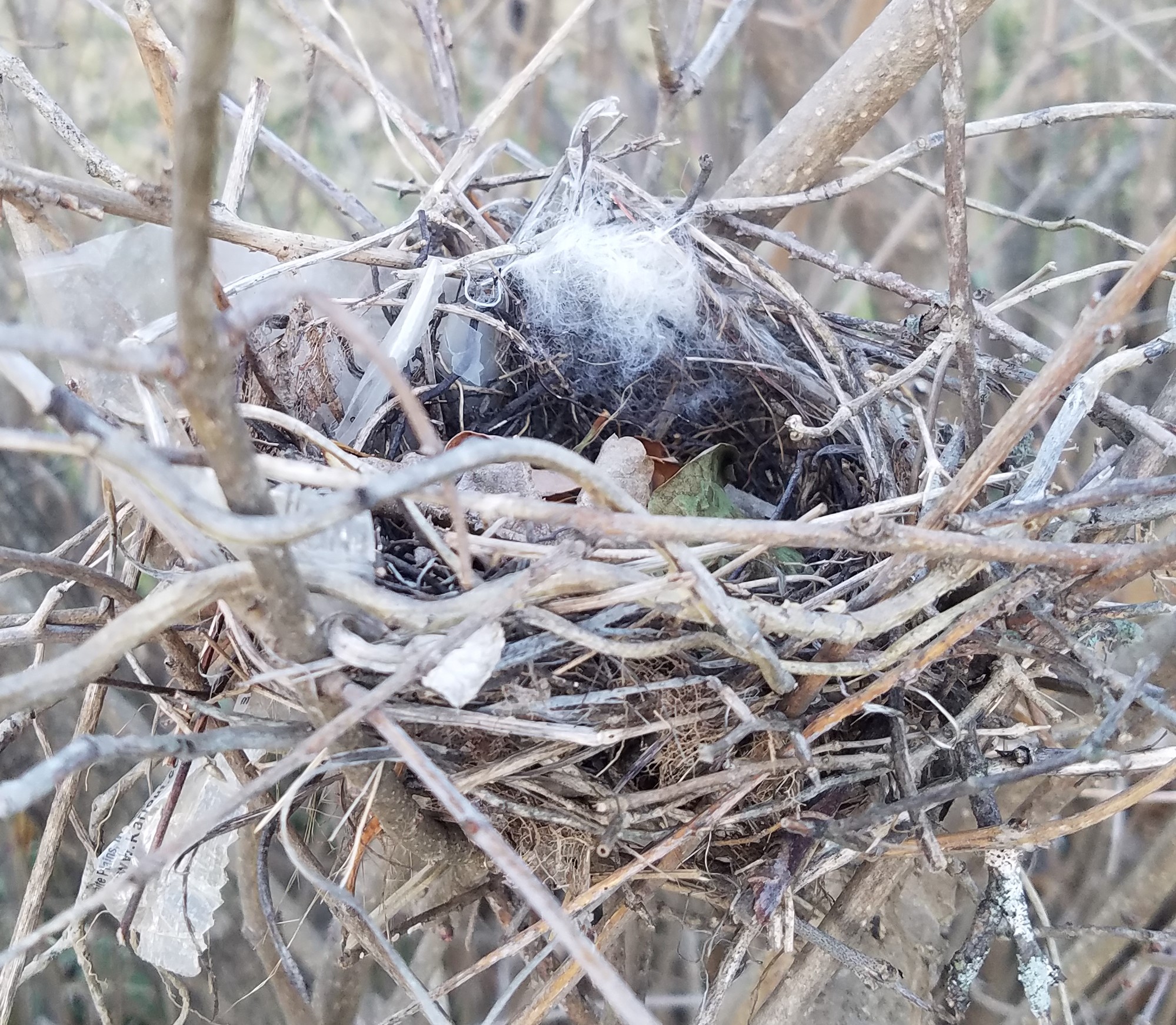
There are at least three bird nests I’ve found. I’m amazed at how they take found objects and craft them. Anything pliable seems a likely building material, including plastic wrap and bits of fiber. I don’t remove the nests unless they fall from the tree or bush. For the most part they are woven into live branches with a sense of permanency.
I’d forgotten how large our yard is and how many distinct landscapes are in it. As we head into winter the walkabouts will be a time for observing, thinking, and planning our landscape. I don’t know how I went so long without this as part of each day.
When we took the land after the 1832 Black Hawk Purchase, it was decimated to make neatly cut rectangles of farmland. People are used to that now. Today Iowa farmland is used mostly as a production landscape for hogs, cattle, corn and beans. For too long, Iowa’s air, water and land have been used like an open sewer to support these operations. Farmers are used to what they know and don’t want to change. That’s true for people besides farmers.
Iowa is not an empty place where someone can do what they want with the land. A utility should not be able to build pipelines and transmission lines, or construct large-scale wind farms and solar arrays with impunity. The current crop of Iowa farmers is possessive of the right to their land and to use it as they see fit. They believe they know better than government what works here and what doesn’t. They don’t want infringement on their rights. The myth of farmers as the original environmentalists persists despite evidence to the contrary.
When solutions to the climate crisis require cooperation between large corporations and Iowa farmers there is resistance.
The new carbon capture and sequestration proposals of Summit Carbon Solutions and Navigator CO2 Ventures will confront these well-established beliefs. Even though a prominent farmer, Bruce Rastetter, is behind Summit, the rollout will follow a path familiar to anyone who knows the history of electricity transmission lines and oil pipelines here. Farmers will push back.
Donnelle Eller of Gannett stated the obvious about Summit in Monday’s Iowa City Press Citizen, “The company, a spinoff of Bruce Rastetter’s Alden-based Summit Agricultural Group, says the project would help ethanol and other energy-intensive ag industries remain viable as the nation seeks to cut greenhouse gas emissions in half by 2030 to address climate change.” The Iowa governor spoke about a low carbon economy, but failed to mention climate change or how CCS fits in such a framework. This underscores a key problem with CCS. They are just out there and bottom line, it’s backers don’t give a hoot about climate change. It’s another opportunity for capital investment which could yield big profits.
The sides are already lining up for this fight.
Opponents of CO2 pipelines have also been opponents of the Rock Island Clean Line and the Dakota Access Pipeline. Rural Iowans do not speak of one mind on this yet a common theme is big money, not farmers, are behind these transmission schemes. They claim the voices of farmers are not being heard. They also claim climate change is a lie.
What is the purpose of CCS if not to address climate change? That’s the wrong question. These projects are about investing capital to get a return on investment. If the government is a source of start-up capital, more’s the better for investors. The words “climate change” aren’t needed in this transaction.
“The world must reach net-zero CO2 emissions by 2050 in order to achieve the 1.5 degree Celsius global average temperature increase limit,” according to Summit’s website. “A dramatic increase in carbon capture and storage (CCS) is crucial to achieving net-zero CO2 emissions.”
The second sentence is unlikely to be accurate. The problem is Summit and Navigator seek to change nothing about industrial use of fossil fuels. They seek a profit from ethanol plants and other CO2 emitters who keep on doing what they are doing now. CCS has become a gigantic boondoggle instead of a solution to climate change.
“Climate and other environmental and public safety concerns about CO2 pipelines are important,” Ed Fallon wrote in a Nov. 11 email. “But as with Dakota Access Pipeline, in terms of mobilizing the broadest possible coalition of opponents, the strongest argument is the abuse of eminent domain.”
In a filing with the Iowa Utilities Board, Janna Swanson, whose land the Summit pipeline would cross, had this to say about the project and climate change:
There are a whole bunch of plans to mine our tax money for revenue and the excuse is Climate Change. When using that as an excuse then any action against humans is justified.
Summit Carbon Solutions will want the right of eminent domain. They will say that because of Climate Change that their business model is for public use.
When one paints with that wide of a brush then no one’s property is off limits for anything. No one has rights.
Let’s be clear. Summit and Navigator are in the CCS business to make money, as much of it as they can. Comments like Swanson’s are setting up climate change as a talking point instead of the reality of extreme weather it is and that must be dealt with.
It is early in the process yet already many comments have been made to the Iowa Utilities Board regarding the potential CCS proposals of Summit and Navigator. If you’d like to make a comment, here’s the information.
Written comments or objections to the proposed pipeline can be filed electronically using the IUB’s Open Docket Comment Form, by email to customer@iub.iowa.gov, or by postal mail to the Iowa Utilities Board, Attn: Docket No. HLP-2021-0003 (Navigator) and/or Docket No. HLP-2021-0001 (Summit) , 1375 E. Court Ave., Des Moines, IA 50319.
The downside of the CCS approval process is it turns rural Iowans against a second science-based phenomenon. Only 56.5 percent of Iowans are fully vaccinated against the coronavirus. There is no inoculation against extreme weather made worse by climate change that Iowans already experience.
Finn Harries and All Gore at the Climate Reality Project leadership training in Cedar Rapids, Iowa on May 7, 2015. Photo Credit: Finn Harries Twitter account.
In 2015, Finn Harries sat at our table during former vice president Al Gore’s Inconvenient Truth presentation in Cedar Rapids. I didn’t know his history as a YouTuber with his identical twin brother Jack. I was assigned as his mentor during the training yet Finn didn’t need a mentor to work on the climate crisis.
Friday, Nov. 26, Finn Harries made this statement on Instagram after attending COP26 in Glasgow, Scotland:
One of the responses I often hear from older people when I talk about the work I do is “your generation gives me hope”… but this is the wrong way to think about how we go about tackling the climate crisis. In effect, this is the same strategy that has got us so deep into this mess… just passing the problem down to the next generation. What’s different this time is that we don’t have enough time to wait for our generation to be in institutional seats of power… we don’t have any time at all. So we’re flipping it around. We’re passing the problem back, up to those who can actually instigate change. Our role as young activists is to hold people in positions of power to account. To make sure they do what they’ve said they will do. In this way, we all have a critical role to play.
Harries is right. It will take all of us to make a difference during the climate crisis. In the U.S. we are not doing enough to hold people in positions of power to account.
According to a recent Washington Post – ABC News poll, “A clear majority of adults say that warming is a serious problem, but the share — 67 percent — is about the same as it was seven years ago, when alarms raised by climate scientists were less pronounced than they are now.” What will move the public opinion needle and lead to effective climate action?
In Iowa, the effects of climate change are clear. I outlined some of them in a letter to my federal elected officials. What are the two Carbon Capture and Sequestration pipelines to transport liquefied CO2 from Iowa to North Dakota and Illinois but a response to the need to reduce CO2 emissions into the atmosphere? Our political leaders don’t even acknowledge the climate crisis while supporting CO2 removal from the atmosphere.
We do have a critical role to play to prevent the worst effects of global warming. Implementing a solution will require us all.
Here is the YouTube video Finn’s brother Jack Harries made for the Conference of the Parties 26 in Glasgow, Scotland. It features an interview with former president Barack Obama. Young people like the Harries twins are not buying much malarkey. We, as a society, need to act.
Let’s be clear about Carbon Capture and Sequestration: it is an unproven technology to enable fossil fuel use when society should be turning away and leaving fossil fuels in the ground. Among the problems with the technology is our government supports it to the tune of $8.5 billion in the Infrastructure Investment and Jobs Act recently signed into law by President Joe Biden. There is more money for CCS in the Build Back Better Act as currently written. Why would our government do that?
The answer is a familiar one. Oil, gas and coal interests have too much invested to let go of their extraction and distribution operations. During negotiations between the White House and U.S. Senator Joe Manchin, support for CCS was included in both bills. Manchin’s vote was needed to pass the legislation.
In addition to funding CCS technology, the Biden administration appointed a prominent supporter of it, Brad Crabtree, a coal ally and longtime carbon capture advocate, to serve as the Department of Energy’s Assistant Secretary for Fossil Energy and Carbon Management. While negotiations over the infrastructure bills were private, Manchin is said to have had a hand in Crabtree’s nomination. Oil, gas and coal advocates let loose a loud cheer of approval upon the announcement.
The question is whether substantial government investment in CCS via the infrastructure bills was a poison pill for environmentalists. Only a few people are asking that question here in Iowa, and fewer still knew what was in the bills. Inclusion of CCS was apparently not too toxic for environmental hawks in the U.S. Congress as it was accepted as part of the sausage-making process of creating legislation.
The partisan lines are clearly drawn. The Republican view of climate action is “with innovative technologies, fossil fuels can and should be a major part of the global solution.” Most Democrats “support increased domestic renewable energy development, including wind and solar power farms, in an effort to reduce carbon pollution. The party’s platform calls for an ‘all of the above’ energy policy including clean energy, natural gas, and domestic oil, while wanting to become energy independent.” It’s no wonder CCS made it into the first infrastructure law, and will into the second if it is passed by the Congress.
The Iowa governor’s task force on carbon sequestration quickly led to Iowa going all-in on the technology, with two proposed Iowa projects. The Iowa Sierra Club opposes them.
We want real climate solutions – not greenwashing schemes!
Iowa has two new pipeline proposals. Both are centered around Carbon Capture and Storage (CCS). The lines would carry captured carbon from ethanol plants. CCS is very complicated but when you boil it down, the basic premise is that it captures the carbon and stores it underground (CCS) or it captures the carbon and uses it for industrial purposes. Both Summit and Navigator pipelines claim that they are going to permanently store the CO2 underground, but we have strong evidence that Summit will use the CO2 for Enhanced Oil Recovery (EOR). EOR is the process of pumping CO2 into dwindling oil fields to get the last bit of oil out of the ground. The two pipelines in Iowa are being offered as false climate solutions, especially if they will be utilized for enhanced oil recovery and extending the life of coal-fired power plants and the ethanol industry.
We already know the solutions to our climate crisis – we must end our dependence on fossil fuels and invest in solar, wind, battery storage, conservation and efficiency!
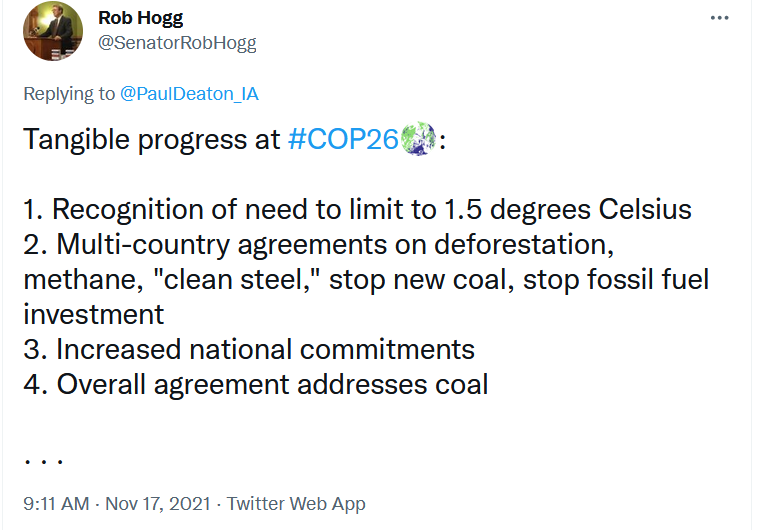
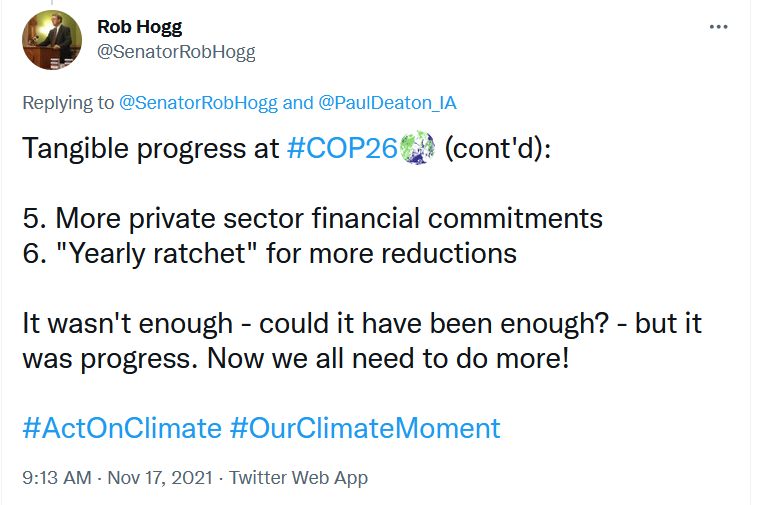
The 26th Conference of the Parties in Glasgow, Scotland seemed like a dud. My friend Rob Hogg corrected me on Twitter, posting:
So there were some positive developments. I’m reminded that zero countries is the number living up to their 2015 commitments to reduce greenhouse gases at COP 21 in Paris, France. It is difficult to let go the negativity when it comes to our collective lack of action on climate change.
On a video call a friend asked if we had installed solar panels to generate electricity for our home. I know our financial condition well enough to say it is unlikely we will because of the up front capital expense. We are doing okay financially yet know our limits.
“When it comes to climate change, we can’t afford to go backward—or even stay where we are,” former president Barack Obama said. “If we are going to act on the scale that’s required to combat this climate crisis, we all need to step up and meet this moment together.”
What does “together” mean? It means governments and a select group of non-governmental organizations and rich people that have the means to address climate change at scale. Behind Obama’s statement is the assumption we live in a democracy. Increasingly, we don’t, as floods of dark money buy our government, including the court system. An individual’s local actions matter, yet they are not enough, especially if one is the only person on the block generating electricity from solar panels.
Former Vice President Al Gore weighed in on COP 26:
Statement from Former US Vice President Al Gore on the Outcome of COP 26
“The Glasgow Climate Pact and the pledges made at COP 26 move the global community forward in our urgent work to address the climate crisis and limit global temperature rise to 1.5°C, but we know this progress, while meaningful, is not enough. We must move faster to deliver a just transition away from fossil fuels and toward a cleaner and more equitable future for our planet.
The progress achieved in the lead-up to and at COP 26 was only possible because of the power of people – young and old – using their voices to demand action.
Thanks to that advocacy, for the first time in 26 negotiations, leaders at COP 26 agreed to language that calls for a phase down of coal power and fossil fuel subsidies – a critically important step forward. Even more important, the deal significantly accelerates the timeline for nations to revisit and strengthen their net zero goals, calling for updates from every nation by the end of next year and a global convening by the UN Secretary General in 2023 to focus on more ambitious goals for cutting emissions dramatically by 2030. But despite that progress, there is much more that must be done – especially to deliver meaningful climate finance for both mitigation and adaptation to developing nations.
Ultimately, the outcome of COP 26 shows us that it has never been more important to hold our leaders accountable to their words and pledges. Advocates for climate action cannot – and must not – let up.
Six years ago, the Paris Agreement set a clear direction of travel that is moving the world away from greenhouse gas pollution and toward a sustainable future. The deal reached at COP 26 reflects the progress we’ve made in the intervening years and shows that the global community of nations is now in agreement that the era of inaction on the climate crisis must come to a swift end.”
Now is the time for government leaders, policymakers, business leaders, consumers, and activists in every nation to redouble their efforts and use the Glasgow Climate Pact as a springboard from which to drive bold action that will keep the goals of the Paris Agreement alive.”
It’s easy to become overwhelmed by the scale of the climate change problem. It is a problem, although against all reasonable efforts to educate, even that is in question for many people.
I wrote to my federal elected officials about how climate change impacted my life. I heard back from Rep. Miller-Meeks and Senator Grassley and am assessing their responses. I’m using my voice to raise the issue with my federal elected officials. Their response falls flat.
We have the tools we need to solve the climate crisis. That seems certain. Yet a society that is interested in supporting the richest among us more than taking care of each other is morally bankrupt.
The latest revelations about the Trump administration’s efforts to manipulate the Centers for Disease Control and Prevention at the beginning of the coronavirus pandemic are evidence that the highest office in government was willing to use mass-death as a political weapon at a cost of hundreds of thousands of lives. What kind of human can support that? Yet Trump flags fly unabated in our neighborhood. It is clear the previous administration was going to do nothing about the climate crisis. If they get back in office after the 2024 elections, they will set about undoing what Biden got started to address climate change and more.
In this context it is important to ask, “What will it take on climate change?” From these quotations and more, we know it will take action on a scale only governments can provide. Yet we can’t be reduced to helping political candidates we favor get elected. There is something more at stake. Regardless who holds political office, governments must act on climate change. There will come a time, and soon, when it will become obvious to even the most prominent naysayers we have to act. So we keep plugging away and hope we are not already too late.
Like it or not, Iowa Republicans have hoodwinked us into a carbon capture and sequestration method of addressing the climate crisis. It is common sense that hooking a polluting ethanol plant, coal-fired electricity generating station, or a propane grain drying operation to a mechanism for carbon capture does nothing to address the root cause of pollution. Nonetheless, here we go.
On June 22, 2021, Governor Kim Reynolds “signed Executive Order 9 launching a task force to explore carbon sequestration and the opportunities it presents for further economic development in the state of Iowa,” according to a press release.
Because of our existing supply chain and emphasis on renewable fuel infrastructure, Iowa is in a strong position to capitalize on the growing nationwide demand for a more carbon free economy. Iowa is a recognized leader in renewable fuel and food production, and this is another opportunity to lead and be innovative, invest in Iowa agriculture, and facilitate new sources of revenue for our agriculture and energy sectors. I am proud to bring together an impressive team of stakeholders that will help formulate smart, commonsense policy recommendations on this issue ahead of the 2022 legislative session.
When we talk about the decarbonization imperative across the global economy, carbon capture and sequestration has only limited use. As is typical of statements from the Iowa governor, there was no mention of the climate crisis in the release.
Having been forced to deal with carbon capture and sequestration as a public issue, advocates need references to understand what it is, its consequences, and risks. Below are some links to get started. Expect this post to be updated as new information is found and becomes available.
How to submit an objection with the Iowa Utilities Board:
Written comments or objections to the proposed pipeline can be filed electronically using the IUB’s Open Docket Comment Form, by email to customer@iub.iowa.gov, or by postal mail to the Iowa Utilities Board, Attn: Docket No. HLP-2021-0003 (Navigator) and/or Docket No. HLP-2021-0001 (Summit) , 1375 E. Court Ave., Des Moines, IA 50319.
I signed up to be a mentor for the Climate Reality Leadership Corps virtual, global training this month. There are more than 500 mentors this time. It’s a chance to meet new people who are taking climate action. The training is also a form of renewal.
I attended the Chicago training in 2013. Since then I mentored groups in Cedar Rapids, and twice virtually. It is a unique kind of work. It is based upon Vice President Al Gore’s slideshow, An Inconvenient Truth. Gore updates the slides continuously and presents it so attendees get a current and terrifying picture of the state of climate change on Earth. It is a crisis.
Sleep came slowly after viewing the first half of the presentation last night.
I wasn’t terrified by the terrifying information Mr. Gore presented. I witnessed the effects of climate change multiple times since moving to Big Grove. The flood in 1993 delayed progress building our home as we moved from Indiana. We experienced multiple straight line wind events that damaged the house, uprooted trees, blew down large branches, and tore through our neighborhood. In 2008 there was record flooding that filled much of the Iowa and Cedar River basins, backing up water into the Lake Macbride watershed to within 100 yards of our home. It made roads around us impassible, and devastated Cedar Rapids, Iowa City and other nearby places. In 2012 there was record drought which made life outdoors difficult and reduced corn yields significantly. On Aug. 10, 2020 there was a derecho which took down one tree and damaged several others on our property. My greenhouse lifted in the air like Dorothy’s farm house in the Wizard of Oz. Winds up to 140 miles per hour destroyed 70 percent of the tree canopy in Cedar Rapids. I know about climate change from living it.
What kept me up late was a newfound sense of hope. There was cause to re-engage in preventing the worst effects of the climate crisis and in mitigating its damage. I couldn’t sleep while the prospect of making a difference surged through me.
The Climate Reality Project rightly focuses on the change in society that most affects global warming: increased burning of fossil fuels. We must find alternative, renewable sources of energy, stop burning fossil fuels, and keep them the ground. We must find and adopt breakthrough technologies for electricity generation to use them to electrify transportation, buildings and industry. Agriculture must play its part by reducing emissions and sequestering carbon in the soil. Let’s put new technologies to work releasing energy for the economy in a way that will improve our quality of life. We must stop using the sky as if it were an open sewer.
I ask myself, how can I make a difference where I live? Personal change is part of solving the climate crisis. We must reduce our personal reliance on burning fossil fuels. Collective action is needed more and that means finding and organizing like-minded people in our area who are inspired to take climate action.
A solution is not evident today. I’m hopeful over the next eight days, along with my colleagues, we’ll discover and take a path forward. I’m okay with losing a little sleep from excitement about our collective future for now.
It’s easy to write a post on social media that says we should reduce greenhouse gas emissions then add a hashtag like #ActOnClimate. What’s harder is knowing what greenhouse gases are at work across the economy and the steps required to reduce them. The upcoming book by Michael Lenox and Rebecca Duff is here to help.
The Decarbonization Imperative: Transforming the Global Economy by 2050 takes “a deep dive into the challenge of climate change and the need to effectively reduce net greenhouse gas emissions to zero by 2050.”
When the authors say “deep dive” that means the book doesn’t read like your parent’s latest mystery novel. It is packed with details and examples, along with questions about whether society can make the transition to a decarbonized economy effectively and in time to avert the worst effects of climate change. The authors remain positive about the prospects even if their narrative presents a bleak answer to both questions. The book welcomes a reader already engaged in how to combat climate change. It takes them beyond generalities.
“The challenge before the world is overwhelming, requiring a profound shift in so many large economic sectors over the course of a few decades. But try we must,” wrote Lenox and Duff. They present five sectors of the economy for review: Energy, Transportation, Industrials, Buildings and Agriculture.
Running throughout the book is the theme of electrification as a way of economic decarbonization. Energy, or electricity generation more specifically, is a key consideration. The other four sectors depend to varying extents upon the energy sector, according to the authors.
Lenox and Duff name all the carbon-free operating methods for generating electricity and point to solar as the one with the most promising capability to disrupt current patterns toward decarbonization of the economy. The narrative is familiar: solar technology is effective, it is currently inexpensive, and costs continue to decline. “Utility-scale solar is now competitive with fossil fuels,” wrote the authors.
Nuclear power is mentioned multiple times in the book as a potential solution to decarbonize electricity generation. Readers of this blog know my skepticism about building new nuclear power generating stations. Like many, I point to the failures at Three Mile Island (1979), Chernobyl (1986) and Fukushima (2011). According to the nuclear regulatory commission, “Today, the Three Mile Island-2 reactor is permanently shut down and 99 percent of its fuel has been removed. The reactor coolant system is fully drained and the radioactive water decontaminated and evaporated.” The other two disasters remain ongoing.
Lenox and Duff acknowledge the high cost of current nuclear reactor technology. They also mention Bill Gates’ nuclear project. In his 2021 book How to Avoid a Climate Disaster: The Solutions We Have and the Breakthroughs We Need, Gates wrote, “I put several hundred million dollars into starting a company to design a next-generation nuclear plant that would generate clean electricity and very little nuclear waste.” While Lenox and Duff acknowledge new nuclear power is too expensive for economically disruptive potential by 2050, Gates’ investment is of the kind for which they advocate throughout the book. If Gates’ company resolves issues with nuclear power, as is its stated goal, it may be worth another look.
The authors emphasize no sector of the economy is without challenges in getting to decarbonization. The benefit of reading the book is its broad overview of these challenges.
There is a lot to absorb in The Decarbonization Imperative. Unless advocates are willing to do the work to understand this narrative, what’s the point? I recommend the book for its analysis by sector and for the ways each sector is connected with others. Climate advocates often focus on electricity generation and electrification of transportation yet to decarbonize the economy, all sectors must be addressed. Zero emissions will be a tough nut to crack, especially when zero means zero.
Michael Lenox is the Tayloe Murphy Professor of Business Administration at the University of Virginia’s Darden School of Business. He is the coauthor of Can Business Save the Earth? Innovating Our Way to Sustainability (Stanford, 2018) and The Strategist’s Toolkit (Darden, 2013).
Rebecca Duff is Senior Research Associate with the Batten Institute at the University of Virginia’s Darden School of Business. She also serves as the managing director for Darden’s Business Innovation and Climate Change Initiative.
Reflection under a foot bridge on the state park trail.
This Friday a lot is going on in real life so I’ll leave this photo taken yesterday.
Once the sun comes up, it’s gleaning the garden, mowing, and a big apple harvest. Kitchen work never ends this time of year. I cleaned four half-gallon jars for apple cider vinegar making and am ready to go.
We take moments of peaceful reflection where we find them.
Today, the Intergovernmental Panel on Climate Change (IPCC) released their sixth assessment report of the global climate. The news is not good.
Human kind must reduce greenhouse gas emissions, and fast, to avoid the worst effects of the climate crisis, according to the report. On tomorrow’s one-year anniversary of the derecho, Iowa’s latest extreme weather event, the Hawkeye State should pay attention to what scientists have to say. So should we all.
Climate change is affecting every region on earth, in multiple ways.
Increases in drought with continued increases going forward.
Projected increase in extreme precipitation.
Projected increase in river and pluvial flooding.
Projected increases in winter precipitation.
There is a lot of information in the report and rather than summarize it here, I’ll direct readers to the report itself. There are summaries and a wealth of information. It can be viewed and downloaded at this link: https://www.ipcc.ch/report/ar6/wg1/
“If we reduce emissions to net zero by 2050, we can keep temperatures close to 1.5C,” wrote Dr Valérie Masson-Delmotte, co-chair of the IPCC. Achieving that would help prevent climate change’s worst effects.
~ IPCC is the international body created in 1988 by the World Meteorological Organization (WMO) and the United Nations Environment Program (UNEP) for assessing the science related to climate change.







 Journey Home
You must be logged in to post a comment.