Categories
Reviews

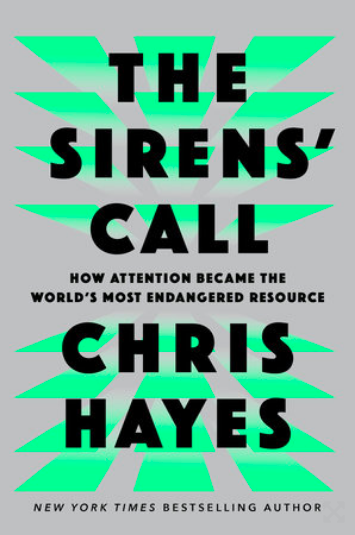
Book Review: The Sirens’ Call

In The Sirens’ Call: How Attention Became the World’s Most Endangered Resource, author Chris Hayes addresses things people in my network are experiencing and to some extent freaking out about: Why can’t I stop doom scrolling TikTok and Instagram Reels? Why can’t I read a long book any more? Or more than one book in a year? How could we have elected the attention hound who is the 47th president? Hayes says attention has become a fungible commodity in our society and people and corporations are intentionally stealing it from us, in part to monetize what we pay attention to. If readers are interested in challenges in modern society, I recommend this book.

“Attention is the substance of life,” Hayes wrote. “Every moment we are awake we are paying attention to something, whether through our affirmative choice or because something or someone has compelled it. Ultimately these instants of attention accrue into a life.” Hayes asserts things have changed, “Our dominion over our own minds has been punctured.”

Back in the day I held an overnight work meeting in Fairless Hills, Pennsylvania. For entertainment, the group voted to go to nearby Atlantic City for dinner and sightseeing. We ended up walking through the Trump Casinos before they went bankrupt. I recall signs saying something to the effect, “Don’t Disturb the Players,” referring to scattered people in a sea of slot machines dropping coin after coin into the slots. Hayes discusses this phenomenon in The Sirens’ Call.

Slot machines hold our attention by grabbing it for just a little bit while we wait for the spinning to stop, and then repeating that same brief but intense process over and over. The model is simple: Each play lasts only a few seconds. Bright lights and novel stimuli compel our attention. A moment of suspense is followed by resolution. A mystery in miniature is revealed, perhaps satisfyingly, perhaps unsatifyingly, but right there to be repeated. (The Sirens’ Call by Chris Hayes).

Hayes points out it is not the gambling that keeps players at the slots. “It is the unique attentional trance the machine’s gameplay induces,” he wrote. The casino uses players’ attention to monetize their time in the trance. That most gamblers have the same motivation is an example of making attention a fungible commodity. In this scenario, the house always wins, even if Trump himself couldn’t make a go of it.

The connection Hayes makes between slot machines and mobile devices, upon which to scroll various platforms, now seems obvious. Mobile devices garner and commoditize our attention to show us advertising, thereby monetizing our time and attention the way slot machines do. We often can feel like we are not in control of our minds.

The range of the book is broad. Hayes uses the narrative of Odysseus and the Sirens from the Odyssey throughout to tell his story. Among the topics covered are Early 19th Century newspapers, The Lincoln Douglas Debates, P.T. Barnum, alienation related to attention harvesting, and the evolution of what he calls the Attention Age. He closes the book with a chapter titled, “Reclaiming Our Minds,” asserting, “The internet is getting worse and worse.” He also offers things we can do to offset this.

Chris Hayes is not your typical writer. Because he spent ten years on cable television he has been in the thick of gaining attention in the form of ratings for his show on MSNBC. In cable T.V. gaining attention is everything. As a young father, his stories resemble ours in important ways. He has an interesting story to tell. I found the book to be a page turner. I recommend picking up a copy at a local library and reading it. Here’s a link.

Categories
Reviews

Book Review: Citizen

Each end of year holiday season I find a book by or about one of our presidents and read it as a gift to myself. Since that slugabed Barack Obama hasn’t published his second book of presidential memoirs (volume one was published in 2020), I settled for Bill Clinton’s post-presidency memoir Citizen: My Life After the White House published Nov. 19 this year. There are plenty of reasons to read Clinton.

My position about Bill Clinton and this book is that since he survived heart disease and a case of sepsis he ought to write a post-presidency memoir so historians can benefit from the information gathered herein. Indeed, there is granular information about the accomplishments of the Clinton Foundation. The first two parts of the book cover those years in detail lest we forget Bill and Hillary Clinton were do-gooders, all over the world. Let’s face it, though. Bill Clinton is a political animal and the third part of the book, “Politics, Rewriting History, and Reviving the Foundation in a Still Uncertain Future,” in which he discusses politics, is what many were waiting to hear.

Clinton points to Newt Gingrich and his Contract with America as the source of today’s divisiveness in society. When Republicans won the 1994 midterm elections and installed Gingrich as Speaker of the House, it was he who changed our politics to be more confrontational. From shutting down the government twice, to welfare reform, to a capital gains tax cut, to impeaching Bill Clinton as president, Gingrich made it so our politics would never be the same as it was. We are still suffering from the conservative detritus in his wake in national politics. He supported Donald Trump’s claims of a stolen election, and claims of voter fraud in the 2020 presidential election.

Important in Citizen is Bill Clinton’s account of Hillary Clinton’s political life through her run for the presidency in 2016. While their story is familiar, he makes a strong case for what happened and why. It is a story infrequently told in major media outlets and worth reading here.

Clinton also reviews some of his major accomplishments, like the Crime Bill and the Family and Medical Leave Act. There is no shortage of moments when he honked his own horn about his many accomplishments as president, including job creation, converting the budget deficit into a budget surplus, and connecting more schools to the internet. Clinton makes a solid case that his administration did many things that benefited middle-income workers.

Beginning around 2016, Clinton received criticism from the left that his signing the 1994 Crime Bill and the 1996 welfare reform bill were actually him (and Congress) caving to the far right. He defends himself rationally as the “explainer in chief” is wont to do. It is important to recall that in the end, Clinton was one of the good guys among politicians and advanced Democratic causes.

I recommend reading Citizen: My Life after the White House by Bill Clinton. It is important to know the history of Democratic politics and Clinton was in the middle of it.

Categories
Reviews

Book Review: The Hidden History Of The American Dream

I understand what Thom Hartmann wrote his new book, The Hidden History of the American Dream: The Demise of the Middle Class — And How to Rescue Our Future. However, the book is less likely written for a boomer like me than for millennials and younger people who did not live through the Reagan Revolution. Hartmann said as much in an email:

“I wrote this book mostly to Zoomers, Gen-Xers, and other younger-generation Americans who don’t understand how we got a widespread middle class in the first place (it was FDR’s government intervention in the so-called “free market”) or why it shrank from two-thirds of us when Reagan came into office to a mere 43-47 percent of us today (Reagan’s 1981 mission was to gut the middle class to “preserve stability”).

When I came of age after finishing graduate school, Ronald Reagan was president and despite an advanced degree, military service, and being a white male with the privilege that means, the American Dream was the stuff of legends rather than something attainable. In his book, Hartmann explains the history of how the Middle Class came to be and what happened after Reagan was sworn in as president. The idea of an “American Dream” is still relevant, he said in a recent interview. His message is one of hope for restoring the American Dream, economic opportunity, and a strong Middle Class.

What makes this book relevant now is the fact that in the November 2024 election, the country is facing a choice between the Democratic Republic upon which we were founded and a rich person’s paradise where privatization of government functions and economic deregulation are the norm.

On Sept. 17, the author interviewed Hartmann about his new book. Click here to listen to the 27-minute interview. You will be glad you did. Hartmann discusses his view of the American Dream, the impact of Reaganism, K-12 and higher education, right to work, and more.

Thom Hartmann is a four-time winner of the Project Censored Award, a New York Times bestselling author, and America’s number one progressive talk show host. His show is syndicated on local for-profit and nonprofit stations and broadcasts nationwide and worldwide. It is also simulcast on television in nearly 60 million U.S. and Canadian homes.

To buy a copy of The Hidden History of the American Dream: The Demise of the Middle Class — And How to Rescue Our Future, click here.

Categories
Reviews

Book Review: The Art of Power

The Art of Power: My Story as America’s First Woman Speaker of the House by Nancy Pelosi is a solid read from a person at the center of American politics since first elected to the U.S. House of Representatives in 1987. In a time when the average American adult finishes just over five books per year, Pelosi’s book is perfect. It is an easy read, about timely topics, and general enough to interest an average reader through to the finish.

Pelosi emphasizes the book is not a memoir. It is the story of her time as the 52nd Speaker of the U.S. House of Representatives. It is also the story of Democratic accomplishments during the last 37 years. We Democrats don’t tell our story in clear, measured prose often enough. More books like this are needed.

While I lived through this period as an adult, Pelosi pulls a narrative together that not only rings true to the times, it leaves out much partisan drivel a lesser writer might include. It brings focus on important events and legislation from her unique platform.

Some say Nancy Pelosi is a lightening rod in politics. What I say is she is a person with an accomplished life who wrote a book well worth reading.

Categories
Reviews

Book Review: Minority Rule

A decent history of American politics in the post-Obama era has yet to be written. One can’t rely upon any of the conservative principals to author one, because they have been drinking at the well of minority rule for too long. A Trump autobiography? He didn’t even write The Art of the Deal.

Enter Ari Berman’s new book, Minority Rule: The Right-Wing Attack on the Will of the People–and the Fight to Resist It, published in April. It provides a well-researched and relatable history of an issue that has been at the heart of modern conservatism since Pat Buchanan worked in the Nixon White House.

In a 1995 National Press Club address, Buchanan, then a presidential candidate, said, “If present trends hold, white Americans will be a minority by 2050.” This underlying fear mongering became endemic to Republican politics and drove the ascendancy of the 45th president. Irrational fears the United States would transform from a First World Power to Third World status drove conservative voters to the ballot box.

In my reading of books about the rise of Donald Trump as president, Berman is the first author to tell a clear, coherent, and relatable story of that time. Minority rule is at the heart of current Republican policy and behavior and Berman lays it all out for the reader.

While the 1965 Voting Rights Act broadened access to the ballot, conservative white folks were aghast and feared they would become a racial and political minority. During the Johnson administration, an emphasis on immigration of whites was transformed to a broader band of global populations. Enter Trump to both fan the racist, anti-immigrant flames, and get elected as a supposed fire fighter for the fires he started.

Berman outlines the constitutional and legal structure that enables minority rule in the United States. The conduct of the U.S. Census, having two U.S. Senators per state regardless of population, the growth of the filibuster, the electoral college, and drawing political districts in a way that disenfranchises non-white voters, all play a part in enabling minority rule, according to Berman.

While it may sound easy to keep the U.S. Census above politics, it was politicized during the 2020 census by the administration. Having two U.S. Senators, combined with the filibuster enables senators representing a minority of the population to set policy and block majority-favored laws they don’t like. Political gerrymandering, especially in states like Wisconsin and Michigan entrenched minority rule and blocked attempts for political districts to represent the people in the state. There is no magic bullet to fix any of these issues. Entrenched, minority rule makes it more difficult.

In Minority Rule, Berman outlines the role of The Heritage Foundation’s sister organization, Heritage Action, in our politics. Heritage Action is a 501(c)4 nonprofit conservative policy advocacy organization founded in 2010. The Heritage Foundation was restricted from advocating policy, so they created this offshoot, which has become one of the most powerful political lobbying groups in the nation. Iowa is one of the states where these dark money groups have been active.

Ari Berman gets a thumbs up for this book, and I recommend you read it yourself. Minority rule is endemic to the problems of politics in 2024. Berman helps us get a grip on it. He also provides hope the electorate can address the problem and embolden democracy going forward. He presents evidence such a movement has already started.

I also recommend Berman’s previous book, Give Us the Ballot: The Modern Struggle for Voting Rights in America.
Categories
Reviews

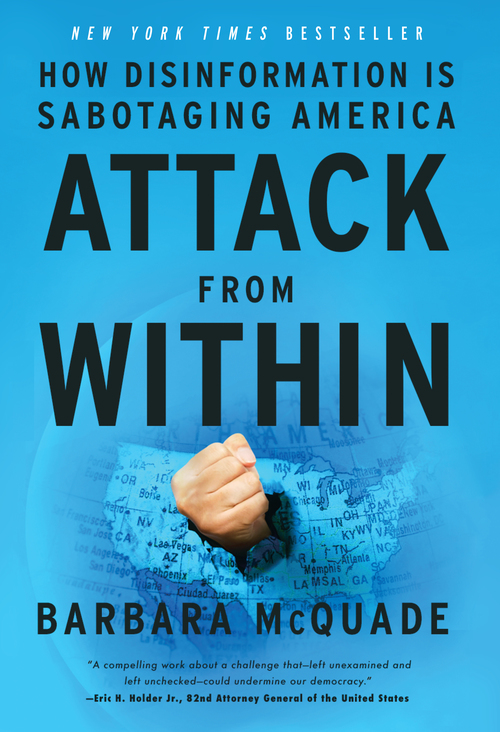
Book Review: Attack From Within

We need information that will help us cope with the 2024 political campaigns and facilitate Democratic wins. Barbara McQuade’s new book has the potential to do that.

McQuade is a law school professor and legal analyst for NBC News and MSNBC. A former US Attorney for the Eastern District of Michigan, she was appointed the first female in that position by President Obama. She possesses legal bona fides. She also co-hosts a podcast called Sisters In Law.

She is one of several combination authors/lawyers/talking heads/podcasters I follow. Her new book, Attack from Within: How Disinformation is Sabotaging America, comes at a perfect time for this presidential election year. It is relevant, engaging, and necessary. What is it about?

In part, the book is an explainer. McQuade pulls commonly known information from the media ecosphere and relates it to the concept of disinformation, demonstrating the potential and real consequences for American Democracy. She presents a coherent narrative that includes how disinformers gain power, disinformation tactics, why disinformation works, the danger of emerging technologies, and more. For those parts of the book alone it is worth reading.

What I found most engaging was the chapter “We Alone Can Fix It: Proposed Solutions.” Dealing with disinformation and misinformation can be daunting. McQuade compares this task to the moon shot during the Kennedy administration and wrote:

The tandem threats of authoritarianism and disinformation can seem overwhelming, but we as a nation have solved big problems before. The stakes for democracy are simply too high to ignore them or surrender to despair. Unless we take action, democracy in the Unites States seems destined to fail, and our sovereignty as citizens will perish with it.

Attack From Within: How Disinformation is Sabotaging America by Barbara McQuade, page 249.

In this chapter, McQuade turns from describing the problems with disinformation to potential solutions. Free speech protections are not absolute in the United States, she said. We should be seeking regulatory solutions to misinformation and disinformation rather than simply banning content. She asserted this can be done without implicating censorship concerns. That may seem like a difficult needle to thread, yet it is the approach taken by other western governments like Germany and the European Union.

Another idea is related to Section 230 of the Communications Decency Act of 1996. I have frequently bemoaned loss of enforcement of the Fairness Doctrine under President Reagan, yet there may be a different solution. “Making online media companies legally responsible for the content on their platforms would force them to remove posts that endanger the public,” McQuade wrote. This issue is at the heart of the Supreme Court case Murthy v. Missouri for which the high court heard oral arguments on March 18. This approach is not without problems. A discussion is needed to discover a way to balance stripping some protections from legal liability while continuing to make reforms in how online content is regulated. It doesn’t have to be a free-for-all. My sense is the high court will decide this case on narrow grounds and throw it to the legislative branch of government to be addressed. The days of having discussions like these at the Supreme Court, as was done in deciding Roe v. Wade, are over with the Roberts Court.

My advice? Secure a copy of the book, by buying it or asking your public library to get a copy, and read it. I’m missing some things in a short book review, but believe me, you are going to want it all from Barbara McQuade.

Categories
Living in Society

Book Review: The Big Myth

The Big Myth: How American Business Taught Us to Loathe Government and Love the Free Market by Naomi Oreskes and Erik M. Conway is a keeper. It was written in the context of a number of contemporary books that outline the role of market fundamentalism in our society. The authors present a convincing case that U.S. Government is smaller than many other industrialized nations and could be better used than it is. The reason our government is not better used is that on the spectrum of free markets to government control, a small group of people have perpetuated the myth that the free market can solve all of our ills and government is too intrusive. They intentionally retard social progress. The book is not a quick read, yet it is vitally engaging throughout.

If you are familiar with the work of Jane Mayer, Nancy MacLean, Anne Nelson, Anne Case, Angus Deaton, Matthew Josephson, and Dahlia Lithwick I recommend reading The Big Myth.

Having married just after Ronald Reagan was sworn into office, I lived through much of the second half of the book. The history Oreskes and Conway wrote is illuminating. What I suspected, and the authors confirmed, was that market fundamentalists found a way to use popular culture to indoctrinate the population in basic tenants of their beliefs. Whether it was the collaboration between Laura Ingalls Wilder and her daughter Rose Wilder Lane in the Little House books, Ayn Rand’s work in Hollywood censorship, Ronald Reagan’s work for General Electric, or Milton Friedman’s numerous and widely read opinions, op-eds and columns, there was an intentional effort to add a layer of conservative ideology to mass culture. Call it what it is: propaganda.

The book made me reflect on how my basic views toward life in society were influenced without me knowing it.

My self-view is one of self-reliance. I stand on my own two feet and endure whatever challenges come my way, hopefully successfully navigating them. I wrote something similar to this many times over 50 years of writing. After reading The Big Myth, I realize this mental attitude may have been a form of indoctrination by active, libertarian agency that found its way into literature, movies, and television programs to which I was exposed from an early age. While self reliance is not bad, that it became part of my mental outlook through indoctrination is not good.

I am not freaking out! The disturbing part of libertarian propaganda about market fundamentalism is the absence of any alternative response. In fact, conservatives constantly accuse liberals of brainwashing children in public schools, to the extent the Iowa Legislature passed a significant private school voucher law to address their fears. Why aren’t liberals in the game? They, like me, likely didn’t understand how deep the propaganda went. There have been few comprehensive stories written about what libertarian radicals have been doing for a hundred years. Oreskes and Conway remedied that.

Pick up a copy at your independent bookstore or, if they have it, from your public library. The Big Myth is essential reading as Republican extremists work to undo American democracy with the backing of large-sized business interests. We can do better than that.

Categories
Reviews

Book Review: The Wide-Brimmed Hat

I’m cautious when I write the first Goodreads review of a book that has been published for more than 20 years. That I read The Wide-Brimmed Hat at all is attributable to finding a first edition copy in a thrift shop or used book sale, and that it was written in and largely about Iowa and Midwestern values. I knew Susan Kuehn Boyd by name yet had no prior knowledge of her as an author before seeing this book.

The most interesting part is excerpts from Boyd’s May 1970 diary during the anti-war protests at the University of Iowa where her spouse Willard (a.k.a. Sandy) was president. I was a senior in high school that year and what I knew about that period was there were protests and the university closed early for the academic year because of them. Protesters occupied the president’s office in May 1970.

In her diary, Boyd shows a privileged life in the university community. During the protests, she and her family moved out of their home for security reasons, attended group luncheons as usual, and ate gourmet food, all well removed from main protest actions. She mentions both her spouse and D.C. Spriesterbach, who both have written about May 1970 in their books. Susan Boyd’s narrative adds another layer of perspective and I’m thankful to have found it.

The stories, play, and poetry that comprise the main part of the book are better suited to magazines like Mademoiselle which published some of her work. The book was readable and if one enjoys the kind of stories anthologized in short story collections, there is something here for you.

Categories
Reviews

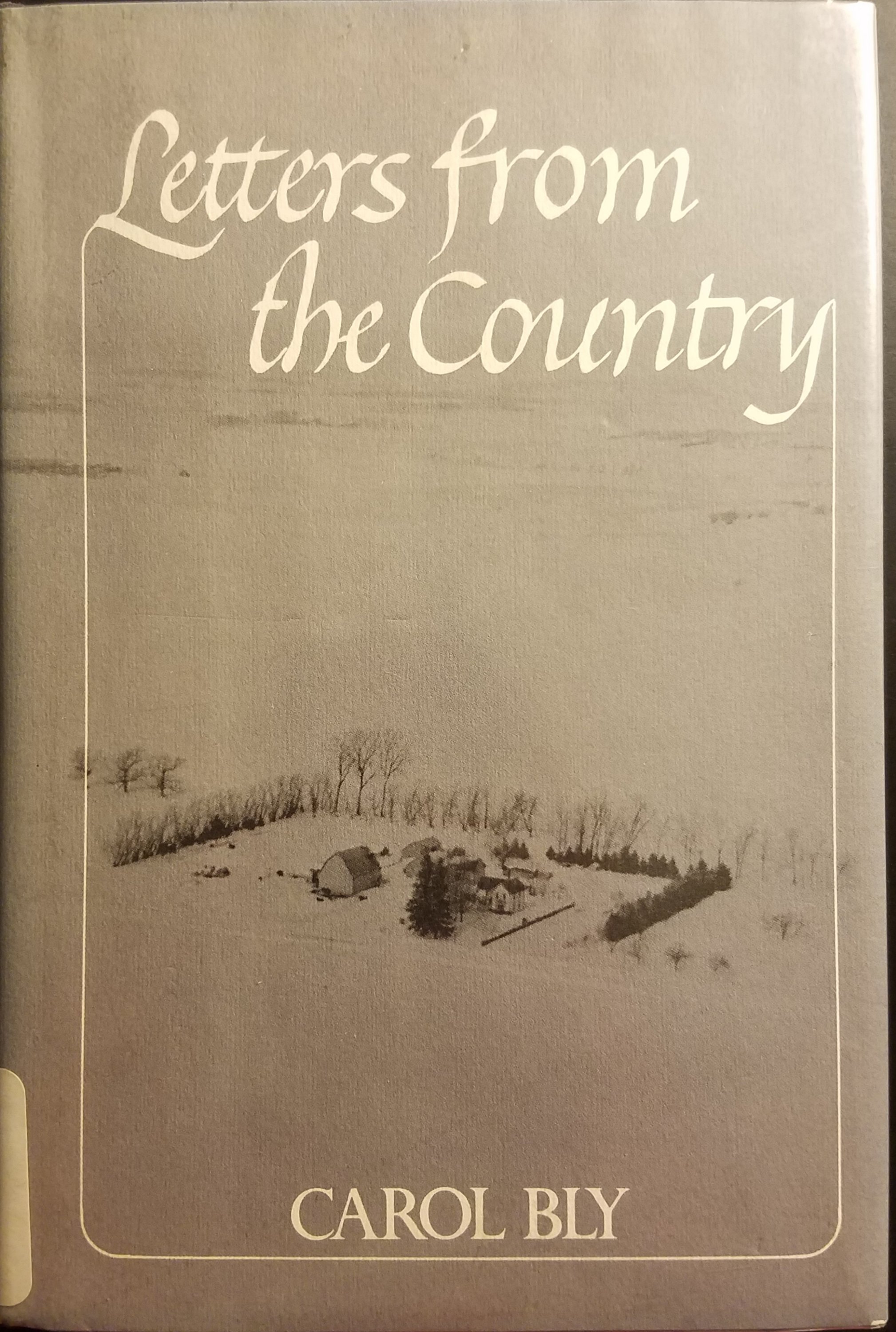
Book Review: Letters from the Country

It was a long time getting to Letters from the Country by Carol Bly. My copy is a discard from the Lake County Indiana Public Library where I picked it up from a used book shelf. We moved back to Iowa in 1993, so the purchase was more than thirty years ago. Attracted by the idea of letters from southwestern Minnesota, where my family bought land from the railroad in 1883, the book failed to stand up to time when I recently read it. If its insights and comments were relevant when it was written in the 1970s, such relevance escapes the reader in a time of internet connections, processed food, sports utility vehicles, and 24/7 right wing talk radio.

There are some truths buried in this time capsule of a book, particularly about how rural people interact with each other. It is a learned protocol of avoiding difficult things in life. Things like problems that have complex solutions that are not obvious, or telling someone “thanks for sharing ” immediately after they spill their guts about something intensely personal that affected them greatly. Away from the distractions of large cities, there is a sense that people have to live with each other and therefore don’t tend to burn any bridge with someone they might see in the neighborhood, or at the convenience store, library, or American Legion. For the most part, this means avoiding talk about politics unless one knows the politics of everyone in the room.

People don’t take well to being told what to do or how to live their lives. Bly’s book is full of that and partly, it’s why it seems outdated. Times have changed. She writes about bringing intellectual pursuits from the city to rural areas, which is a noble idea. Today, folks just get into their SUV and drive to Chicago to see the latest exhibition at the Art Institute. Or they fly to New York to see what’s on Broadway. For the time being, arts and the humanities are taught in rural public schools. The annual cycle of K-12 school musical, dramatic, and literary productions are part of the fabric of rural society. The direction our politics is heading may remove these topics from curricula in the near future to focus on skills needed to get a job, raise children, and get along well enough to not rock the boat of social mores.

Some of the letters mention the frequency with which rural folk write their congressman. Not writing is a sign of a decent level of satisfaction in the community. That’s why, Bly wrote, rural folks don’t write that many letters. If current elected officials seem out of touch with reality, it’s not because they don’t know what’s going on with citizens. They choose to address their concerns while adding a layer of indoctrination in the new ways of a national conservative culture. Why talk about poor air and water quality — real problems in Iowa — when citizens can be scared by tales of bogeymen laden with fentanyl illegally crossing the border with Mexico. The latter pays a political premium.

I didn’t dislike Letters from the Country. I do want to say more than “thanks for sharing” to the author. What I will say is it is good to read Bly’s analysis of what’s wrong with country folk and their way of life. Maybe it just needs updating. That would be a fit project for someone to take as long as it is not me.

Categories
Reviews

Book Review: Democracy Awakening

Democracy Awakening: Notes on the State of America by Heather Cox Richardson is a must read for anyone following the contemporary discussion of conflict between the liberal consensus and movement conservatism. If you don’t know what those two things are, Richardson takes the reader through how they came about, beginning with the founders. She explains why the discussion is important to American democracy. The liberal consensus has been under assault since Ronald Reagan was sworn in as president in 1981. To a large extent, conservatives have been successful in beating back the liberal consensus.

The benefit of reading this book is it takes political things we mostly know about and frames them in a narrative that both explains them from Richardson’s singular perspective and makes sense. To the extent she is preaching to the choir of readers who already understand the liberal consensus, how it came about, and why wealthy Americans are dismantling it, the book stopped short of expectations. There could be more calls to action to satisfy us. However, the important aspect of the book is that most modern adults haven’t lived through the Reagan years and their aftermath. It serves as a primer for millennials and more recent cohorts who now comprise the nation’s largest living adult generations. The book is not directed to boomers, although we will read it, but to younger Americans. They will have to take action to defend or re-invent the liberal consensus simply because my generation is dying off.

Part 2, The Authoritarian Experiment, is an important narrative about the rise of Donald Trump and a popular history of his administration. Many words have been written by others about this, yet what I found lacking in other accounts, and Democracy Awakening addresses, is a basic timeline and explanation of the shit show that was the Trump presidency. Many people stuck their heads in the sand from the November 2016 election until the present because they found it incredible that Trump’s outlook and minions would prevail. Indeed, with the election of Joe Biden as president, forces of authoritarianism were held back.

Democracy Awakening was a fast read, I finished in four days. I recommend it to anyone concerned about the future of our democracy. It seems unlikely the book will be the definitive history of that period. At the same time, it is what we need to inform our political action during the 2024 election cycle and beyond.

I also recommend subscribing to Richardson’s daily substack, Letters from an American. It is a blend of history, journalism, and analysis of current events. It is one of the sane bits of writing coming out of the explosion of disinformation in our media sphere.