The weather has been kind of pissy to this gardener. Ambient temperatures have been all over the place during the last ten days. The soil for the garlic patch has been spaded yet is too wet for tilling and planting due to intermittent rains. It is raining as I write… and wait for spring to truly arrive.
I received notice my Medicare Supplemental Insurance premium is increasing by 11.7 percent beginning May 1. Making a big assumption — that Social Security will continue to pay out as previously — there should be enough money to cover the additional $28.73 for me and a similar amount for my spouse. May have to cut back elsewhere, but insurance is a top tier priority.
My Social Security payment arrived on time this month. Two for two for the new administration. The Washington Post has been following the turmoil since DOGE turned its sights on the agency upon which more than 70 million Americans rely.
“What’s going on is the destruction of the agency from the inside out, and it’s accelerating,” Sen. Angus King (I-Maine) said in an interview with the Washington Post. “I have people approaching me all the time in their 70s and 80s, and they’re beside themselves. They don’t know what’s coming.”
Most of us fear what is coming. As the senator said, we don’t really know what’s coming, except that in fits and starts, the administration appears to be making random cuts and illogical accusations about the program with an endgame of privatizing or killing it. My fear is the billionaire class plans to rob the Social Security Trust Fund in its entirety. It’s almost $3 Trillion value won’t even begin to cover the tax cuts the president has proposed, and the Congress seems intent on legislating into law. That means more debt if it moves forward, in addition to poverty among many seniors, if it doesn’t kill them first. Republicans don’t seem concerned about bankrupting seniors, the government, or anyone but themselves.
Today’s news hits like a brick. I can deal with pissy weather and am reminded of this verse from Cristy Lane’s hit song One Day at a Time, which provides some resilience:
Do you remember, when you walked among men?
Well Jesus you know if you're looking below
It's worse now, than then.
Cheating and stealing, violence and crime
So for my sake, teach me to take
One day at a time.
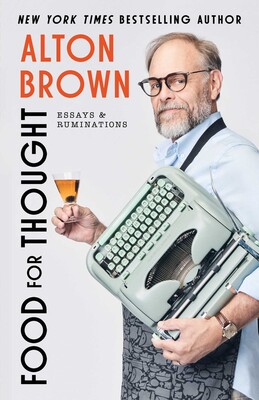
My reaction to Food for Thought: Essays & Ruminations by Alton Brown is it fills gaps in my personal culinary history. Brown occupied space after the formative experience I had in South Georgia in 1997 and 1998. While working on a logistics project at a clay mine and processor, after a 14-hour shift at the plant I retired to a motel room in nearby Thomasville. There I was exposed to Food TV Network, Emeril Lagasse, Mario Batali, Susan Feniger, Mary Sue Milliken, Julia Child, and others. It was a formative experience yet Brown came along after that period, airing his first episode of Good Eats on July 7, 1999.
During that work assignment I escaped into the T.V. During thirty minute segments I could forget extreme poverty and plain family restaurants that served a meat and three sides in rural Georgia, and engage in celebrity chefs who enjoyed what they were doing as locals did not. I had no kitchen at the motel so the interest was intellectual. My later involvement in the local food movement has its origins in the contrast between that poor, uninviting place in South Georgia and my nightly food escape. I learned a lot from Brown’s television programs when he later came on the cable channel and I watched them back in Iowa.
I didn’t know if I would enjoy his book. As I read, I liked it more with each turn of a page. For the kind of local food enthusiast I have become it is essential reading because of Brown’s unique role in televised, public cooking. Hearing his personal history, especially beginning with the premature and unexpected death of his father, informed the personality I remember from Good Eats.
After Good Eats ran its course, I fell off the Alton Brown bandwagon. I did not care for the stadium-style Iron Chef cooking competitions where he was a commentator. I also missed his coronavirus pandemic home cooking show on YouTube. By the pandemic, I had developed my own concept of a kitchen garden and no longer needed a recipe writer as Brown describes himself in Food for Thought.
The book is a miscellany of stories in the form of a memoir. As such one can both enjoy and not enjoy the writing, chapter by chapter. It was somewhat disappointing to read of Brown’s tobacco use and over-indulgence in alcohol. At the same time, the “Meals that Made Me” series is engaging and insightful. In all, the positives outweigh the negatives which is what I seek in a memoir.
If a person works in a modern, American kitchen, Food for Thought is well worth the time it takes to read.
Snow and ice melt draining off the Lake Macbride watershed.
It’s no secret a new president has a limited amount of time before re-entering an election cycle. I assume our current president is not stupid and realizes, given recent polling, Republicans could well lose control of the U.S. House of Representatives in the 2026 midterms. Those campaigns crank up in about a year and that’s how much time he has to make his mark. This is politics 101, and nothing about the current administration modified that.
It’s been nine weeks since the inauguration and the resistance is getting more active, court cases more numerous. What became clearer this week is the plan, whether it be Project 2025 or whatever, is to move as quickly as possible to dismantle parts of the federal government to stay ahead of the courts. The courts are now catching up with the administration. They will not bend a knee to the president, even some justices appointed in the president’s first term. Public resistance to dismantling our government is also growing.
Secretary of State Marco Rubio declared he was done with USAID on Monday, March 10. He cancelled 83 percent of their contracts and rolled the remainder of them into the State Department. A done deal, one could reasonably say. On March 19, a federal judge ruled that Elon Musk and his DOGE team likely violated the Constitution when they effectively shut down USAID, National Public Radio reported. Out here in the middle of the country, that looks like too little, too late to save the organization. The jig is up, though. By executing their plan, they also disclose it, empowering the resistance.
When on Friday, March 14, the executive order to dismantle the Institute of Museum and Library Services (IMLS) came down, it didn’t take long for friends of libraries to respond. Over the weekend, libraries across the state launched an advocacy program to contact our elected officials to explain what the agency did and why it should not be dismantled. Various libraries explained it differently. Here is one example:
The State Library of Iowa relies on Library Services and Technology Act (LSTA) funding from the IMLS to deliver statewide library development initiatives and services to Iowa libraries and citizens. This critical funding is tied to matching dollars from the Iowa Legislature.
These funds directly support services our patrons depend on:
Interlibrary loan system and twice-weekly delivery service
Annual Summer Reading Program theme & resources, and the All Iowa Reads program
Bridges (Libby app) platform fee and magazine collection for the statewide digital library consortium
Brainfuse HelpNow online resource
Website hosting
Online calendar, registration, meeting room scheduling software
Train and support skilled public librarians and effective library boards and the State Library Endorsement program
Standards and Accreditation program for high quality libraries
People’s Law Library of Iowa.
I haven’t time to follow all agencies affected by the administration’s executive orders, yet am guessing the same response is happening widely. The resistance is building. I sent my own email to elected officials, saying, “As a resident of your district, I don’t understand how the executive branch can intervene in a congressionally created agency, cancel grants, and in effect put it out of business. Please explain.” Senator Grassley’s office was first to respond. Here is an excerpt from his March 21 response:
I appreciate hearing of your support for IMLS employees and the programs they administer. I agree that Iowa’s libraries play an invaluable role in the lives of Iowans by promoting literacy and information access, and our museums are valuable cultural assets that enrich the lives of Iowans and promote tourism in Iowa communities.
At the onset, I understand and recognize many Iowans are concerned about the Executive Order I will be discussing in this message. I would like to take this time to share as much information as I know about this situation, and please know myself and my staff are continuing to monitor this situation.
Grassley’s response was something, yet it left me feeling dissatisfied because he doesn’t seem to know much more than I do. It seems clear moving quickly to address the administration’s action with members of the Congress should be a main tool in our resistance toolbox.
There is a lot to talk about. Let me close with this: The game in the reconciliation bill (that hasn’t been written yet) is to cut government costs by $1.5 Trillion to give a $4.5 Trillion tax cut to the wealthiest Americans. If they pass it, they are going to get the money somewhere, namely by incurring more debt. I know in my household budget, thinking like that doesn’t stand the scrutiny of family members. Even someone with a basic understanding of arithmetic sees the numbers don’t add up.
Bottom line: if we can’t afford a tax cut (and we can’t) without incurring additional debt, we shouldn’t legislate one. House Republicans don’t know how to write a federal budget, as evidenced by the need for a continuing resolution through the end of the fiscal year. There is plenty of time to resist a large tax cut for the wealthy. The resistance should keep our collective eyes on this ball.
Library lovers gather at the public library. It is not a formal meet up or conference. We are more like a living coral reef where symbiosis is more important than creating permanent structure. The weather was so mild on Tuesday, we chatted outside on the walkways to the parking lots. Library lovers are concerned about what our government is doing regarding libraries.
As mentioned March 12, there is an anti-intellectual movement afoot in Iowa that would abolish public libraries. The expectation is a slate of bills will be debated on public and school libraries soon. Hopefully they are defeated, and better yet, never come up for a vote because of lack of support.
Among the bills is repeal of the state exemption from obscenity laws for public libraries. A worst case scenario of repeal is some librarians may see jail time because a kid brought home a book their parents didn’t like. The purpose of public libraries is not to provide cheap child care to parents who are too lazy to supervise what their children read.
An equally serious problem is the impact state lawmakers new “library regulations” will have on the talented staff at libraries across the state. I would expect these good folks to err on the side of caution: caution against winding up in jail. If the zealots have their way, I would expect libraries to experience significant turnover. If such turnover happened, the quality of patrons’ experience would be diminished, possibly permanently.
Another impact on Iowa libraries is what the federal government does regarding the Institute of Museum and Library Services (IMLS)—the only federal agency focused solely on supporting the nation’s libraries and museums. Established by Congress, the agency assures federal resources would be available to improve and support the nation’s libraries. Iowa City Public Library Development Director Katie Roche issued a press release on the impacts of losing funding through IMLS last night. Read it here. The impacts of killing IMLS would be many. It would change dramatically what we could expect from public libraries. Yes, I’m talking about your library.
Folks who work at public libraries are well aware of how to deal with budget constraints. What makes the current climate different is a third party, namely outside zealots and the federal government, are directing actions with expected and politicized desired outcomes. People across the political spectrum can agree public libraries are a positive influence on society. We should stand up to defend them. How best to manage them should be and is an ongoing topic of discussion. Library lovers are stakeholders who shouldn’t be excluded from the discussion. For heaven’s sake, visit a library and check out a book. That’s what I was doing on Tuesday and it was uplifting. We do more than check out books.
Would I call Senator Elizabeth Warren’s office and tell her how to vote on the pile of crap that is the House continuing resolution to keep the government open? No, I would not. Same goes for Bernie Sanders, Ed Markey, and others. Senator Chuck Schumer? Especially after he announced last night he would be voting for the House CR? No I would not do anything there either. It is important to look at Schumer’s stated reason.
“For sure the Republican bill is a terrible option,” Schumer said on the Senate floor, according to the Washington Post. “But I believe allowing Donald Trump to take … much more power via a government shutdown is a far worse option.”
It is what it is, although Schumer’s announcement provides cover for some Democrats to vote yes. If every senator shows up for the vote, and the two independents side with Democrats, (I think one Republican is absent). Republicans need 8 Democrats to file cloture before the actual CR is up for a vote, passing with a simple majority. So they have Fetterman and Schumer. That leaves six more.
Progressive personalities were out after Schumer’s announcement last night.
“Should Schumer and Jeffries be replaced?” Stacey Walker asked on Substack. ” Instead of leveraging this moment to demand real concessions, Schumer has once again capitulated without a fight, proving that Democratic leadership is not just ineffective but woefully complicit in the assault on our democracy. At what point do we demand a change?”
“Tonight, Chuck Schumer announced that he is going to vote in favor of the Republican budget resolution, which includes massive, unprecedented cuts to social services like SNAP benefits (better known as food stamps), Medicare, Medicaid and Social Security, all so that billionaires can get even richer through tax breaks.” Elizabeth Cronise McLaughlin wrote in her weekly newsletter about Trumpland. “Reportedly, Chuck is doing this because he’s afraid of what the American people will think of Democrats if the government shuts down. That is complicity. It is cowardice. It is shameful.”
I’ve already written my U.S. Senators and Chuck Grassley wrote back already. There is no changing Republican minds on the CR. So we wait. The vote is expected today, and if there is no CR, the government begins shutting down a minute after midnight tonight.
In addition to calling the American Library Association a “Marxist” organization, and asserting librarians should be arrested for materials found within the walls of spaces they manage, there is an anti-intellectual movement in Iowa to eliminate public libraries. There isn’t a bill for that, because it is a sub rosa campaign. The intent is there, yet supporters hide it because they are dishonest.
Our local library community responded to the bad bills filed by members of the Iowa legislature. They sent an email to patrons and published a guest column in the March 11, Cedar Rapids Gazette. Click here to read the guest column. Shedding light on what this small minority is attempting is the best way to defeat these bills. Anyone with common sense realizes the value our libraries represent in our communities.
I sent this email to my district legislators:
Dear ___
I live in your district urge you to vote no should HF521/SF235 come up for a vote. The bills would repeal current exemptions from Iowa obscenity laws for educational institutions and libraries.
Here is my reason.
The basic question is who should decide what content is available in public libraries and schools? I submit it is someone trained in library science and rooted in the community. We should empower librarians to do their job and settle any disputes regarding content, including those relating to obscenities, without getting run out of town on the rail. The obscenity exemption protects government employees who seek to do their job.
Should we have public libraries? I believe we should because they benefit the entire community, especially those who have limited means. We need an arbiter of what resources are in our libraries, and that person should be a trained librarian.
Vote no on HF521/SF235.
Thanks for considering my request.
Regards, Paul
Supporting your local library includes standing up for them when an unreasonable minority tries to impose their values on the rest of Iowans. The time to contact legislators is now.
My credentials to write a review of Romney’s book are somewhat chary. I have never read a book by Jane Austen (Gasp!). When on vacation in Stratford, Ontario, our family attended a dramatization of Pride and Prejudice during which I promptly fell asleep. Yet here I am saying Jane Austen’s Bookshelf: A Rare Book Collector’s Quest to Find the Women Writers Who Shaped a Legend is one of the best books I read this year. Why is that? It is easy to get caught up in Rebecca Romney’s quest.
There is a lot to learn in Jane Austen’s Bookshelf: about rare book collecting, about Jane Austen, about approaching books through multiple media, and about the women she found with connections to Austen. For a general reader, this was the best introduction to all these women born in the 18th Century who lived until the 19th who experienced success as writers.
The most interesting questions Romney answers is why the well-known authors she identifies fell out of favor among readers. She also explains the role of re-prints in perpetuating a writer’s legacy.
From beginning to end, Jane Austen’s Bookshelf was captivating, informative, and fun to read while following along with the author. If you care about books, this is one you will want to add to your to be read pile.
Waiting room at the University of Iowa Health Care Radiology Clinic.
When the University of Iowa bought Mercy Iowa City Hospitals and Clinics in November 2023, we were thankful our hospital of decades did not close the doors because of bankruptcy. We haven’t had major health issues, yet our child was born there 40 years ago, and they kept the facility up since then. Why ruin a good thing?
Now called University of Iowa Health Care, there are changes to accommodate. For example, we have to wear a wrist brand inside the 2,828 square foot building when we are at an appointment. I suppose practitioners might confuse us with the other patient seeking treatment at the same time. It’s not like we are a small town. We’re up to 3,182 people according to the most recent census information. Hell, I don’t know the half of them! There were questions about the wrist bands at first, yet we didn’t want the administrators in the county seat to get mad at us and close the only clinic in this rural part of the county. We now wear them when asked.
I’ve been treated in our local clinic since we moved back to Iowa in 1993. The doctors and nurses used to be good. Nurses still are, but the first impulse of recent physicians seems to be to refer us to another clinic in the university system for a test or consultation. Hang on to your wallet, because if you don’t have good insurance, these referrals can run into the thousands of dollars.
Some practitioners, the male ones anyway, give me the wooden Indian look when I ask about my records from before the acquisition. They don’t say, but I think there is an issue with integrating our old medical records into the university system. No worries, though. Doctors today seem to live in the moment. They might say, “Don’t worry about those old records. Let’s take a look at you now!” That’s fine with me because I live in the now. I’d just as soon forget about all the ailments for which I have been treated in the last 32 years. The only major health concern from the old days is my being obese. That persists, yet the university has a solution.
I first noticed the double-wide waiting room benches when I went to the podiatry clinic. A six-hundred pounder could fit into one of those no problem. My spouse and I can share one since there is room to spare for the two of us. In another context, we might call the double-wides “accommodation.” I suppose the doctors get tired of telling patients they need to lose weight, therefore let them have double-wides. Now that I’m thinking about it, some of the examination chairs I’ve been in are double-wide as well.
Obesity is a problem in the state:
Iowa currently ranks 11th in the nation for adult obesity, according to the latest Behavioral Risk Factor Surveillance System (BRFSS) data. However, Iowa is one of 19 states with an obesity prevalence rate of at or over 35 percent. (Iowa Department of Health and Human Services website).
It is good the hospitals and clinics try to accommodate people with every characteristic. The University of Iowa is a teaching hospital that accepts patients from all over the state. That is, they accept people if there is room and sufficient staff to treat what ails them. Otherwise, we go to Illinois, Nebraska, or Minnesota. Anyway, if obese Iowans make it through the maze to treatment, they will be comfortable while they are at the clinics.
There is a dark side to all this, and that is people are getting fed up with all the accommodation in society. It’s not just the double-wides. It’s everything. It’s like we returned to the 19th Century world of the great novelists with their chatty gossip and sexual double entendres. Where wit and morality are front and center in books that purportedly corrupted youth. I’m thinking of Charlotte Smith, who promoted women’s rights as long as women knew and kept their place subservient to their husband and produced a large number of children. It is as if to say, “Here! You have a right to this double-wide. Also know that we are better than you and will lord it over you.”
Sorry for that last paragraph, which was a bit of a stretch. Sorry, not sorry.
Let’s face it, though. Some in the Iowa legislature and the Congress definitely want to tell us how to live. In many cases, it has become a big morality play in which we have to hear their values and comply… or else! Here I am thinking of the state bill to repeal the obscenity exemption for schools and libraries. Our local library emailed us:
While the intent behind these bills may be to protect community standards, the broad language used could lead to unintended consequences. By altering obscenity exemptions, these bills could subject libraries and educational institutions to increased legal scrutiny and potential penalties for materials deemed inappropriate by subjective standards. This shift could result in self-censorship among librarians and educators, limiting the diversity of materials available and hindering the open exchange of ideas that is fundamental to educational growth. (Email from the Solon Public Library, March 7, 2025).
They expect us to comply and remain in our station in society. They assert in this, they are better than us.
All of this said, I like the new arrangement with the University of Iowa Health Care organization. The people are friendly and helpful, and if something is wrong, and we can afford all the tests and consultations, problems can be detected early and addressed before they get out of control. That’s what we want with our health care. Double-wides are optional.
Heat stored in the driveway concrete is doing its job. As I write, the snow is forecast to end in about an hour. After that, very high winds are expected: the kind that blow trees over and wreck buildings. It will be a day of staying indoors and wondering how the apparent demise of the National Oceanic and Atmospheric Administration will affect these small updates. Several hundred NOAA employees have been fired. National Public Radio reported staff cuts at NOAA could interrupt the weather forecasts many Americans rely on.
We finished our federal and state tax returns and neither owed anything nor expect a refund. In the meanwhile, Associated Press is reporting the Internal Revenue Service is drafting plans to lay off half of its 90,000-person workforce. “A reduction in force of tens of thousands of employees would render the IRS ‘dysfunctional,'” said John Koskinen, a former IRS commissioner.
Our Social Security pensions came on time in February. The Social Security Administration plans to lay off 7,000 workers, bringing its workforce headcount to about 50,000, according to a recent news release. Workforce cuts may delay benefits, shut down offices, and create problems for retirees who rely upon government assistance, according to a US News and World Report article. Our family bellwether is whether the payments arrive on time. We are waiting to see what happens.
There is the uncertainty at the National Institutes of Health which is the government mechanism to help fund research in so many diseases we seniors might get. The way cuts rolled out was the same way a group of kids dink around with a live turtle, seeing what it will do under stress conditions. Morale at the clinics and labs that rely on this government funding must be low. Low enough for employees to look elsewhere for a new, more stable job. I hope they get NIH funded so the research on infectious disease, cancer, and other common ailments continues before more people need life-saving treatments and die for the lack of them.
We don’t use Medicaid presently. We might as we age and perhaps need continuous care in a nursing home. It is best if a family can care for their aging members, yet not always possible. The Congress is playing a shell game about cuts to health care, yet it is no secret they are looking at $880 million or so in cuts to Medicaid in addition to other programs poor people and children rely upon. The prospects for such cuts loom like the forecast high winds later today.
The wind picked up since I began writing this post. After experiencing the 2020 derecho, high winds have been unsettling. Maybe it wasn’t the best idea for me to watch damage occur in our yard during the derecho, rather than take shelter in the lower level. What the experience gave me was a direct connection to the potential damage of high winds. If NOAA is dissolved, the uncertainty of from where we will get reliable weather forecasts can cause stress. With everything going on in the administration, more stress is something we don’t need.
Sunday was the annual award ceremony for the Academy of Motion Picture Arts and Sciences. I’ll just straight up say it: I don’t recognize any of the honored films, actors, and technicians and can’t find the impetus to learn who or what they are.
It’s hard to say what happened. When I returned from Europe and attended graduate school, I saw multiple movies every week. When we gathered for the recent holidays the family viewed a made for television movie. Before that, who knows when I saw the last one. It had been years.
I’m not the only one. The online service Quora posted, “Less than 10 percent of Americans go to the movies regularly today, but that has been true for the last 20 years or so. Now overseas markets, especially China, bring in the big box office.” Streaming services, installed home theaters, and changing preferences contribute to the decline. Movies have been in decline more than 20 years for me.
In 1986, I wrote a high school friend about this:
I have been thinking about the motion picture of late. It has been about a year since we saw one in a theater. Probably will be as long before we see another one. Film was a crucial part of my masters degree. I saw so many. I thought about and digested them constantly. Here in Cedar Rapids, film has taken a back seat in my intellectual journey. Rather, I have changed my perspective.
What is essentially an entertainment became, for a brief instant, an inspiration. Film is visual, musical, and most of all, a social statement. By watching so many, I studied one of the societies in which I live. But now, this study finished, I turn to application of this knowledge. (Letter to Dennis Brunning, April 19, 1986).
I had viewed maybe ten films in Europe over three years. One of them was Patton which we showed repeatedly to soldiers in the field. I became an expert at showing a film movie using a generator and a lamp projector.
For me, movies were part of an intellectual process. It began when I saw Apocalypse Now in Springfield, Illinois while on my trip home from Europe in 1979. Francis Ford Coppola’s film opened up a new world of creativity. When I finished mining the movie vein in the early 1980s, film-watching at theaters was mostly over for me. It became a “date night” special we did only a time or two per year.
Back in the day, before there were talkies, movies were available everywhere. Many urban neighborhoods had a place to pay a dime and see a movie. They were cheap entertainment. Over time, these storefront neighborhood theaters disappeared to be replaced by movie theaters on the scale of the RKO Orpheum chain. My home town had four of these, the Capitol, State, RKO Orpheum, and Coronet. Next came multiplex theaters where concession sales were consolidated for many motion pictures playing in close proximity. In our community of about 250,000 there was at one time a single multiplex. Traveling a half hour by car to see a movie eroded interest in new release films.
Home movie watching had its heyday with the advent of VHS cassette tapes of movies, and later DVDs. I continue to have a collection of VHS tapes stored in two banker’s boxes. The technology to play them has become too expensive to justify getting a player. It was great while it lasted. When we lived in Indiana in the late 1980s and early ’90s I would stop at the video rental store after work, get a movie or two, and order pizza delivery for supper. It made a good, inexpensive Friday night in our small family.
Today, I just don’t know. Groups I know get on Discord to live stream a movie for people viewing from all over the globe. Some people are addicted to Netflix and its equivalents. Viewing a movie on television in the family room morphed into each family member watching something different on individual screens. The movie itself seems to be beside the point.
The short analysis of why movie watching is in decline is people don’t have “spare time” the way we did. We view every moment as an opportunity to be occupied with activities. We believe we have more activities than time. There is too much investment of time to see a movie at a multiplex. The same social behavior impacting movies also affects reading, which, as I have written, is also in decline. The idea of spare time and needing something to do with it, just doesn’t seem to be present in society the same way it was 40 years ago.
Some day I will take my DVD copies of The Matrix, Out of Africa, Blade Runner, and Lord of the Rings to the living room and watch them. Revisiting my favorites does not help the broader problems of the motion picture industry. I’m not sure going to the multiplex a couple of times a year would either.






 Journey Home
You must be logged in to post a comment.