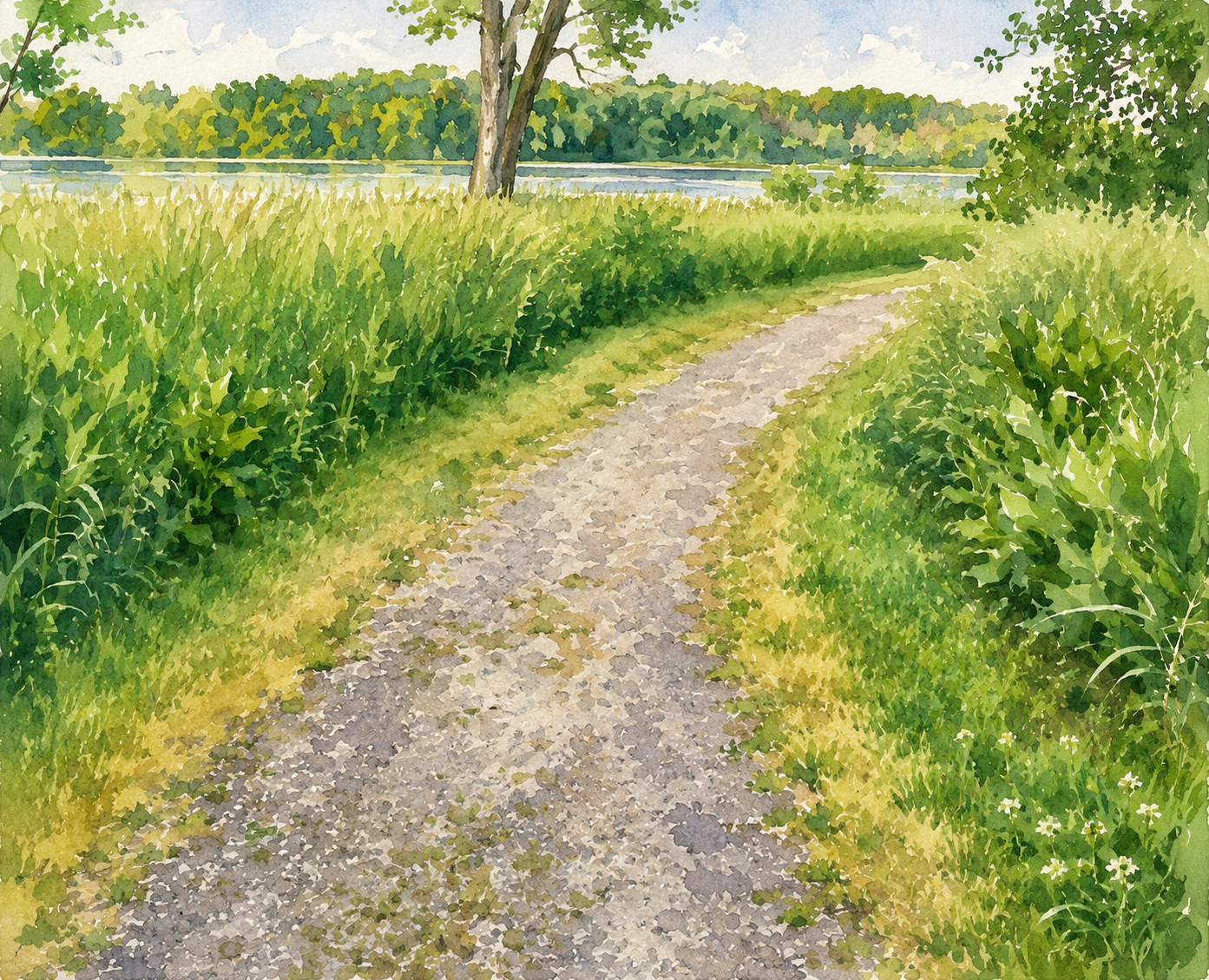

It has been a rainy week. Too much moisture in the garden to plant, and constant showers to keep me inside. When the weather is like this, I make a point to find space between rain clouds and get in my 30-minute daily morning walk. A two-hour rain delay is typical.
When I finally got on the trail, I took this photo. There are two geese. The one on the left is ducking its head in the water while the other keeps watch. I don’t usually see them this close to shore.
While waiting for the rain to end, I emailed U.S. Senators Chuck Grassley and Joni Ernst to vote no on HJR 140 which pertains to opening the Boundary Waters to foreign copper mining. It took a couple of minutes. Here is what I said:
I urge you to vote NO on House Joint Resolution 140, the Congressional Review Act targeting the Boundary Waters mineral withdrawal. The Twin Metals mine is owned by a foreign company that has an agreement with China to smelt the copper in China for free — and China gets the copper. The United States gets nothing but the pollution. No United States Senator should support this anti-American bill that would allow China to pollute our most treasured wilderness to gain a competitive edge over us. Please stop it by voting NO.
Bread on the water. The resolution needs only a simple majority, which if they get it, Poof! The Boundary Waters are open to mine runoff. That is, after the inevitable lawsuits end.
On Thursday, the Senate approved the resolution in a 50-49 vote, so folks are lawyering up.
One day this week a beaver was swimming a few yards off shore. They are common in the area and occasionally cut down trees along the lake shore. I have also seen mink on the trail. It reminds me of a time when natives trapped fur-bearing creatures to trade with white people. Typically that was in autumn.
I once visited the House on the Mound in Prairie du Chien, Wisconsin, built by Hercules Dousman. He managed trading operations for John Jacob Astor’s American Fur Company in the Upper Mississippi Valley. The Victorian-style home was luxurious by any standard. It was called the house on the mound because it was built upon an ancient native burial mound. Dousman flourished on the Wisconsin frontier. “As a fur trader, railroad builder, grain-shipper, he became the most influential figure of the upper Mississippi Valley and the Midwest’s first millionaire,” wrote August Derleth in his 1958 book The House on the Mound.
The beaver I saw seemed unaware of the value of its fur.
If we look closely, there is evidence of lives lived long ago all around us. I used to go with a friend to Palisades Kepler Park near Mount Vernon to climb the bluffs overlooking the Cedar River. I don’t do rock-climbing any more, but I used to enjoy it. On top of those bluffs were Native American burial mounds.
According to Google search results, “The Native American mounds located along the bluffs, represent the prehistoric Woodland Indian culture. These sacred sites include conical and effigy mounds that are often knee-high, with some reaching up to six feet, serving as a reminder of early indigenous habitation.” The burial mounds are some of the last remaining in the area. So many of them were turned into farm land, or like the House on the Mound, built upon by white settlers.
Whether it is waiting out a rain delay or observing our habitat, it is easy to feel connected to nature, and to civilizations that went before us. We forget that Iowa wasn’t always a grid of farms, towns and cities. There were woodlands and prairies, and pure springs flowing within walking distance of where we built our home. On days like this I can imagine the grid being lifted, then walking this land like Natives did in the 17th and 18th Centuries. I live for that imagining. It can be who we are.
You must be logged in to post a comment.