If it seems impossible to curate my life-long collection of analog and digital photographs, that’s because it is. My presumption is of making a useful archive for others to use when I’m gone. However, that is an old school idea poorly aligned with the way photographs have come to be used. I am fine with sharing photos via social media and email. I also believe they have more than transient value. This is at the core of my struggle to make progress in curating my photographic work.
I am interested in technology. My maternal grandmother participated in photography culture and bought a Kodak Brownie and Instamatic 126 at the local drug store. She developed her exposed film at the same drug store. It was a creative outlet for her, creativity being something her family discouraged when she was young. When she asked us to pose in our Easter best clothing, how could we refuse? She had the camera and wanted to preserve the moment. That felt important.
In college, I experimented with a Minolta SRT-101 I bought from one of my band buddies. I got away from posed photographs to the extent possible and captured where I lived, both in my residence and on day trips to neighboring places. I bought a small 35mm camera and a dozen rolls of film to take on my 1974 trip to Europe. When my backpack was stolen in France, I lost all the film and ended up with only two rolls to develop after three months away. When I bought a mobile flip phone, I took a few photographs with the built in camera, notably one of Senator Barack Obama at the 2006 Harkin Steak Fry. In 2008, I bought a Kodak EasyShare digital camera, and then when I converted to a smartphone in 2012 the smart phone became my primary photographic method. There is a whole story in technology. My experience since the 1950s is likely not that different from other amateur photographers in my cohort.
The cultural aspect of my photographic history is more interesting. I was able to own a simple camera because I had an income from delivering newspapers. I became the person in the family called upon to record an event when Grandmother was not available. My early photographs are packed with domestic images of holidays and birthdays, vacations, and the stuff in our lives like pets, houses, cars, and more. In high school, I worked part time at a department store and had means to use photography. I accumulated photographs in shoe boxes and a few albums. Mother had a short filing cabinet on wheels where all of her photographs migrated. Photography has always been a simple, affordable, and happy thing to do. There was always a half life of attention given to photographs. However, we couldn’t bear to get rid of them.
To some extent, my photographs are a visual record of how I lived. At the same time, I have been journaling since 1974 and have given more thought to what I wrote than I did to photographs. As I write an autobiography, I decided to use only one photograph in the first book, and am not sure whether or how many I might use in the second. To avoid consideration of photography as part of my life would be decidedly wrong.
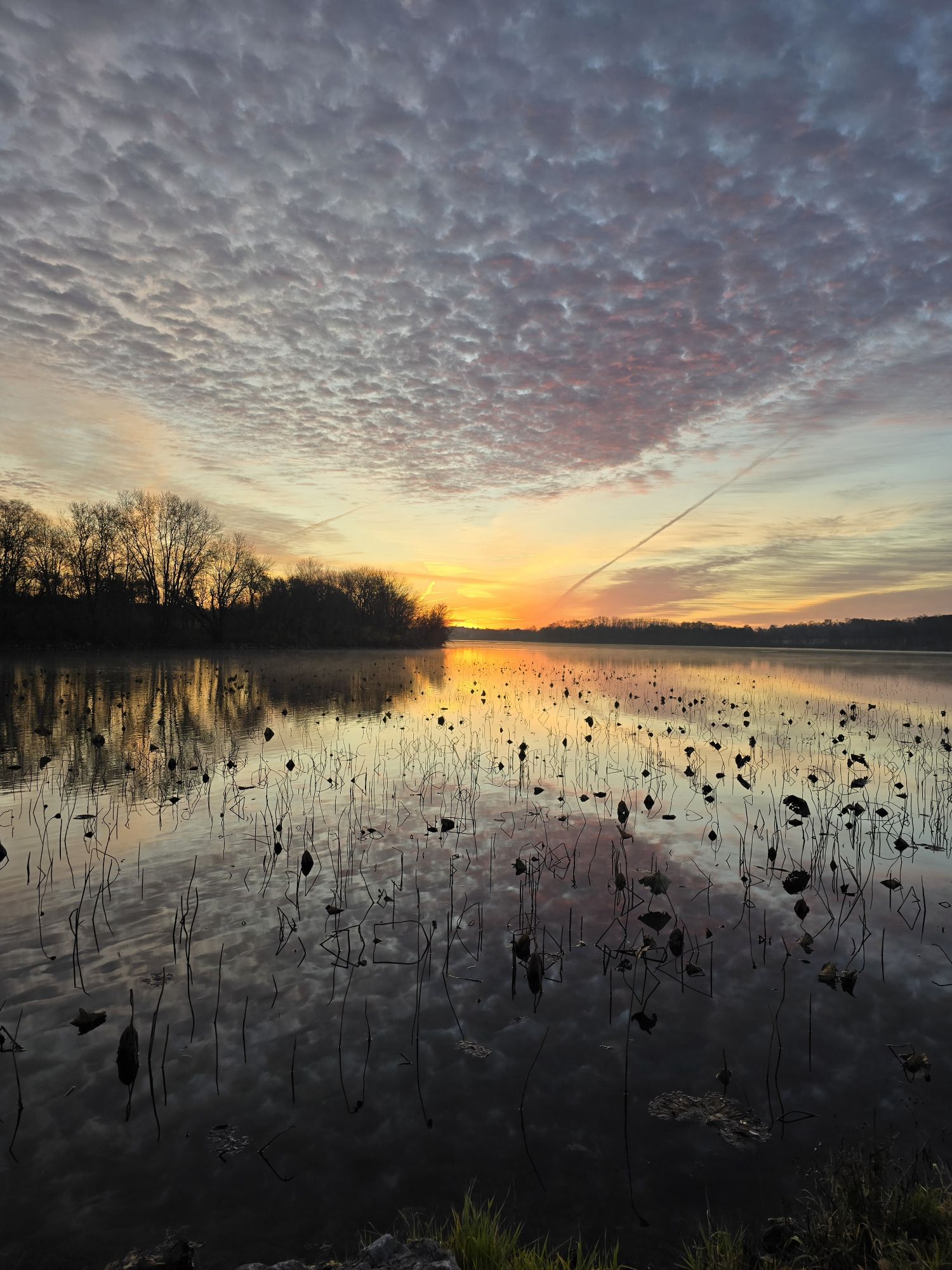
Social media changed how we use photographs. With digital cameras and smartphones, photographs have no operating cost other than the time and attention paid to them. When I take a photograph like the sunrise in this post, I make multiple exposures and edit them to pick the “best” one to post. This form of curation was not easy in analog photography, yet is basic to posting photographs on social media. I archive all my saved photographs on the cloud, yet seldom go back to them.
On social media, we get to know people a certain way. For example, on BlueSky, the 99 accounts I follow post photos and create an account ambience I came to recognize over time. This is a real thing, yet not the same as having an in real life relationship with a person. I submit I have a different relationship with someone I know in real life as compared to their social media account. Both seem valid.
Photography in 2025 does not entail a lot of curation. We take photographs, briefly edit and share them, and then forget them. Seldom do we have a processor make prints. I’m okay with that. When I curate four photos for a post on social media, that suffices to sate my urge toward a creative life. Maybe I will use the same photographs in a blog post, or maybe not. I want to believe there is more to this creative process as I look at thousands of images captured over a life and work to define their meaning and gain insights. Because of my current autobiography project, I am willing to devote time to photography. I continue to believe the words are paramount.
Will I end up with a usable archive? It may seem impossible now, yet I hope it ultimately isn’t. Figuring this out is just another part of my life.
 Journey Home
You must be logged in to post a comment.