When a group of men gathered at the Rock Island home of George Davenport in 1835, they had a mind to purchase land and lay out a town on the Iowa side of the Mississippi River. With native tribes removed, something needed to be done with the land, or so they believed. By any measure, the enterprise was a commercial venture in a relatively optimal, if arbitrary location. Its lackluster beginnings would haunt the city until I was born more than a century later.
In Spring 1836, Major William Gordon surveyed the place that would become the City of Davenport. He and his business partners, including George Davenport and Antoine LeClaire, offered a sale of lots to a party from Saint Louis who had been transported by steam boat to participate in a two-day auction. Sales were much less than expected. The sellers did not have clear title to the lots at the time of the sale and that likely contributed to poor sales.
There was never a question Davenport would be settled by non-natives. As original forests were clear cut upstream, and rafts of logs floated to river towns on the Eastern border of Iowa, there was money to be made. The lumber business was profitable, yet not sustainable. It was one more instance of profiteering in the city’s history.
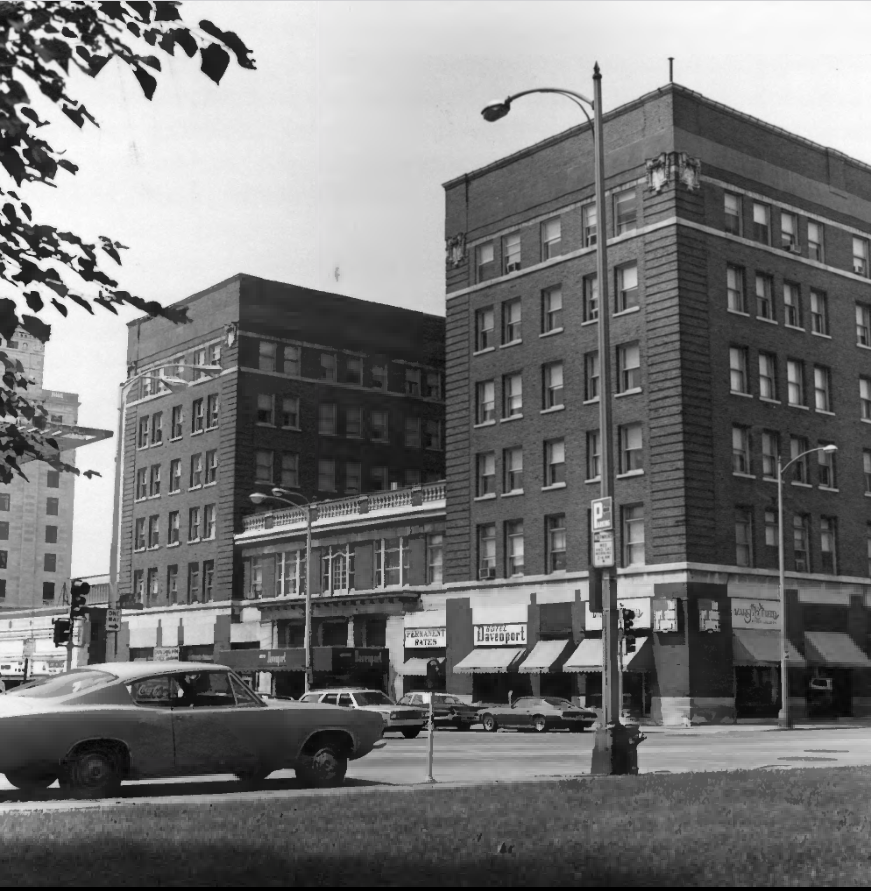
The lumber business gave rise to the railroads. When the Davenport Hotel was constructed in 1907 it was situated equidistant between the two major rail stations in the city. “Erection of the Davenport Hotel inaugurated a period of building that would bring Davenport’s central business district fully into the era of the ‘tall buildings,'” according to the National Park Service website. Other tall buildings were built around it, including The Dempsey Hotel (1913), The Blackhawk Hotel (1915), The Davenport Bank and Trust Company Building (1927), and The Mississippi Hotel (1931).
Temple and Burroughs Architects created the Davenport Hotel building in the Renaissance Revival style. The structure was an important feature of the city’s commercial center. Located in Antoine LeClaire’s first subdivision of Davenport, one couldn’t get more center city. As commercial needs changed in downtown, some of the tall buildings were converted to housing. My maternal grandmother lived in government-subsidized housing in the Mississippi Hotel for many years.
The May 28, 2023 collapse of part of the Davenport Hotel building should be a wake-up call for city governments everywhere. The response of the City of Davenport has been as lackluster as the city’s founding. What seems obvious today is these tall buildings are getting old and literally falling apart.
At least there is political hay to be made in this national story. Florida Governor Ron DeSantis just announced he will send a crew to Davenport to help in the recovery of the building collapse. Is it a coincidence he is also vying for position in the 2024 Iowa Republican caucuses?
There may be dollars to be made from old building stock. City staff needs to energize and make sure none of the other tall buildings in the commercial district collapses while developers pursue the almighty dollar. History has shown, they are likely to nod their heads toward developers and let the action play out as it did last month. What a sorry way to run a city.
 Journey Home
One reply on “District of Tall Buildings”
The number of “soft mud” buildings throughout Iowa should give pause, no matter how tall they are. “Soft mud” refers to local brick that was not adequately fired in a kiln. (reaching temperatures to make the brick impervious to water). Often tempered with grass, the clay was filled into wooden molds, left to dry and then stacked around a pile of wood and covered with even more wood and set on fire. When the fire cooled the “brick” was seperated into two catagories, facing brick that was straight and not too discolored for exterior walls and the rest for interior walls that would be hidden behind framing and plaster and lathe. Nether varieties will stand the test of time or the ravages of rain and other sources of water. It is not uncommon to have a raw soft mud brick wall three foot thick and have a driving rain push water all the way through it! often times you will see these types of walls painted to keep that from happening, but it only lasts as long as the paint can stick to the brick itelf, which isn’t long! Many communities have no building codes that adequately address the potenial failures of this “building material” and like ticking time bombs, line the streets of many a small town. Something to think about that this failure in Davenport may help bring to light. The direction of the Republican legislature seems to focus on political who ha that makes little sense and better sound bites, I have my doubts it will ever come up!
LikeLiked by 2 people