Categories
Living in Society

Sunrise at Autumn’s End

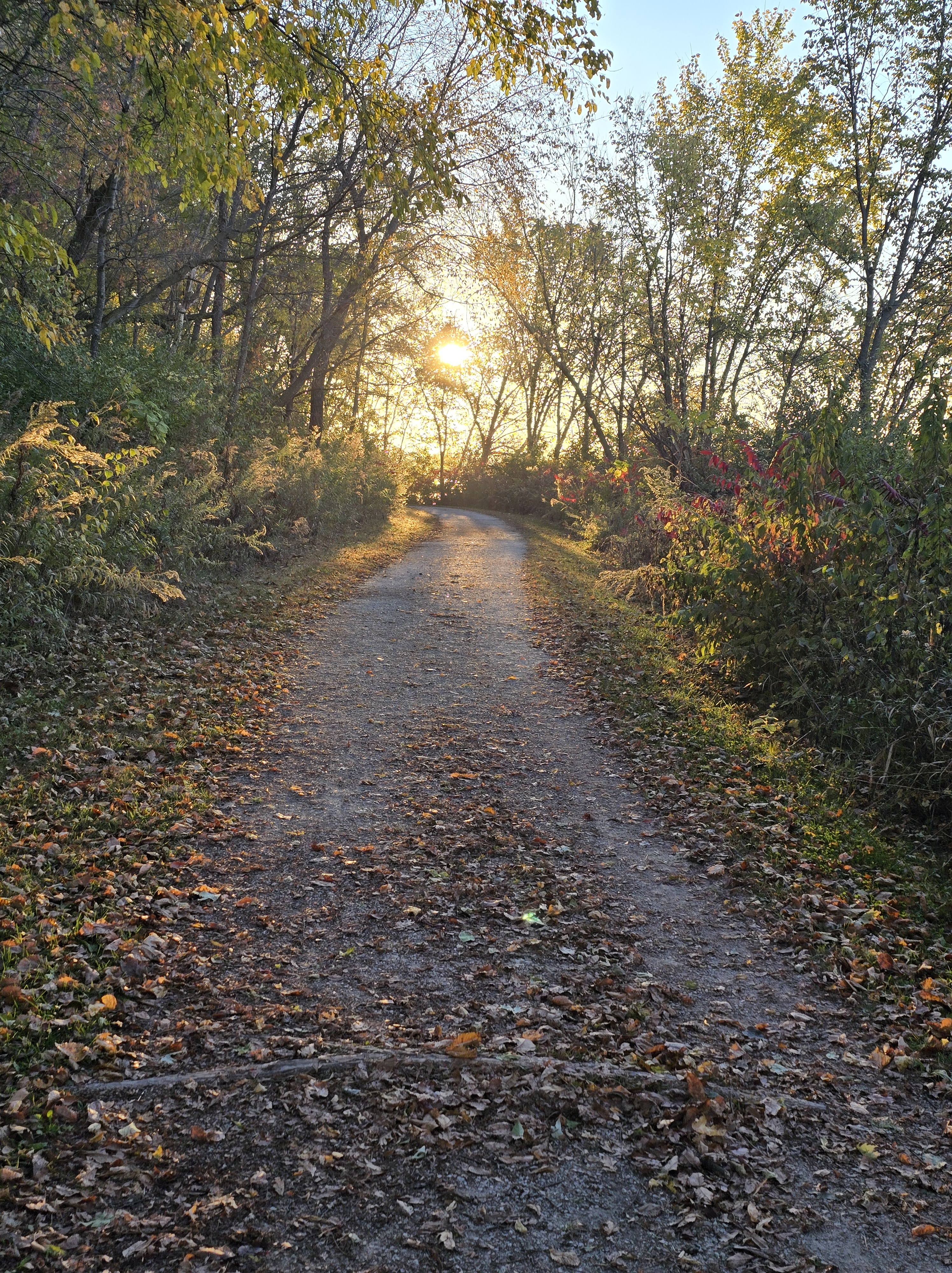
Sunrise on the state park trail on Dec. 9, 2025.

Everyday I am out in the weather for at least part of the day. This December has been weird with heavy snowfalls coupled with spells of above freezing ambient temperatures. The talk on the trail is about how the trail surface varies with snowfall and temperature. We are all of retirement age so our concern is testing new muscles and stress on our ankles and joints. Thus far I have been able to navigate rough surfaces without mishap.

The outdoors temperature was 37 degrees Fahrenheit when I woke. By the time I was ready to walk on the trail it had dropped to below freezing. As I entered the state park, the wind picked up and snow began to fall. The trail surface had frozen unevenly around snowmobile, wildlife, and pedestrian tracks. I had to be careful to preserve my joints and ankles. I knew the weather forecast before I left home.

I’m not the only one who takes accurate weather forecasts for granted. My resource is the Weather Channel with its hourly forecasts and radar images. Mostly I seek short-term weather forecasts in order to do something like mow the lawn, take a walk, or work in the garden. Existing technology gives me accurate forecasts that facilitate what I want to do.

Hannah Ritchie is a Scottish data scientist, senior researcher at the University of Oxford, and deputy editor at Our World in Data, according to Wikipedia. Her work focuses on sustainability, in relation to climate change, energy, food and agriculture, biodiversity, air pollution, deforestation, and public health. She recently wrote the following about weather forecasting:

The potential for AI to improve weather forecasting and climate modelling (which also takes a long time and uses a lot of energy) has been known for several years now. AI models have been tested for one- and two-week forecasts with promising results. Scientists will often need to wait weeks for a complex, high-resolution climate model to run; AI might be able to do this hundreds, if not thousands, of times faster. (Email from Hannah Ritchie on Oct. 27, 2025).

Naturally, I asked ChatGPT about this, “When scientists like Hannah Ritchie say weather forecasting can be much improved with artificial intelligence, what do they mean.” As is usual for artificial intelligence, the answer was very long. Here is the crux:

When scientists say weather forecasting can be dramatically improved with artificial intelligence, they usually mean something more specific than “AI makes everything better.” They’re referring to concrete technical bottlenecks in current forecasting and the ways AI can overcome them. Hannah Ritchie, and researchers at ECMWF, NOAA, Google DeepMind, NVIDIA, the UK Met Office, and others, are all pointing to similar developments. (ChatGPT query result, December 2025).

More specifically, in explanation, the machine listed multiple bullet points:

  • Weather prediction is limited by physics-based models.
  • AI models can “learn the atmosphere.”
  • AI lets scientists blend physics and data.
  • AI makes weather forecasting more democratic. By that, it means cheaper and more broadly available than on expensive, physics-based computers.
  • AI enables longer-range and global risk forecasting: seasonal climate forecasts, agricultural and drought planning, energy-grid load forecasting, and catastrophe-risk modeling.
  • But: Scientists emphasize that AI is not a replacement for physics.

The machine summarized: forecast faster, forecast at higher resolution, run at vastly lower cost, improve extreme weather warning lead times, complement physics with learned patterns, and democratize forecasting globally.

According to the machine, consumer-scaled artificial intelligence models might be available by 2032. In the meanwhile, I’m just glad I didn’t turn an ankle on the trail this morning.

Categories
Living in Society

Living with AI

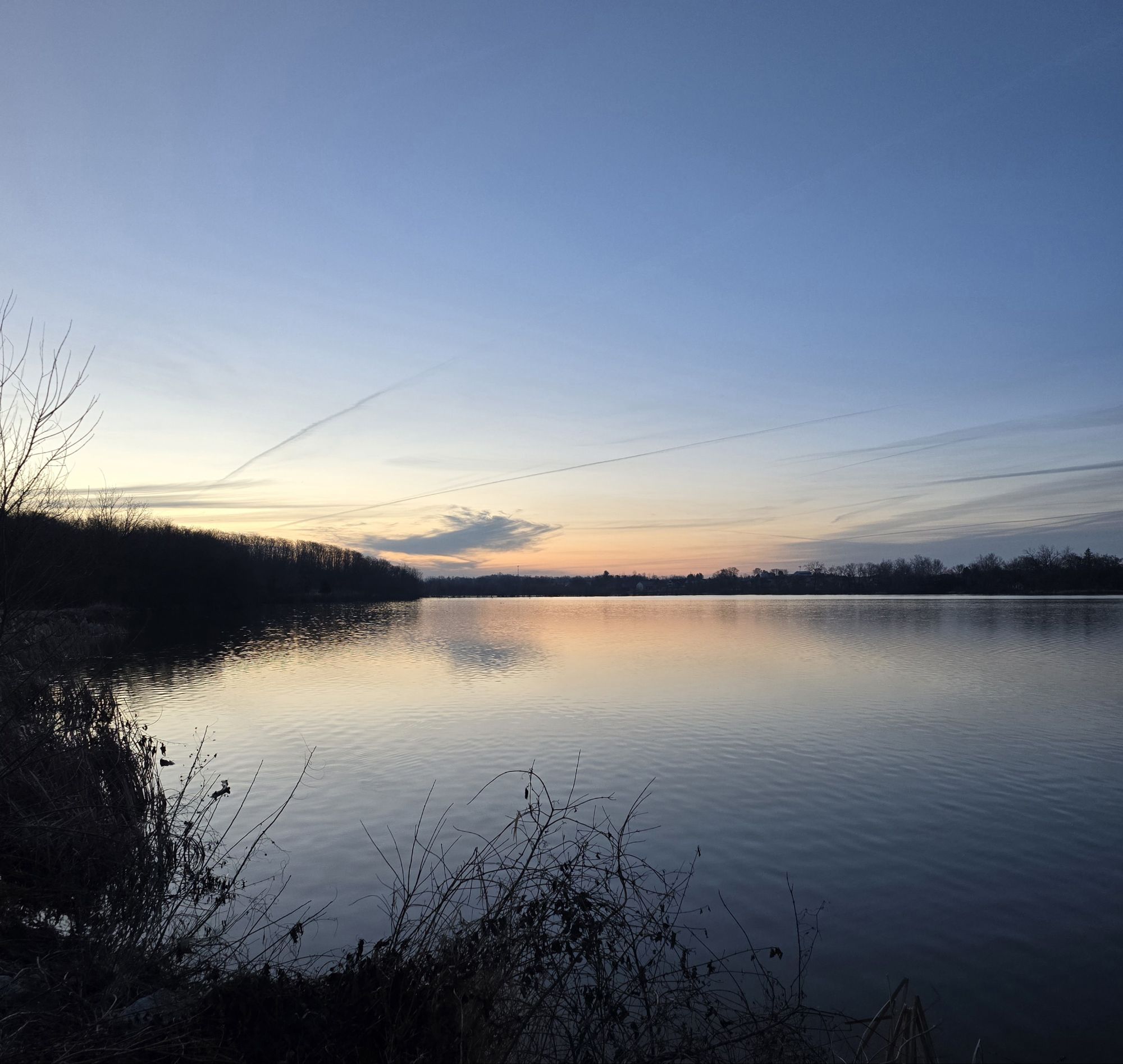
Analog sunrise on the state park trail.

It seems clear we will have to live with artificial intelligence, like it or not. As Scottish data scientist and senior researcher at the University of Oxford Hannah Ritchie posted on Monday, “AI could really change things. It has the potential to not only improve the accuracy of (weather) forecasts but also to run them more quickly and efficiently. That then makes them better and cheaper.” Okay… I’m listening.

At the pre-2025 National Oceanic and Atmospheric Administration, weather predicting got very good. I could look at the weather radar on my computer, identify where the storms were going and with what intensity, and then figure out how much time I had to mow before rain started. Because of great weather forecasting, I was almost never wrong. How much better can it get? With the administration’s cuts to NOAA, the machines may be necessary to continue progress, and according to Ritchie, it looks like they have the potential.

For me, the AI game changer has been organizing basic life tasks. On Oct. 10, I wrote:

I’m four days in using AI to help plan a more productive day. With its “Balanced Day Plan,” I immediately eliminated a background concern that there is too much to do and not enough time in which to do it. I am fond of the saying an air traffic controller can only land one airplane at a time. So it is with tasks I have before me. AI finds a way to get it all into a day. If it can’t, it tells me. This serves as a stress reliever, helping me focus on the task at hand, and I do a better job with it. For example, I need to drink more water to stay hydrated. …This pursuit is just getting started and my best hope for AI lies herein.

From there, my life has taken wing. It is curious what a tonic eliminating worries can be. While AI has been great at getting my organizational juices flowing, I have already come to a high water mark with the machine, and from here I can proceed on my own.

I took the “Balanced Daily Plan” and translated it into language that fits in my world. I updated my existing, pre-AI Daily Plan to include the most salient points identified by AI. I was concerned about adequate hydration, so I highlighted in blue some words where my new hydration schedule would occur. I generalized the pomodoro work block process, with three blocks in the morning and two in the afternoon. I was careful to create plenty of space to do necessary tasks and recover once they were done. I decided to move to the kitchen about 3 p.m. and work there until dinnertime. AI helped me to recognize how a day could be structured, something I was not doing with any effectiveness on my own. Now that I re-wrote my regular schedule, I am free to go on my own, and will.

During the pandemic, stuff had a way of accumulating without being adequately addressed. This includes all of the areas in which I work at home. Think of the basics: food, shelter, and clothing. Each of them was a disorganized space where I had no idea what was possible. I got bogged down by stuff accumulated in each area. To get started, I queried AI about the vast quantity of t-shirts scattered throughout the house. The machine result helped organize the collection enough to know what I could be wearing for different purposes, and store the ones not in immediate use in labeled boxes. That had been hanging over me, yet by using AI to do the project I relieved stress and worry about it.

From here it became easier. I cleaned out the refrigerator and found a vast quantity of pickled items. Unaware, I overestimated how many pickles I could eat in a year. The pickled vegetable situation got away from me. I did not use AI for this sorting. The t-shirt project had primed the pump for any type of organizational project. Now I look for those projects to fill some of the space outside pomodoro blocks. This will apply to my workshop, writing space, the kitchen, garden, and all of the defined spaces in our home. This is what I mean when I say my life has taken wing.

AI is not going away. I expect to use it as a tool when I find a project puzzling, poorly designed, or inadequately resourced. No one knows the future of AI despite all the public rhetoric. It is far from easy to use and keeps crashing on what I believe are easy tasks. For the time being, it is one more tool in my workshop to help make life better. That and a few pickles to snack on and I can make it a day.

Categories
Living in Society

Stormy Weather

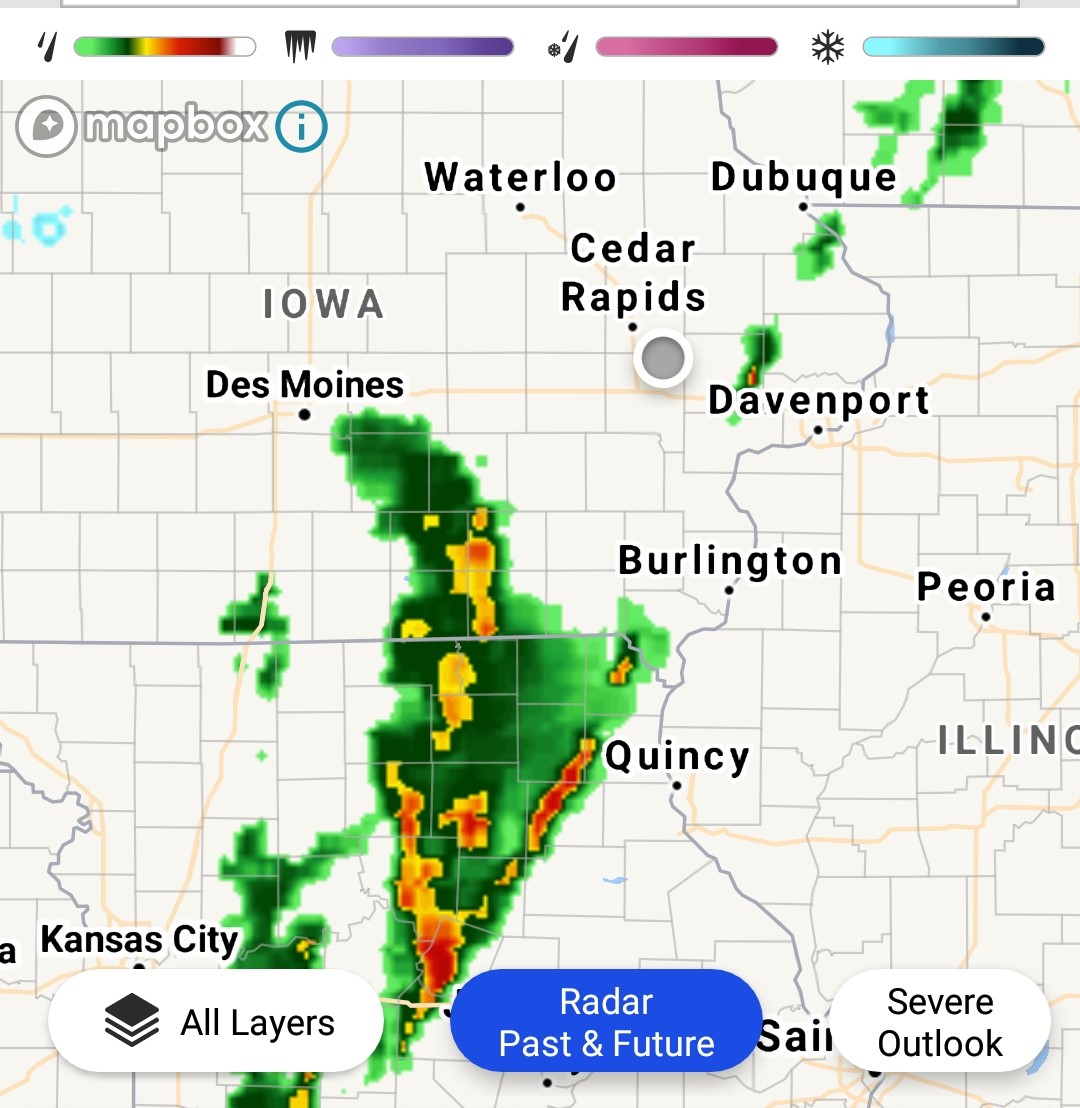
Screenshot of weather forecast on April 4, 2023.

Iowa Valley Habitat for Humanity reported their warehouse in Iowa City was destroyed by a tornado. They sent this email yesterday:

As a result of the March 31 storms that brought tornadoes through towns across Eastern Iowa, our 5,760 square foot warehouse used as the main storage space for our construction tools, supplies, materials, safety equipment, vehicles, trailers – everything necessary to build and repair homes – is a total loss. At this time, we have no plans to stop building and improving homes, especially now that our neighbors impacted by the storms are in need of home repairs. To continue this critical work without interruption in our services, IVHFH is looking to the support of the Iowa Valley community to raise funds and rebuild the Habitat warehouse.

Habitat for Humanity is an organization full of good people and volunteers doing good work. I volunteered on a couple of projects and the spirit of teamwork is infectious. If you can help them, they made a website to donate or volunteer here.

Even though the main lines of storms blew through here during the last five days, we were unscathed.

My first weather learning experience was in the military. When traveling around West Germany in formations of armored, tracked vehicles, both current and forecast weather mattered a lot to operations. Weather reports came down from on high, although from how far up the chain of command, I’m not sure. I remember being near Baumholder, in a tent on a hill, with 20 degree below zero ambient temperatures. The S-2 intelligence officer cradled a telephone receiver in a machine that wrote a facsimile of weather maps on a roll of thermal paper. Mostly, we were interested in precipitation forecasts before maneuvers.

Ever since, I tried to learn about weather forecasting in a basic human way.

The amount and types of free weather information available today is remarkable. It is also easy to use. Once one understands prevailing wind direction and how to read a radar map, it is relatively easy to plan around storms. The more I look at actual weather and compare it to radar, I gain a sense of how the large bodies of water around us impact storms. This is particularly useful when a storm is coming and the lawn needs mowing. A few clicks of a mouse on the computer screen and a person will have a good idea whether an hour’s outdoors work can be finished before rain falls. It’s a great feeling to see the first raindrops just as mowing is finished and I’m heading for the garage.

We have a safe place on the lower level of our home where multiple load-bearing walls intersect. When a big storm is coming, we move a chair there and bring a laptop to follow the storm. We don’t have a permanent space, like a storm cellar and don’t need one.

If you can spare some change, I hope you will help Habitat for Humanity rebuild their warehouse. Here’s the link.