BIG GROVE TOWNSHIP, Iowa — The ambient temperature dipped below zero degrees overnight, signaling the arrival of the polar vortex. Soon it will be time to prune the apple trees — most likely next weekend.
I worked a door knocking shift for the Hillary Clinton campaign on Saturday. While a lot of people weren’t home, those who were are ready for the 2016 general election campaign.
It was unanimous the Democratic party must work together to elect the person nominated for president at the Democratic National Convention the week of July 25, 2016.
At three weeks until the Feb. 1 Iowa political caucuses the tenor of this year’s build up has been much different from past cycles.
One person professed to be in throes of existential questions about the future of our country. He was an outlier. Everyone else was confident about for whom they would caucus and why. My targeted walk list identified Hillary supporters and some Bernie leaners. To a person they recognized a need to prevent Republicans from winning the White House. I invited Hillary supporters to seek me out at the caucus, and encouraged the rest to participate and then unify behind our candidate for the fall campaign. It was a much easier sell than in previous cycles.
My interactions with campaign staff and volunteers for the three remaining Democratic campaigns has been professional at a much higher level than in previous cycles. Partly there is a professional class of political consultants, activists, fund raisers, corporate media correspondents, bloggers and supporters that has matured. These folks have stepped up their game with systematization of the process of identifying and building supporter networks. The rest of the change is that with money in politics, each of the campaigns has effectively reached out to voters, and mostly in a professional manner which is the result of specific training. This cycle’s presidential primary campaign has been like the roll out of a new project by a giant corporation, and that includes the Bernie Sanders campaign which eschews corporate influence. The end result has been a modern democratization of national politics.
With the increased use and maturity of social media in politics, I’m finding commonalities between people that no one specifically engineered or engendered but will influence the fall campaign and the next presidency. Much of what I’m seeing is good news for Democrats, and better news for our country.
I told the outlier he’d better stick with the Democrats if he wants any of his priorities to get worked on in Washington. He smiled at the prospect of that.
When our family lived in Indiana, the 1988 Democratic nominee for president was mostly decided when our May 3 primary arrived. Michael Dukakis had been dominating previous primary contests and was expected to get the nod for president. He did.
If I voted in that primary (don’t remember) it was a harbinger of what I felt on election day, basically what the f*ck? It seemed futile to vote for a candidate I hadn’t supported and didn’t like. At the same time, living in a Democratic county, I wasn’t about to pull the lever for a Republican. George H. W. Bush trounced Dukakis 426 – 111 in the electoral college, winning Indiana and 39 other states.
In Iowa we hold the first presidential nominating event — the Feb. 1 Iowa caucuses. I like the early attention, but less so each cycle. The 2016 contest has been about whether or not to ratify Hillary Clinton as the Democratic nominee. She has not wavered in her effort or in polls conducted in Iowa, making this the most lackluster Iowa caucus cycle I can remember. Clinton is not inevitable, but her campaign’s strategy, tactics and discipline make it hard for her to lose in Iowa. The campaign is trudging its way to a caucus win, with the saving grace being the large number of young, energetic and enthusiastic people helping organize the effort.
A professional class of political consultants, activists, fund raisers, corporate media correspondents, bloggers and supporters has evolved. At each announcement of a new supporter, there is a discussion of whether that person is a significant “get” for the campaign. The rise of this new class of operatives, many deriving a living from politics, has been because of unlimited money in politics. Money feeds the professional political class which is inflicting the body politic like a cancer. The Democratic process has become about winning elections.
Elections matter, but like the professional political class feeding on our Democracy, a sole focus on elections is problematic for our long term political health.
U.S. Speaker of the House Paul Ryan mentioned the Democratic focus on elections in his Dec. 3 Confident America speech.
“Maybe the way to win the debate is to play identity politics, never mind ideas,” Ryan said. “Maybe what you do is slice and dice the electorate: Demonize. Polarize. Turn out your voters. Hope the rest stay home.”
While Ryan is supporting a conservative agenda with this speech, and Democrats I know focus on governing as much as elections, what he said describes exactly what Republicans are doing in Iowa more than Democrats.
What I miss most about Iowa politics is the chance to build the community where I live. It has been difficult to do so in campaigns with which I have associated since 2004. The hindrance has been the data analysis method of targeting caucus-goers or voters, and the necessary exclusion it breeds. The Iowa Democratic Party is not about community building in a geographic sense. It is about building coalitions of whoever will join together with us to win elections. To say I despise it is an understatement.
Whatever issues I may have with the Democratic Party, they are not the reason Iowa should ditch the caucuses. It’s because candidates roaming free-range around the state has served only slight useful purpose. It has been harmful to the Iowa that elected candidates like Harold Hughes and Robert Ray.
There is an economic benefit of having 20+ candidates campaigning in Iowa, but less than one thinks. Brianne Pfannenstiel posted an article at the Des Moines Register recapping candidate spending this cycle.
“Despite Iowa’s outsize influence in the nation’s presidential nominating process, political spending is still funneled primarily to coastal states, which house major political consulting and advertising firms,” Pfannenstiel wrote. “Iowa accounts for just three percent of the $153.3 million that presidential campaigns have spent so far this cycle, filings with the Federal Election Commission show.”
The amount is much less if one removes fees and salaries paid to members of the Iowa professional political class. The Iowa caucuses are not about economic impact, as facts in the article demonstrate.
For the most part, the Iowa caucuses are about party building. If you think having as many as 20 non-presidents wandering every restaurant, gas station, gymnasium and legion hall isn’t having an impact on what Iowans believe about politics, think again.
There is little chance President Santorum will undo the Obama legacy because there is zero chance of him being president. What he, Mike Huckabee and others polling less than five percent do is build the culture of party politics in a corrupting manner. It reinforces what people already get from mass media. Minority and fringe views are depicted in media as being acceptable as media corrupts.
Candidates seek supporters to build their respective campaigns. There are few better examples of the deleterious effect of this than this headline and story by Jill Colvin and Bill Barrow of Associated Press, “Trump backers baffled by criticism of his Muslim proposal.”
When we open the state to all political comers, candidates who still poll in the asterisk range have been given serious coverage in corporate news outlets and blog posts alike. There is no sacred responsibility to cover the presidential aspirations of candidates like Lindsey Graham, Carly Fiorina, Lincoln Chafee or Jim Gilmore. That they travel Iowa is to our detriment. Attention given them is time we could focus more productively.
While I grumbled about my choices in 1988, I knew I was a Democrat and that gave me standing in my community. What is heard today is a plethora of weird views with serious and flaky mixed together in a jumble. Politics is like Chex mix gone wrong. Activists and advocates say we should ask “serious questions” of candidates, but there is little use of asking any question of most of these candidates. After all, we are not on a fact-finding mission to fill our grocery cart.
The benefit of holding the first in the nation caucus is much less than we think. More than that, it is corrupting Iowa in a way that has yielded us more conservative elected officials including Governor Terry Branstad, Senators Chuck Grassley and Joni Ernst, and Representative Steve King. That’s not the Iowa I want to see, and rethinking our role in presidential politics is important to making a change.
Any useful discussion of guns in society is personal.
Frequent shootings have been reported in nearby Cedar Rapids, often in the neighborhood where we lived when our daughter was born. We heard gunshots while we were there. Most times a weapon was discharged with no one injured and no subsequent news story. The main reason we moved was not the presence of guns, but to find a rodent-free rental home in which to raise our daughter.
At the shopping mall in Coralville where I buy button-down shirts, neckties and dress slacks, a man shot and killed a women near her workplace at the Iowa Children’s Museum on June 12. The murder appears to have been premeditated. This and other shopping mall shootings are a constant reminder of the peculiar risks of our consumer culture.
When I hear about shootings, it often takes the form of an anecdote. Like the Nov. 27 incident in which a man was asked to stop smoking by a restaurant employee in Mississippi, and then shot the woman dead. If you’ve never been to a Waffle House, like the one where this murder occurred, I recommend it. The counter is close to the kitchen and it is hard not to get involved in the drama acted out between customers and staff. There was drama at all the Waffle Houses where I dined.
What to do about the increasing number of firearms discharges in populated areas and public places is an open question our society won’t ask with any seriousness. By serious, I mean addressing the related political, regulatory, Constitutional, educational and public health issues in a way that would reduce the frequency of shooting incidents and the number of people killed and injured in gun violence. If we don’t ask the question it won’t get answered.
As a soldier I trained on every weapon in our company’s inventory from personal weapons like the Colt 45 revolver and the M-16A1 rifle, to mortars and the TOW anti-tank missile system. I became an expert marksman and have the badge to prove it. When I left the Army I checked my guns at the arms room and never looked back.
The existence of guns and weaponry in society is not our American problem. How they are used and regulated is.
Guns are regulated — just go to a gun shop and try to buy one. Changing regulations to address gun violence in mass society seems a logical way to address the problem — a no-brainer. A large majority of Americans would support tightening regulations with simple solutions like restricting gun purchases by people whose names appear on government terrorist watch lists. There is also broad support for universal background checks, such support blocked by a few vociferous pro-gun advocates.
There is a black market in gun sales and an active off the books exchange of weapons between friends and family. Criminals and terrorists will always be able to locate some of the hundreds of millions of firearms in the country to do their malevolent deeds. That is less the issue.
There is a lot of stupid stuff going on: things like keeping loaded weapons where toddlers can access them. Reasonable people who own guns take appropriate action to keep guns safely, or at least out of the hands of toddlers. We all need to stop doing stupid stuff, and media should develop common sense in reporting gun violence.
The media, both corporate and social, is culpable in gun violence. As data journalists Ritchie King, Carl Bialik and Andrew Flowers pointed out yesterday, mass shootings have become more common in the United States, but overall, gun homicides have decreased. If the Cedar Rapids Gazette writes a story about every reported gun discharge inside city limits, the issue of gun control would be escalated to higher importance than when shootings were commonplace in my family’s neighborhood — background noise while living in a rodent-infested area. There are few ledes to gun stories that capture the broad issues of what happens when our educational system is underfunded, mental health care is inadequate, people fear loss of Second Amendment rights, and politicians won’t take action to fix obvious problems with gun regulations. How writers spin this matters and the stories are spinning out of control.
Personal responsibility, while lacking in large segments of society, would be something, but it is not enough. As Tracy Leone posted after the recent San Bernardino, Calif. shootings,
Prayer is for church. Congress legislates.
— Tracy Leone (@LeoneTracy) December 3, 2015
It is time for elected officials to act to reduce the frequency and severity of gun violence. We need to coach them in this as they need it.
In the meanwhile, we live our lives as best we can with the ubiquitous presence of guns, shopping in the mall, and engaging in the drama of everyday life, all the time understanding that if we don’t follow the golden rule, our chances of avoiding gun violence decrease.
On Thursday I made the last garden harvest and brought the water hose inside the garage. Snow began to fall yesterday around 5:30 p.m.
I am writing and waiting for daylight to shovel the driveway.
More is changing than the weather. I started a new, full-time job at the home, farm and auto supply store Nov. 12. All other paying work ended. The coming weeks will be a time of figuring out how to make the rest of our revenue budget while supporting my writing. I’m beginning again, which is much different from starting over.
A political organizer from the Bernie Sanders for president campaign found me yesterday and emailed a canvass. Email is impersonal, and I don’t recognize the canvasser as being from our precinct. I responded with my lack of support for Sanders. She wanted to know more. Instead I emailed I was on a hiatus from politics until after Jan. 1, 2016. That’s as true as is any effort to divorce oneself from politics.
I’ve been more concerned about my writing. Specifically, whether I should continue to publish for free. This blog, and others, help me practice the craft. The same can be said for my newspaper writing, except the difference was having an editor. An editor helps improve the quality of work. At what point does this editor-less, non-paying work become less relevant? I don’t know.
The project on local food slowed with my new job. I’ve written a lot about agriculture, gardening and food, so there’s material for a memoir. Some figuring out of life, work and play is required before taking it up again.
Everything is in between. Crossing the line to a new construct is possible with the new year, spring latest.
There is snow to shovel and a shift at the supply store. Those things take precedence in this moment.
Drake University Photo Credit Cedar Rapids Gazette
The winner in last night’s debate at Drake University’s Sheslow Auditorium was the American people as Hillary Clinton, Martin O’Malley and Bernie Sanders discussed, and actually debated issues that matter. This is in sharp contrast with the multi-level Republican debates.
Only 700 people had tickets to attend, so I closed the door of my study, put on my headphones and shut down all browsers except the CBS live stream. I took notes using Microsoft Outlook.
It is ironic that Twitter, a debate co-sponsor, was pretty useless once the questioning began. With an avalanche of more than a thousand Tweets per minute, it was more than a person could comprehend, let alone participate effectively in. I opted to listen to the actual debate.
From here, the race is between Clinton and Sanders. Martin O’Malley had his last chance to gain traction in the race, and he whiffed.
One of O’Malley’s campaign taglines is “new leadership.” He failed to demonstrate it last night. When directly asked about his lack of experience in international affairs, O’Malley dodged the question. He won’t break loose from low polling numbers by dodging key questions. Without more support, he lacks a path to win any of the four early states.
As noted previously, it is hard to find fault with O’Malley’s core positions. The trouble is with his narrative. His style of using personal anecdotes, pointing to what he did in Maryland, is part of the reason he isn’t getting traction despite solid Democratic policy positions. O’Malley says the country needs new leadership, but doesn’t provide meaningful evidence to back up his assertion he has that capacity.
Then there were two.
There is a lot to like about both Clinton and Sanders. As with the results of a single poll, there is not as much meaning in a single debate performance as some supporters assert. At the same time, Clinton is the better debater and it showed.
Clinton’s response to the question about her campaign contributions from Wall Street demonstrated her mastery of the debate form. She began with a curious statement about needing to “do more” to regulate Wall Street. She didn’t say the words, but essentially lit the fuse for Sanders and O’Malley to go off on their position of re-instating Glass Steagall. Clinton’s position is re-instating Glass Steagall is not enough, and she was able to frame the discussion on her terms.
Reforming Wall Street and reducing the influence of money in politics is Sanders’ signature issue. It appeared Clinton got Sanders’ goat because he brought Glass Steagall up in the next question even though it wasn’t the topic. As long as there is money in politics (which there will be forever) and presidents appoint financiers from Goldman Sachs and J. P. Morgan Chase to key positions in their administration (which Sanders said he would not do), the appearance of impropriety will exist. Clinton didn’t shake this completely, but defended herself well in the debate.
The other topic where Clinton was able to frame the debate to her advantage was about increasing the minimum wage. Sanders and O’Malley support the Democratic party platform plank to raise minimum wage to $15 per hour. Clinton supports $12 per hour.
In asking the question, Kathie Obradovich of the Des Moines Register gave framing favorable to Clinton, mentioning the concerns of Alan Krueger over raising the minimum wage to $15 per hour. Insiders would have known Clinton’s deviation from the party platform and that her position is partly a response to Krueger. As Clinton pointed out during the debate, Nobel Prize winning economist Paul Krugman agrees with her. While both Sanders and O’Malley piled on Clinton, she maintained the upper hand on this topic.
A couple of people remarked in social media about Sanders’ increasing hoarseness during the two hours. I was reminded of John Kerry having the same issue with losing his voice on the trail in 2004. Kerry made the decision to send running mate John Edwards to an event in Cedar Rapids so he could save his voice for an upcoming debate. It’s insider baseball, but as I listened to Sanders I thought he should have backed off some of his events the previous day to save his vocal chords. He was able to adequately speak, but the hoarseness was a distraction. Clinton was not without fault in this regard. She sounded like she needed a drink of water as her laughter cackled across the stage after her competitors said things she must have thought were outrageous.
Tony Leys of the Des Moines Register made this comment on Twitter:
Even before a national TV audience, Clinton uses Iowa’s Gov. Branstad as a foil. Her rip on him draws whoops from local Dems in hall.
Some don’t want to hear it, but the Democratic primary debates are about Iowa, New Hampshire, South Carolina and Nevada period. While Sanders’ reference to bloated spending on the nuclear weapons complex may provide traction in New Hampshire, Clinton was the only candidate to use the reality of Terry Branstad’s Iowa effectively.
There are two more national debates before the Feb. 1 Iowa caucuses.
Hillary Clinton Walking to the Stage at S.T. Morrison Park, Coralville, Iowa, Nov. 3, 2015
CORALVILLE — Hillary Clinton held a town hall meeting in S.T. Morrison Park on Tuesday with more than 500 people in attendance, according to event organizers.
After a brief speech, she called on audience members, taking 13 questions covering a wide range of international and domestic issues.
Her command of the current political scene and experience with politics at the highest level was on display. For the wonkier among us the exchange was welcome.
If voters could set aside preconceptions formed since Clinton was first lady of Arkansas, she would be the clear choice to lead our country for four or eight years. Whether caucus goers will give her that chance remains uncertain despite her continuous lead in the polls since she declared her candidacy April 12. Supporters I spoke with in queue to enter the seating area seemed likely to turn out for her despite minor grievances with Clinton and her campaign.
Johnson County is the strongest liberal center in Iowa, and according to New York Times correspondent Amy Chozik, “Sanders Country.” Her narrative is as follows:
On Tuesday, Mrs. Clinton plans to answer Iowans’ questions at two town-hall-style events in Coralville, near Iowa City, and Grinnell, another university town. Both are known as Bernie Sanders country because of the devoted liberal college students who have been intrigued by his candidacy, but Mrs. Clinton, feeling emboldened, will seek to make inroads in the areas to talk about her plans to lift middle-class incomes.
The trouble is the narrative doesn’t reflect the complexity of the community. As John Deeth pointed out, Johnson County is different from the rest of Iowa. That difference is not only in its presidential politics, and the role of the student vote, but in Iowa City ballot initiatives like the 21 Bar Referendum; thrice failed county-wide efforts to gain approval of expanded jail capacity and a more secure courthouse facility; and the board of supervisors decision to raise the minimum wage coupled with the prompt rejection of the ordinance by some cities. I get that Ms. Chozik works on a deadline and has to keep it simple for her readers, but narratives that ignore the complexity of society in favor of pabulum-style writing should be an affront to people who know better.
Another problem with the narrative is depiction of Clinton as a poll-watcher feeling emboldened by the surge since mid October. This is ridiculous in light of the fact that one of Hillary’s key Iowa supporters is former Iowa Democratic Party chair Sue Dvorsky who lives in Coralville. Why wouldn’t one of Clinton’s biggest fans invite the candidate to the park where her husband, state senator Bob Dvorsky, has held his annual birthday party fund raiser?
While I appreciate that Chozik spends time in Iowa reporting on the run up to the caucus, and her stories do add value, corporate media narratives shaped the opinions of people with whom I queued before the event. They give people something to talk about, and there is already enough gossip in our community without the media adding more.
Not everyone likes the policy wonk Clinton was on Tuesday. People who live on the surface of what is happening in society, who don’t have the advantage of being physically close to a candidate like we can be in Iowa, get their information largely from mass media. On the playing field that is cable news, print or social media, and network news, one brief story is juxtaposed with another at a continuing and mind-numbing pace. It makes for a bitter soup of life. That Hillary Clinton knows policy inside out from personal experience makes her unique in the race. The media format and content as presented by many serves to distract viewers from that.
The Iowa caucuses are a blessing and a curse. Our first in the nation status enables almost anyone who wants to get up close and personal with a candidate who campaigns here. On the other hand, organizing people to caucus for a candidate can be an exercise in frustration, beginning with the fact that people don’t want to hang out for more than a couple of hours taking care of what most believe is irrelevant “party business.” The Democratic Party process excludes people as much as it welcomes.
Hillary Clinton in Coralville, Iowa, Nov. 3, 2015
My main challenge in attending the town hall was light. I wanted a few decent photos on my inexpensive Kodak camera as the sun would be setting when Clinton spoke. Sunset is still magical to me. I chose a seat west of the stage so the setting sun would be at my back. Of 200 shots, about six were keepers, including this one of Clinton with the sun illuminating her.
As writers, what we see and hear is influenced by who we are as much as by what is said and done by our subjects. Input is filtered and shaped by our biases, learning, and method of information collection, the way an anthropologist influences ethnographic interviews with questions asked. Hearing the entirety of what a candidate has to say at an event like Tuesday is pure Iowa. Or, as Sue Dvorsky posted on Facebook about the town hall, “The breadth of topics were a credit to our community, and answer the question ‘Why Iowa?’ And the depth of her responses answer the question ‘Why Hillary?'”
Beginning with the first debate on Oct. 13, it has been a fast and wild ride for Democrats.
Hillary Clinton held her lead in the polls, and Bernie Sanders appears to have reached a ceiling of support. Vice president Joe Biden won’t enter the race for president. Webb and Chafee bowed out. The Benghazi hearing turned to Clinton’s advantage due mostly to the Republican bubble combined with the fact that most viewers understand the political nature of the investigation. As I write, 6,000 ticket holders are ready to grace the HyVee Hall in Des Moines on Saturday to hear speeches and have some fun before the real work of organizing the caucuses begins with the end of year holidays.
What about Hillary Clinton?
I re-read my reasons for supporting Hillary, and find no need to switch. At the same time, some intertwined questions give progressives pause. Is she too close to Wall Street? How will she handle international trade and its relationship with the environment, labor and working Americans?
As the Democratic choice is reduced to one between Clinton and Sanders, the contrasts between them are what matters most.
Bernie Sanders has called for breaking up the big banks like he is beating a drum. In May he introduced a bill in the U.S. Senate “to break up the nation’s biggest banks in order to safeguard the economy and prevent another costly taxpayer bailout,” according to his campaign web site.
“No single financial institution should have holdings so extensive that its failure could send the world economy into crisis,” Sanders said. “If an institution is too big to fail, it is too big to exist.”
Clinton doesn’t go that far. Instead she supports reforms that would close loopholes in the 2010 Dodd-Frank Wall Street reform bill and strengthen enforcement against financial wrongdoing. Read the details of the plan here.
The difference is this. In order for Sanders to break up the big banks, he needs the cooperation of the Congress. For that to happen, the “political revolution” mentioned in his every speech must happen first, along with correction of Republican gerrymandering after the 2010 census. That’s a tall order for the Sanders agenda and if he has truly hit the ceiling of support, less likely to happen.
When we consider Clinton’s plan for reform, it has its challenges as well. Both President Obama and JP Morgan Chase CEO Jamie Dimon lobbied the Congress to reinstate banned federal subsidies for derivatives trading in Dodd-Frank. The plan Clinton announced would repeal these perquisites, returning to the original intent of Dodd-Frank. She too will need the support of the Congress to make that happen.
Skeptics point to Clinton’s treasure trove of campaign donations from Wall Street and question whether she will actually execute the reforms she proposed. Clinton pointed out that as a U.S. Senator she represented Wall Street in the Congress, literally, so the point is well taken. This question is less about her relationship with Wall Street and more about whether or not the electorate will engage in the general election and bring needed change to our government regarding Wall Street and across the board.
Both Sanders and Clinton oppose the Trans Pacific Partnership, based on what is known about the recent agreement (which has not been finalized). Progressives fear TPP will be another step toward globalization with consequences for the environment, labor and the way of life for many Americans.
The impact of globalization has been devastating in the U.S. as large businesses got larger and manufacturing moved to countries with lower labor costs and less stringent environmental regulation. Because of wage stagnation, middle class people have been compelled to purchase low cost goods produced in other countries, thus encouraging a cycle that isn’t in our best interests. Patterns set during the post-World War Two era were broken up with harsh consequences for workers and their families.
Bernie Sanders has voted against trade agreements such as NAFTA, CAFTA and the TPP. He has also voted yes on withdrawing from the World Trade Organization. Hillary Clinton shares her husband’s legacy which includes NAFTA, the World Trade Organization and the General Agreement on Trade and Tariffs. These entities epitomize the hopes for increased trade with globalization. They also brought along environmental degradation and substantial changes in the U.S. workforce experience.
Between Sanders and Clinton, who has the better policy?
The answer seems less than clear. There is little agreement and less understanding among members of the electorate about the relationship between trade, globalization, environmental degradation and labor. There are no simple answers when people want simplicity in a complex world.
What we know is the interests of Wall Street align, for the most part, with interests in globalization. We are back to the basic difference between Sanders and Clinton in implementing change during a potential administration. Sanders calls for a revolution, and Clinton does not. Sanders assumes down ticket wins to support his positions will happen as a corollary to his “revolution.” Clinton takes the world as it is and intends to improve it.
Given Hillary Clinton’s long involvement in globalization as a path to economic prosperity, one asks whether her views have changed since her husband’s administration and how. She repeatedly said she is not planning for Bill Clinton’s or Barack Obama’s third term, but rather her own first term.
Answers have not been forthcoming. Globalization has been indirectly referred to in this campaign. There is no trade section on Clinton’s campaign website and the issue is much deeper than her skepticism about the TPP.
These issues matter, and remain at the core of the differences between Sanders and Clinton. Globalization is also at the core of concern about jobs, the environment, and a U.S. middle class lifestyle that has been under assault beginning with the Reagan administration.
Going into the Iowa Democratic Party’s Jefferson Jackson dinner, Clinton looks to be the nominee more than she did when she entered the race. It is up to progressives to look past the horse race and press her on these issues.
Going into what is arguably the biggest political event of the year for Iowa Democrats — the Jefferson Jackson dinner on Saturday — the Feb 2 caucus is coming into focus.
Despite a field of six plus Joe Biden, the contest has never been about more than two candidates, front runner Hillary Clinton and Vermont Senator Bernie Sanders. That is not expected to change.
If Biden enters the race for president, he will suck the oxygen from candidates Martin O’Malley and Larry Lessig. Lincoln Chafee isn’t running an Iowa campaign and Jim Webb bowed out earlier today.
In any case, if Biden runs, O’Malley gets very few or no delegates. If not, O’Malley has a chance to hoover up those dissatisfied with Clinton and Sanders as the alternative and maybe get viable. In 2008, the Bill Richardson, Joe Biden and Chris Dodd groups attempted viability this way to no avail, at least in my precinct where the caucus was 95 Obama, 75 Edwards and 75 Clinton.
There are two tickets out of Iowa and Clinton and Sanders have them booked. Not much can happen to alter that outcome.
It is not certain, but Hillary Clinton will likely be the party’s nominee for president and win the 2016 election, at least according to Las Vegas odds makers today. There may be some local variations. Sanders may take Johnson County, and other Iowa liberal centers, but lose the state to Clinton. I wrote my expectation Sanders will win back yard New Hampshire some time ago. Having been through a 50-state campaign before, Clinton is the odds-on favorite beyond Super Tuesday.
There is work to get out the caucus for our candidates. There are some Democratic issues remaining to be addressed, not the least of which is activating voters who care less and less about belonging to a political party. It’s hard to see how the Jefferson Jackson dinner will be a breakout event for any candidate as we slog toward the caucus and the 2016 general election.
Bernie Sanders at the 2014 Johnson County Democrats BBQ
It’s hard to disagree with Bernie Sanders (I-VT): a political revolution is needed to make sustained, progressive change in the U.S. political system.
It takes more than a president.
“No president, not the best intentioned in the world can implement the changes we need in this country without a political revolution,” Sanders said at the University of Chicago on Sept. 28. “I am talking about the need to transform the political system.”
Unless Sanders can inspire more Americans to participate in the political process, any top-down plan for revolution is set to fail. He knows this.
“There is nothing that I am telling you today that is pie in the sky, that is Utopian. Nothing,” Sanders said. “We can accomplish all of that and more, but we will not accomplish that if 80 percent of young people do not vote. We will not accomplish that if 63 percent of the American people do not vote.”
Let’s say Sanders overtakes Hillary Clinton’s double-digit lead for the Democratic nomination for president. There is time for him to do that, and key Clinton endorsers acknowledge privately it is possible.
Much of the Democratic establishment in Iowa, including former senator Tom Harkin, has endorsed Clinton. Journeyman blogger Pat Rynard details some of them here. If Clinton secures the endorsement of Democratic politicos and Sanders wins the Iowa caucuses, what then?
What we know, or should, is once the nomination is finalized the party needs a kumbaya moment to elect the nominee. Mine is a history of picking losers when I have caucused in Iowa. Ted Kennedy, George McGovern, John Kerry (won caucus, lost presidential election), and John Edwards. I’m well familiar with having to settle for someone who was not my first choice.
Some, like aficionado of the sport of kings Jerry Crawford, will pivot or lose what credibility they have left. The rest will go along with mixed levels of enthusiasm. That’s not the core issue.
Without legislative support any president’s agenda is reduced to a small number of victories combined with executive actions. The power of the presidency is not insignificant, however, implementing the proposals evident in almost every Sanders speech will prove impossible if the Congress continues to be dominated by money, corruption and the influence of corporations. To be effective, the new president will need congressional support in the form of an Iowa congressional delegation consisting of more than Dave Loebsack (IA-02).
We each have some take-away from Pope Francis’ visit to the United States last week. Mine was his pointing to the bas-relief portrait of Moses by Jean de Marco hanging in the House chamber. It may take a Moses figure to lead us out of the political quagmire where we find ourselves in exile from the democracy created by the founders.
“You are asked to protect, by means of the law, the image and likeness fashioned by God on every human face,” Pope Francis said on role of Congress. We are a long way from that, and both Sanders and Clinton know it.
My bet is on Clinton winning the nomination, but a focus solely on the presidential horse race misses Sanders’ point. Winning the general election is by no means a slam dunk for Democrats. Key to Democratic success in 2016 is organizing now to bring more people into the process. This is where the use of corporate money, control of the media, and emphasis on religion is serving Republicans.
While voter registration matters to the party, it’s importance is eroded by the clear expression of more than a third of the electorate that “No Party” is better than any party. The focus on the Iowa caucuses and the presidential pick is a distraction from what we need to do to accomplish Sanders’ revolution.
There are no easy answers to Sanders’ call for a revolution. As long as Democrats focus on the horse race, revolutions will remain a part of history — something to distract us from today’s problems, the ones many avoid confronting.
Leaves of soybeans turn, painting a landscape of green, amber and gold as the plants die, pods wither and beans dry in the field. Tall corn is also losing its green, its growing season done. Soon harvest will be here.
Freedom comes with being an unpaid blogger. Posting what I will with only the sense of propriety and culture gained over six decades restraining me, on days like today, I write about myself.
Outbuilding in Johnson County
Yesterday started with interviewing a farmer for a freelance article. Before going to the county seat, I interviewed another. When people talk about a “career” they often don’t consider how complicated a farmer’s life is. There is income from farm operations, but it often doesn’t cover the bills, so growing vegetables, selling eggs and becoming a sales representative for a national business are added into the mix.
People don’t farm alone. There is always a network of family and friends to lend a hand with the physically demanding work. It has been that way since we took the land from those who lived here before in the 19th Century.
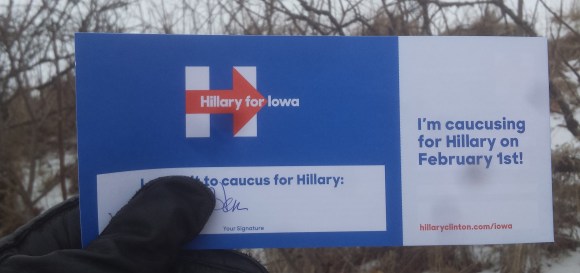
Caucus Card
After the interview I drove into the county seat at Linn and Market Streets to meet up with organizers for the Hillary Clinton campaign. I signed a caucus card and offered to canvass some area people I know, bring food to their Iowa City office when I come to town, and help organize an event or two.
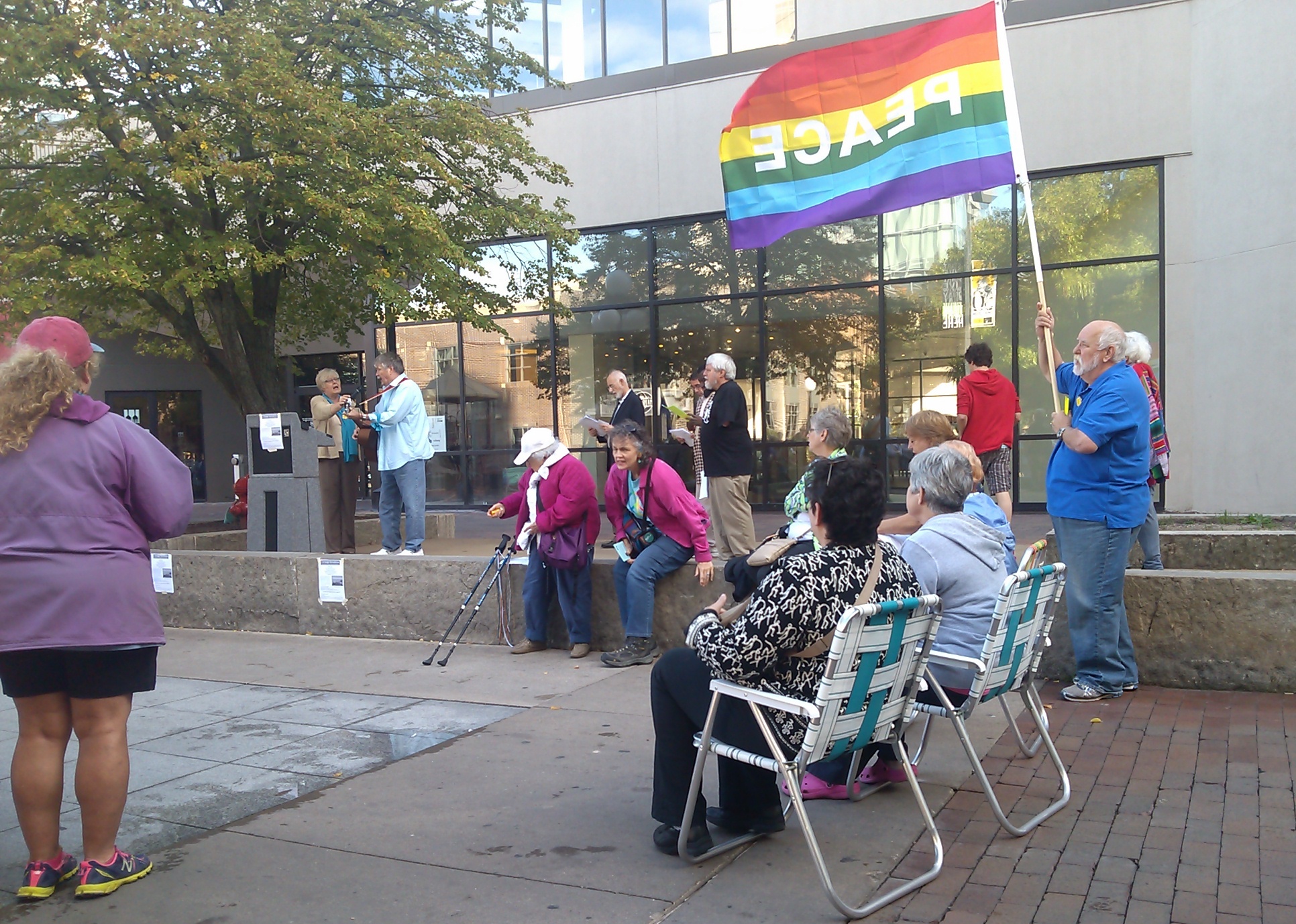
After that, I walked to Old Brick where Free Press Action Fund had organized a meeting about advocating for Internet access, affordability and freedom. More than a dozen people attended and at the end we took this group photo.
Free Press Action Fund Training at Old Brick
It was a long day, capped by getting caught in a rainstorm. Luckily it relented before getting thoroughly drenched.
You must be logged in to post a comment.