Categories
Living in Society

Preserve the Iran Deal

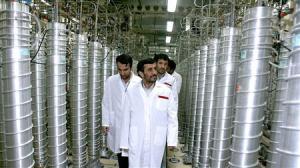
Iranian President Mahmoud Ahmadinejad visits the Natanz nuclear enrichment facility April 8, 2008 Photo Credit: Reuters

The 45th president doesn’t like the Iran Deal.

He campaigned against it. He begrudgingly certified Iran’s compliance with it after his inauguration. As additional 90-day certification periods passed, he didn’t. Neither did he move to end it.

With the installation of John Bolton at the National Security Council, and Michael Pompeo as Secretary of State, administration policy regarding Iran is expected to change.

The Iran Deal or Joint Comprehensive Plan of Action Regarding the Islamic Republic of Iran’s Nuclear Program (JCPOA) was the signature foreign policy achievement of President Barack Obama. The United States, along with the United Kingdom, Russia, France, Germany and China, stopped Iran from building a nuclear weapon.

In July 2015, Iran had almost 20,000 centrifuges used to enrich uranium in the cities of Natanz and Fordo, according to BBC News. Iran had been building a heavy-water nuclear facility near the city of Arak. Spent fuel from a heavy-water reactor contains plutonium suitable for a nuclear weapon. Iran agreed to restrict these activities in the JCPOA which brought a robust regimen of monitoring, verification and inspection designed to ensure Iran’s compliance with the deal. Every 90-day certification period, which is peculiar to the United States, international inspectors reported Iran maintains its compliance.

We should keep the Iran Deal. It’s not just me who says so.

“120 of America’s most respected national security leaders want to keep the Iran Deal,” wrote Joe Cirincione, president of the Ploughshares Fund. “Trump, Pompeo and Bolton want to kill it.”

Click on the link to read Keep the Iran Deal — 10 Good Reasons Why authored by the National Coalition To Prevent An Iranian Nuclear Weapon.

Categories
Living in Society

WYSIWYG — County Convention

Delegates and alternates arrive in the Liberty High School Commons at 8:10 a.m., March 24, 2018. Photo Credit – Lauren Whitehead

“The metaphor of WYSIWYG, taken from the advent of computer graphical user interface, is an apt model for what I’m doing. The operative function of building an electorate presumes nothing and is rooted in a belief the 2018 general election electorate is not pre-made. It is being formed as we proceed through time and events toward election day. We have to pay attention to what is happening in real time and modify our activities to create a successful process.” ~ February 9, 2018

NORTH LIBERTY — I had planned to spend the three dollars in my wallet on coffee at the Johnson County Democrats convention Saturday, March 24, at Liberty High School.

The arrangements committee selected the breakfast vendor with the largest coffee urns, so I was ready for the tedium and time-killing activities of a political convention with a cup or three of Joe.

I went home with those same three dollars in my wallet. It was one of the better conventions I attended since moving to Big Grove in 1993. There was plenty to keep a person busy with no time for a coffee break.

Solon, Iowa Grocer March 24, 2018 Photo Credit – Lauren Whitehead

Heavy snowfall Friday night made the roads passable but dangerous. A significant number of delegates did not brave the snow-packed highways creating seats for the alternate delegates who did. In all, the credentials committee seated 241 of 251 possible delegates. Desire for change in November trumped concern about road conditions.

Senate District 37 candidate Zach Wahls asked for a show of hands of people who were attending their first convention. More than half the delegates responded. Saturday’s convention was another example of the strength of the electorate we are building for November. It’s fine with me that new and younger people are joining the process. I’ll step aside, wear the LBJ for the USA button from my first campaign, and entertain delegates with my stories to avoid becoming irrelevant.

My fave memory from the convention was John Norris’ speech about his relationship with Harold Hughes, Tom Harkin, César Chávez, Paul Wellstone and the Rev. Jesse Jackson. The gubernatorial candidate’s voice was a bit hoarse, but the message was strong. Norris is an Iowan with whom people in the general election can relate.

To win the governorship, Democrats need to win more than Johnson County as our last gubernatorial candidate did in 2014. We need to approach winning 68 counties like Tom Vilsack won in 2002. Norris is laying the groundwork for such a campaign, although that strategy is a bit dicey as primary votes are mostly in urban areas.

The other gubernatorial candidate to speak was Cathy Glasson who is running what she described as an “issues-based campaign.” Despite similarities between all six candidates on issues, her approach poses more liability than asset in the general election. What if voters who haven’t participated in the electorate yet don’t like the way she framed her issues? They could vote for the other female in such a hypothetical match-up.

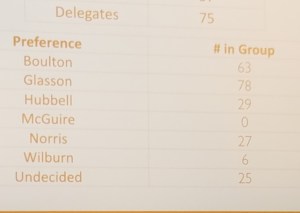
First Alignment March 24, 2018

It was no surprise when a motion was made to form preference groups by gubernatorial candidate. Breaking into preference groups added about two hours to the day.

There were three preference group alignments and those viable after the second selected delegates to the district and state conventions in the third. The image shows delegate counts after the first alignment. It took 37 delegates to maintain viability. After the second alignment there were three viable groups. They elected district and state delegates as follows: Glasson (27), Uncommitted (25) and Boulton (23). Our Norris group joined Hubbell and Uncommitted delegates and sent nine of our delegates to the next level. Hubbell did likewise and Uncommitted took the balance.

The highlight of the first alignment was that after a contentious 2016, Bernie Sanders and Hillary Clinton supporters appeared to agree on something — to rebuke former Iowa Democratic Party chair Andy McGuire for her performance in the run up to that year’s election. She had zero delegates. I’m glad former Iowa City mayor Ross Wilburn had a few delegates. They were sanded off in the alignment woodshed.

In a 2018 oddity, one of the Kucinich delegates from 2008 had become a Hubbell supporter. A sign of the times.

I liked our Norris group. Our oldest delegate was octogenarian and former state senator Jean Lloyd-Jones and our youngest was a high school senior. Gender equity in our delegation to district was important to the group. We sent five women and four men. I am thankful to be going to district and state. I was prepared to argue a case why I should be elected, but we had exactly the number of people interested as we had slots.

Should the field of six gubernatorial candidates fail to produce a clear primary winner June 5 (35% of votes cast), the state convention will decide our nominee. If the nomination goes to convention, it is likely to be one of the four who garnered delegates statewide, Boulton, Glasson, Hubbell or Norris. However, it could be anyone. That’s why it’s important there be a clear primary winner. A contentious nominating process at the state convention would detract from the party’s ability to unite behind the eventual nominee.

Other highlights of the convention include:

State Senator Bob Dvorsky gave his farewell address which ended with passing the basket for State Senate District 25 candidate Tracy Freese who has a special election April 10.

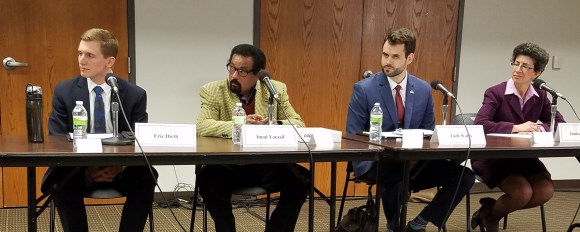
Speeches by three of four candidates for Senate District 37, Eric Dirth, Zach Wahls and Janice Weiner. They are all becoming better speakers. In case you missed it, I’m with Wahls.

Speeches by the three current candidates for the county board of supervisors, Mike Carberry, Pat Heiden and Janelle Rettig. Incumbents Carberry and Rettig are well known, experienced public speakers. Heiden presented herself well with an impassioned speech. Many of my local friends are supporting Heiden. I’m with Rettig and another to be decided after the filing period closes and candidate lists are published by the county auditor.

The star of the show had to be the facility itself. Liberty High School was a project of the somewhat controversial facilities master plan of the Iowa City Community School District board of directors. It is a beautiful facility. If I had gone to such a school, I would not want to leave. We were lucky the school administration allowed us to use their facility.

After the slate of 75 delegate was ratified by the convention, things started winding down. Snow had piled up to about nine inches while we were inside. The roads were mostly cleared by the warmer temperatures and I made it home without incident.

The day made me feel positive not only about myself for being part of the group, but about our prospects in the November general election.

Categories
Living in Society

Vote in the June 5 Primary

Woman Writing Letter

Less people are expected to vote during this year’s midterm elections than during a presidential year.

I don’t agree with letting others decide who will represent us in government and encourage Democratic voters to turn out during the June 5 primary. Early voting begins in about five weeks.

I encourage Republicans to vote as well, however, I’m a Democrat.

Races to watch in the Democratic primary are governor, secretary of state, state senator and county supervisors.

Six gubernatorial candidates filed nominating papers for governor. They are Nate Boulton, Cathy Glasson, Fred Hubbell, Andy McGuire, John Norris and Ross Wilburn. Check them out! They each have distinct talents to bring to the governor’s office. To my knowledge, Norris is the only one who held an event in Solon, and that’s who I plan to support.

There are two candidates for secretary of state, Deirdre DeJear and Jim Mowrer.

State Senator Bob Dvorsky is retiring. Four Democrats filed nominating papers to replace him. They are Eric Dirth, Zach Wahls, Janice Weiner and Imad Youssif. All except Youssif held events in Solon. All are expected to hold more. I’m supporting Wahls. Who will you support?

The filing period for county supervisor closes March 28. Presently three Democrats are running: Mike Carberry, Pat Heiden and Janelle Rettig. I’m supporting Janelle Rettig and waiting until after the auditor releases the final candidate list to decide who will get my second vote.

Democracy is participatory. Please vote in the June 5 primary.

~ Published in the March 29, 2018 edition of the Solon Economist.

Categories
Living in Society

Jodi Clemens Announces for Iowa House District 73

Jodi Clemens

(Editor’s Note: Jodi Clemens (D-Springdale) will run as a Democrat for state representative in Iowa House District 73. The filing period for candidates ended March 16 without any other Democrats, so Clemens has a clear path to begin a general election campaign. Following is her announcement press release).

Jodi Clemens, a long-time resident of Springdale, announces her campaign for the Iowa House, seeking to represent House District 73, which covers all of Cedar County, the north-east corner of Johnson County, and the city of Wilton in Muscatine County.

Clemens, a Democrat, is running a campaign based on the Iowa values of compassion, respect, fairness, and community.  Her values translate to progressive stands on the issues.

For her campaign, Clemens has pledged not to take any money from Political Action Committees (PACs). Instead, all donations come from a grassroots effort that is free from corporate influence. Clemens has seen how huge, unfair tax breaks for out-of-state corporations have contributed to economic injustice in Iowa, as budget woes force more Iowans to face hardships with fewer services that could help them.  Clemens has made campaign finance reform a cornerstone of her campaign because money in politics acts as a barrier to our government making progress on all of the other issues.

After working for four years for a nonprofit as a financial advisor and teaching financial literacy classes in local churches for the past decade, Clemens has seen how difficult things have become for so many Iowans.  “I have had to look many people in the eye and let them know they will either need to work longer, or live on less in retirement,” says Clemens. “I see firsthand how many people are struggling to make it until the next paycheck.”  When elected, Clemens pledges to work to help the state craft a budget that reflects Iowa values, helping those in need instead of turning its back on them.

For Clemens, that means better funding for healthcare, especially for those who suffer from mental illness, because, she says, people who suffer should be treated with compassion.

And that means better funding for Kindergarten through college education, because it is through education that the young people in Iowa will find opportunities to improve their lives.

“Our school budgets have been tight and just got a lot tighter,” Clemens says, adding that student success depends on paying teachers a competitive wage and supporting their right to organize.

Clemens is a small business owner and volunteers in her hometown, where she serves on the Board of Directors of the West Branch Community Development Group, as Vice President of her children’s fine arts advocacy program, and as an active member of her church and community. She also co-founded a local non-partisan Indivisible Iowa group and a 100+ Women Who Care chapter.

“I am working to lead with values and issues,” said Clemens. “Question me, challenge me, help me grow as a person and as a leader.”

Website: ClemensforIowa.com
Facebook: Jodi Clemens for Iowa House District 73
Twitter: @jodi4iowa

Categories
Living in Society

Filing Day in Iowa

It’s Always Sunrise Somewhere – Highway 382, Solon, Iowa

March 16 was filing day in Iowa for statewide and legislative candidates. It is a time for candidates to walk the walk and show up at the Secretary of State’s office with enough petition signatures to get on the June 5 primary ballot.

Some made it, some didn’t.

Most surprising to me is former Cedar Rapids mayor Ron Corbett was a last-minute filer. He filed so late the Secretary of State won’t be able to determine his viability until tomorrow. With his substantial financial backing I expected him to have petitions wrapped up earlier. It would be good for Governor Kim Reynolds to have a Republican primary challenger, so fingers crossed for my former colleague at the transportation and logistics company where I spent 25 years.

Six Democratic gubernatorial candidates will be on the primary ballot according to the Secretary of State: Nate Boulton, Cathy Glasson, Fred Hubbell, Andrea McGuire, John Norris and Ross Wilburn.

Lefties in the county seat are all about this year’s union and legislature-backed candidates for governor, Cathy Glasson and Nate Boulton. I’ve been to this rodeo before and in two words can debunk the idea that Johnson County Democrats decide statewide candidates: Patty Judge.

In the 2016 primary for U.S. Senator, Johnson County Democrats backed State Senator Rob Hogg with 4,577 of 8,189 votes cast (56 percent). Three other candidates split the remaining votes: Patty Judge (2,476, 30 percent), Tom Fiegen (524, 6 percent), and Bob Krause (218, 3 percent). Statewide, Judge led the field with 46,322 votes (45 percent) to Hogg’s 37, 801 (37 percent). Total statewide Democratic primary votes cast were 101,991.

In the 2006 primary, when Judge shared the ticket with Chet Culver, a majority of state lawmakers endorsed Mike Blouin who got 4,324 (40 percent) of 10,786 cast in Johnson County, beating Culver-Judge with 2,811 votes (26 percent). Culver-Judge came in third behind Ed Fallon with 3,447 votes (32 percent) in the liberal bastion. Statewide, Culver-Judge won with 58,131 votes (39 percent) compared to Blouin at 34 percent and Fallon at 26 percent. 148,751 Democrats cast a vote in the 2006 primary.

If there is a liberal bubble in Iowa, Johnson County is it.

John Norris in Solon, Iowa March 17, 2018

I’m backing John Norris for governor in the primary for a couple of reasons. He’s the only gubernatorial candidate to host an event in the small town nearest me. I heard him speak for the second time yesterday in Solon.

As Norris admitted, his plan to engage rural and small town Iowans may not be a winning strategy in a primary where Democratic voters are concentrated in urban centers. The flight from rural to cities and out of state is not new and is a key challenge Iowa faces in growing our economy. Norris hopes by focusing his campaign away from population centers his shoe leather and car rubber approach would payoff in the general election. If Norris survives the primary, he would have laid the groundwork to compete statewide with the Republican nominee.

Norris would be ready to govern on inauguration day. As Governor Tom Vilsack’s first chief of staff he has experience in cleaning up a Terry Branstad mess, and that’s where the state finds itself in 2018. He addressed the need to repair the damage Branstad and his protege Reynolds have done since their election in 2010. Democrats taking control of the state legislature is a necessary component of Norris’ strategy and that could take multiple election cycles, he said. Having the knowledge and experience — being ready to govern on day one — is an important aspect of his campaign and why I support him.

Can John Norris get 35 percent of the votes in the primary? He said yesterday his campaign is between a rock and a hard place. He wouldn’t lose the election based on policy, as I believe a majority of Democrats could get behind a Norris primary win. Others have better statewide name recognition, particularly Fred Hubbell and Andy McGuire. According to a Feb. 6 poll by Selzer and Company, Hubbell and Boulton would present the strongest challenges to Reynolds in a head to head race. Where is Norris’ opening?

With six gubernatorial candidates it is possible none of them gets 35 percent of votes cast to win outright. That would take the nominating process to a convention. Because of Norris’ name recognition and long experience in Iowa Democratic politics, the convention could be his path to winning the nomination as a compromise candidate in a potentially heated debate between highest vote-getters in the primary.

Glasson has a “win at the convention strategy” and won 33 percent of delegates to the district and state conventions in Poweshiek County, which held their county convention yesterday. She appears to be the only gubernatorial candidate with such a strategy. In Solon, Norris expressed confidence he could win the primary outright.

A lot depends on primary voter turnout, which I expect to be more like 2006 than 2016, when Democrats won the general election for governor. Johnson County will contribute to, but not drive this effort and that’s where I believe Norris’s campaign is worth supporting.

In other filing news, Democrat Jodi Clemens and Republican Bobby Kaufmann will face off in House District 73. There is a four-way Democratic primary in Senate District 37 with Eric Dirth, Zach Wahls, Janice Weiner and Imad Youssif filing petitions. The winner of the senate primary will run against Libertarian Carl Krambeck unless Republicans hold a nominating convention to get a candidate on the ballot. Kaufmann has said in public Republicans don’t plan to run in Senate District 37, however, that could change. I plan to vote for Clemens and Wahls in the primary.

The last statewide contested race in the Democratic primary is for Secretary of State where perennial candidate Jim Mowrer and Dierdre DeJear filed petitions. I support DeJear.

Categories
Living in Society

Letter to the Solon Economist

Woman Writing Letter

Someone broke the law to leak information about the county’s potential purchase of property with conservation bond money.

In a closed session of the full board of supervisors, with five staff members present, one or more of them broke the trust of being invited by leaking information about property the conservation board was considering for purchase. He or she broke the law.

The news made its way to the Solon Economist last week in the form of a letter written by two grey-haired Iowa City liberals. They made a case against a potential purchase most of us hadn’t heard about. Their biased opinions fill otherwise empty space about this topic. The letter raised questions about how they got their information.

“Someone flagrantly broke the law,” wrote Supervisor Rod Sullivan on his weekly blog. “She or he ought to face consequences. This was not an accidental slip. This was a purposeful, devious violation of the law.”

I’m all for a robust debate of how the county spends our tax dollars. If last week’s letter is true, I question whether buying the property is an appropriate way to spend conservation bond money.

However, I support the rule of law and the leaker should be sought out and receive due process for committing a crime.

Early and illegal notice about conservation fund spending did not benefit public discussion one bit.

~ Published in the Solon Economist on March 15, 2018

Categories
Environment Living in Society

Letter to the Johnson County Supervisors

Woman Writing Letter

Dear Lisa, Mike, Kurt, Janelle and Rod,

Your vote on the acquisition of Dick Schwab’s property will make it easy for me to determine for whom to vote in this year’s June primary and who to support going forward.

I know the property involved better than most and have worked and spent time with Dick there. In my discussions with him he made it clear he would donate the property to what is now the Bur Oak Trust. I don’t know what changed his mind, but it is human to reap a profit and I’m not surprised he seeks a buyer as he makes his exit from Johnson County.

Maybe I misunderstood his intent. I’m human too.

It is not clear what portions of his property are included in this transaction, as I just found out about it in the newspaper tonight. It isn’t clear what exactly is proposed.

The fact is what I know of this property is well developed and does not seem a good use of the limited conservation bond funds set aside. I hope and expect you to vote no on the acquisition of this property using conservation bond money.

I don’t usually weigh in on your activities, but this one is important enough for me to do so.

Good luck with your decision.

Regards, Paul

Categories
Living in Society

Kansas Connections

Kansas Grass Fire. Photo Credit: Travis Morisse/The Hutchinson News via AP

I’d go back to Kansas for a visit.

More specifically, I’d like to see the Eisenhower Presidential Library in Abilene.

Not that I like Ike or have many memories of his administration. He was president at a time when our family was unsettled. After we moved to a permanent home in 1959, my neighborhood friends were consumed with talk about World War II, including Eisenhower, because so many we knew had been in the war. Eisenhower was of that era which was eclipsed by John F. Kennedy, Lyndon Johnson and Richard Nixon. I don’t recall Nixon speaking much to Eisenhower as the aging soldier faded into history in 1969.

In 2007 I traveled to Kansas on business. It was a hopeless sales call that mustered some of our logistics company’s best talent for a whim. During nights in Parsons and Wichita I posted about Kansas and the demise of coal-fired electricity there. Political uncertainty about greenhouse gas emissions was killing capital investment in new coal plants in Wyoming and Kansas.

I’d return to Wichita to see where the Kochs came up. I doubt I could walk up to Charles Koch’s front door and find him home, but I’d make a special side trip enroute to Abilene to see Wichita through that frame.

Today, “Kansas” and “the Koch Brothers” have become talismans for too many Democrats.

I don’t see positive value in comparisons of legislation Iowa Republicans are considering to what happened in Kansas. Iowa is not Kansas and that is exactly how Republicans will use this comparison against our Democratic candidates.

The people of Kansas elected and re-elected Governor Sam Brownback knowing his history better than we do. His tenure is described on Wikipedia:

Brownback was elected governor of Kansas in 2010 and took office in January 2011. As governor, Brownback initiated what he called a “red-state experiment”—dramatic cuts in income tax rates, intended to bring economic growth. He signed into law one of the largest income tax cuts in Kansas history. The tax cuts caused state revenues to fall by hundreds of millions of dollars and created large budget shortfalls. A major budget deficit led to budget cuts in areas including education and transportation. While Kansas’s economy has performed reasonably well since the cuts were passed, the economies of neighboring states have done as well if not better. In the run-up to the 2014 gubernatorial election, over 100 former and current Kansas Republican officials criticized Brownback’s leadership and endorsed his Democratic opponent, Paul Davis. Brownback was reelected in a close race with a plurality, a margin of 3.7 percent. In June 2017, the Kansas legislature rolled back Brownback’s tax cuts and enacted tax increases.

In a repudiation of the federal Patient Protection and Affordable Care Act, Brownback in 2013 turned down a $31.5 million grant from the U.S. Department of Health and Human Services to set up a public health insurance exchange for Kansas. Also in 2013, he signed a bill that blocked tax breaks for abortion providers, banned sex-selection abortions, and declared that life begins at fertilization.

Are there comparisons to be made with Kansas? Of course.

However, Iowa Democrats should be ever cognizant the budget problems in this state were created by the largess of Governor Branstad, Republicans and Democrats in handing out tax credits that contributed to the last two years’ revenue shortfalls. In addition, Branstad enacted a sales tax exemption for many businesses. In retrospect, he must not have had a clue how large a decrease in tax revenue it would create. My point here is Iowa made its own problems before Republicans controlled the governor’s office and both chambers of the legislature. In that respect, we are not like Kansas. As gubernatorial candidate Ross Wilburn keeps telling us, “Let’s be Iowa.”

Regarding the Koch Brothers, Iowa Democrats need to give it up. Every Iowa Republican who has been attacked for taking Koch Brothers’ money has credibly denied it, even members of the American Legislative Exchange Council and Americans for Prosperity, two Koch-backed entities. That’s not to say the influence is absent, just that Democrats are losing this messaging struggle. Jane Meyer’s recent book, Dark Money: The Hidden History of the Billionaires Behind the Rise of the Radical Right tells the story of dark money in politics, including the role Charles and David Koch play. It is way more complicated than a single family advancing its agenda. To create a totemic relationship with the Koch Brothers or Kansas is the wrong framework to win voters and elections in Iowa politics.

The people I know who live in Kansas, including family members, don’t have issues with the state. Like all of us, they are working to sustain their culture in a turbulent world.

I get the fact raising “the Koch Brothers” and “Kansas” is a form of confirmation bias among Democratic activists. However, as Senate District 37 candidate Zach Wahls posted on twitter last night, “It’s a reference that, in my experience, tends to work among Dem activists – but it’s a head scratcher among non-activists.”

I’m with Wilburn on this. Let’s be Iowa.

Categories
Living in Society

WYSIWYG — Town Hall

Lynn Gallagher with her posters about CAFOs at the Rep. Bobby Kaufmann town hall in Solon

SOLON, Iowa — What you see is what you get. Politics is more meaningful with experience and a proper lens. Our view of things is imperfect.

A political Saturday began with a meeting of the county party arrangements committee in North Liberty where members went around the table to introduce ourselves and tell how we got active in politics.

My first political campaign was for Lyndon Johnson. After taking the bus downtown and paying my weekly carrier newspaper bill, I stopped by the Democratic party office to help out. I wanted an LBJ for the USA campaign button and asked for one. They had me stuff envelopes for a while then gave me a button. The 1964 election built my expectation as a Democrat that we would win every election by a landslide. Imagine my disappointment when Richard Nixon was elected in 1968. Imagine my outrage as he dissembled about the war in Cambodia. Imagine how I feel now.

A fluffy, wet snow was falling as I left the arrangements meeting. I swept a couple inches off the Subaru with a broom and made my way across the lakes to Solon where Rep. Bobby Kaufmann was holding a town hall meeting at 1 p.m.

The town hall venue was the Palmer House Stable built in 1838. It has a turbulent recent history as it was bought for cheap and remodeled in a way that forced the owner to declare bankruptcy. A local Republican owns it now and holds some events there. He donates use to Kaufmann a couple times a year. Covered in snow, it looked very picturesque as I walked up to the door.

The setup was clean but uncomfortable with cheap plastic folding chairs. Local resident Lynn Gallagher brought posters with information about Concentrated Animal Feeding Operations and lined them up on chairs along the wall in the main room. Someone else brought a couple of trays of mini-cupcakes. When the town hall ran long, half a dozen attendees stood up from the chairs to alleviate back pain they caused. Despite the discomfort, I didn’t see anyone leave until the question and answer period was over.

In all 23 people plus Kaufmann attended the meeting, about double the normal number for a Kaufmann town hall in Solon. Most of the faces were familiar and most attendees had a prior relationship with Kaufmann. Whenever he took a note to get back to someone, he did not ask their name. He called on many of us by name to ask our question. To say attendees were supporters is not true. At the same time everyone had an interest in government, a relationship with the representative, and more interest than usual demonstrated by venturing out on slippery roads to attend. Based on attendance and level of engagement, interest in politics continues to run high in the 2018 midterm election cycle.

I found the town hall to be valuable because Kaufmann gave a glimpse into his work in the House and the environment in the Republican caucus. His view was surprisingly insular and focused on the House, not Republicans in general. For example, according to his response to the Republican who asked the question, he didn’t know that the Senate had advanced the embryonic heartbeat bill until someone from Cedar County pointed it out to him. The takeaway is the heartbeat bill is unlikely to get 50 votes in the House because Republican members believe that when it is struck down by the courts, it will be done in a way that makes it difficult to appeal to the U.S. Supreme Court. Getting another abortion-related issue to the Supreme Court is the endgame of the flawed bill.

A good mix of Democrats and conservatives attended the meeting, although the group leaned somewhat Democratic. It seemed ironic that a current Iowa City School board member asked about his pet projects rather than school funding, and a former Solon school board member was more interested in the heartbeat bill than school funding. To characterize the meeting, school funding was not raised as an issue with the current legislature.

Kaufmann gave about ten minutes to answering my question about Governor Reynolds’ proposed tax cut, which I felt was generous. The new federal tax bill is forcing the state to do something to avoid a dramatic increase in taxes, according to Kaufmann. Governor Reynolds wants to delay addressing the $500 million in tax credits going out the door each year until next year. Kaufmann and other house members want them addressed this session.

Mental health got the biggest part of the discussion based on time and number of participants. I appreciated the woman who coached Kaufmann on mental health messaging. His statement, he was waiting to see the revenue estimate before action, seemed like a dodge of the need to do something to fix the mental health regions Republicans previously designed. Why wouldn’t the legislature determine what is needed to fix the mental health system and only then determine how to pay for it?

We talked about gun control beginning with a neighbor’s suggestion county sheriffs register assault weapons like the AR-15. This kicked off a long, albeit civil discussion about gun control that bordered on a skirmish. It had me wondering who might be packing. Kaufmann let the discussion get out of control and it degenerated into a pointless endeavor of confirmation bias.

The strong attendance at the town hall was a sign that people are engaged in politics more than in previous years. My conclusion afterward was that even on a snowy day people can come out, be civil, and learn about our government. This group was definitely not a flock of sheeple. People are engaged in politics more now than I can recall since 2012. An electorate for change in November is beginning to come together.

Categories
Living in Society

Favoring Tax Relief

Mad Hatter’s Tea Party – Photo Credit Wikimedia Commons

I favor tax relief.

The relief I favor is from worry that the state can pay its bills.

Each year the Iowa Legislature and Governor are required by law to create a balanced budget. The last two years, they couldn’t support their own budget as there was a revenue shortfall and mid-fiscal year cuts had to be made. These cuts equate with our government inadequately understanding the tax revenue stream.

In this environment it makes no sense for Governor Kim Reynolds to propose cutting taxes:

“The plan is projected to cut income taxes by $1.7 billion by 2023, while maintaining expected growth rates in revenue,” according to the governor’s web site. “Even assuming no dynamic effect (economic stimulus) from federal or state tax reform.”

Everyone who believes that stand on your head.

A revised tax policy may be needed. Before Republicans get carried away with the idea some basic housekeeping is required.

Let’s go a complete fiscal year without having to amend the state budget.

Let’s understand how the agricultural economy impacts tax revenues.

Let’s pay back the rainy day fund that was tapped to make up for revenue shortfalls.

Let’s understand the impact of the business sales tax cuts Governor Branstad made.

Let’s understand the impact of business tax credits given to the Iowa Fertilizer Plant, Apple and others.

Let’s do as a state what we should have been doing with our budget all along.

Reading the governor’s tax proposal is like entering the Mad Hatter’s tea party. The March Hare offers wine to Alice, only there is no wine.

“It wasn’t very civil of you to offer it,” Alice said.

~ Submitted as a letter to the editor of the Solon Economist