Categories
Living in Society

Iowa Caucus – 2022

The late Bob Handley signing nominating petitions at the 2010 Democratic caucus.

When the alarm to take my pill went off at 7 p.m., 263 accounts had logged in to the 2022 Iowa Democratic virtual caucus in Johnson County. Some accounts had multiple household members named or in video feeds that were shown. Throughout the main part of the caucus, the number wavered between 290 and 300. It was a reasonable turnout given the persistence of the coronavirus pandemic combined with a more general lack of interest in party politics.

It was nice to walk upstairs to retire when it finished instead of driving half an hour from some godforsaken corner of the county while watching for deer crossings and drunken drivers. My takeaway is as some long-time legislators and officials step back from public office, not enough new names were on the roster of attendees. Democrats have a tough row to hoe in the midterms. When don’t we in Iowa? We chose Richard Nixon instead of John F. Kennedy for Pete’s sake.

Last Obama Campaign Rally, Des Moines 2012.

The main business of the caucus was twofold: learn who is running for office and elect folks to do party work going forward. I self nominated to be a delegate or alternate to the county convention. I also self nominated to be an alternate central committee member. I hope the two central committee members we chose in 2020 sought re-election, although I didn’t see their names on the roster of attendees. No committee work for me this year.

The single person I recognized from my precinct had contacted me earlier in the day for our traditional pre-caucus chat. Our main relationship is related to county politics and we both have opinions about what is going on. We began working together on campaigns in 2004 and attended Barack Obama’s last political rally in Des Moines together, just before election day in 2012.

Elle Wyant and Kevin Kinney at the Feb. 7, 2022 Iowa County caucus in Marengo.

A slideshow displayed on a shared screen while we waited for caucus to begin. One slide showed State Senator Kevin Kinney is running for re-election in the new District 46. Elle Wyant had a slide as well. She is running for House District 91 in her first-ever run for political office. She gave a one-minute speech in her allotted time. These Republican districts will be tough to win for any Democrat. Best of luck to the two candidates.

Five U.S. Senate candidates had slides on the presentation, although my only question in this race is whether retired Admiral Michael Franken will win the June primary. It is between him and Abby Finkenauer, although Dr. Glenn Hurst is actively campaigning. Franken, Hurst and Satro Narayan gave one-minute speeches at our caucus. Until the primary, I’m keeping my activism powder dry in the U.S. Senate race.

I dialed in early and the caucus ended shortly after 8 p.m. Much less of a time commitment than attending an in-person event. I liked that aspect of it. Democrats have to get organized in an election year and the caucus format serves this purpose. We now have the framework from caucus to the election, a timeline upon which to hang our plans.

Off we go!

Categories
Living in Society

Republican Romp

Iowa Capitol

We know Republicans are feeling pretty good about the way the state is going when the normally reserved Matt Windschitl includes a joke in his legislative update. “If a car uses wheat-based ethanol, does it qualify as a hy-bread vehicle?” The newsletter was about ethanol, and Republicans feel good when they address it to support corn-growers and the product from which it is made.

The Iowa House got its way with last week’s HF2128 regarding E15 ethanol in the state. It passed with many Democrats joining the Republican majority in favor. What didn’t get told in Windschitl’s newsletter was it was Democrat Mary Wolfe of District 98, ranking member of the judiciary committee, who wrote the language to help gas station operators in small towns deal with changes the new law would bring by increasing the blend of ethanol.

As has been expected for many years, especially since Republicans gained control of the Iowa Senate in 2016, each year brings more crazy legislation. Among the topics that have been broached in the early days of the final session of the 89th General Assembly are eliminating state income tax, eliminating all Iowa Code (yes, all) a bit at a time until it is revised by the legislature or deleted, putting surveillance cameras in virtually every K-12 public school classroom so parents can watch, sending teachers and librarians to jail for making unapproved classroom materials available, qualified immunity for police officers, and there will be something about taking away the rights of women to manage their health care once the U.S. Supreme Court issues a ruling that may impact Roe Vs. Wade later this year.

With all of these and more, Republicans are feeling pretty good about themselves. Don’t break your arm patting yourselves on the back people.

It looks like Democrats have a long road toward regaining a majority in either legislative chamber. Republican Governor Kim Reynolds rules the roost and is expected to cake walk into another term after the November election. Democrats ran one of their biggest donors against her in 2018. He came up short on charisma if not on money. Only Democrat Deidre DeJear, the losing 2018 Secretary of State candidate, is in the running against Reynolds. DeJear’s campaign hasn’t been able to achieve lift off. Being well-liked among Democrats hasn’t translated into a successful campaign for DeJear.

As I wrote yesterday, the pandemic is being normalized, even if it is not over. What hasn’t been normalized, or even adequately addressed, is how Democrats dig out of the grave they dug for themselves since Tom Vilsack was governor.

Like many Democrats, I’m willing to do my part. I also have stuff to do before I’m ready to enter my own grave. As a new septuagenarian, there is no time to wait for Democrats to get organized. That I can write that sentence does no justice to how disorganized we are as a party. The fear is there is no hope of digging out in the foreseeable future or in my lifetime.

I’m not encouraged by people who say we should wait until the campaign season is upon us. That means the 89th General Assembly adjourned sine die, summer is behind us, and the election is within shouting distance. The long-term structural change Iowa Democrats need lies outside any single election.

Some positive things have been accomplished by our leaders, especially by my state senator and senate minority leader Zach Wahls. What Ross Wilburn, Zach and the gang are doing is okay, yet not enough, and too slow in evolving.

While good people try to organize the circus we Democrats tend to be, Republicans are telling jokes and enjoying good times promoting corn ethanol during the Republican romp of which they can see no end.

Categories
Living in Society

Pandemic Being Normalized

It had been 13 days since I started the automobile. Luckily, it turned over and was ready to go across the lakes to the wholesale club for provisioning. The trip there and back took less than two hours. I won’t leave the house again until mid month if all goes well.

All of the staff and about half of the customers at the retail outlet were wearing masks to protect against the coronavirus. No one bothered me as I wore my KN95 and went about my business. I worked as efficiently as possible, staying away from the unmasked as much as I could. It seemed a bit weird because absent were many of the well-dressed, Chinese-speaking folks who frequent the place, replaced with scruffy-looking white folks shopping without masks and heatedly discussing shopping choices among themselves.

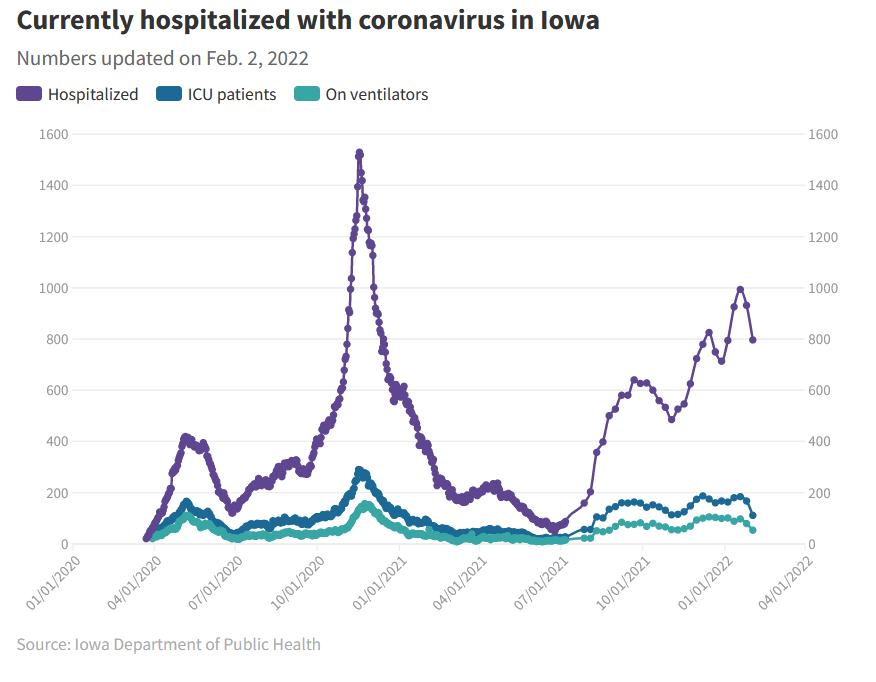
The governor’s press release arrived after I returned home. It indicated there is no ending the coronavirus pandemic. She is extending the state’s Public Health Disaster Emergency Proclamation on Feb. 3, announcing it will expire at 11:59 p.m. on Tuesday, Feb.  15. After that, the coronavirus becomes normalized in daily, routine public health operations. I’m not surprised.

Here is the press release in full:

OFFICE OF THE GOVERNOR
Governor Kim Reynolds ★ Lt. Governor Adam Gregg 
FOR IMMEDIATE RELEASE: February 3, 2022
CONTACT: Alex Murphy, 515-802-0986

Gov. Reynolds announces expiration of Public Health Proclamation, changes to COVID-19 data reporting

DES MOINES – Governor Reynolds signed the final extension of the state’s Public Health Disaster Emergency Proclamation today, announcing it will expire at 11:59 p.m. on Tuesday, February 15, 2022. The signed proclamation can be found here.

The proclamation was first issued in accordance with the Governor’s executive authority on March 17, 2020, to enable certain public health mitigation measures during the state’s response to the COVID-19 pandemic. Over time, it included hundreds of provisions assembled in the midst of an emergency to quickly address a pandemic the nation knew little about. Today, the remaining 16 provisions focus primarily on lingering workforce issues exacerbated by the pandemic that are best addressed outside of emergency executive powers.

The State of Iowa is working with stakeholders in an effort to address pervasive workforce issues through more permanent solutions like legislation, rule changes, and grant programs.

“We cannot continue to suspend duly enacted laws and treat COVID-19 as a public health emergency indefinitely. After two years, it’s no longer feasible or necessary. The flu and other infectious illnesses are part of our everyday lives, and coronavirus can be managed similarly,” stated Gov. Reynolds. “State agencies will now manage COVID-19 as part of normal daily business, and reallocate resources that have been solely dedicated to the response effort to serve other important needs for Iowans.”

The expiration of Iowa’s Public Health Disaster Emergency Proclamation will result in operational changes related to the COVID-19 response. The most noticeable change will be how data is reported publicly. The state’s two COVID-19 websites, coronavirus.iowa.gov and vaccinateiowa.gov, will be decommissioned on February 16, 2022, but information will remain accessible online through other state and federal resources.

“While our COVID-19 reporting will look different, Iowans should rest assured that the state health department will continue to review and analyze COVID-19 and other public health data daily, just as we always have,” stated Kelly Garcia, director of the Iowa Department of Public Health (IDPH). “The new format will include data points that Iowans are used to seeing, but moves us closer to existing reporting standards for other respiratory viruses. This new phase also assures that our teams, who have been deeply committed to the COVID-19 response, can return to their pre-pandemic responsibilities, and refocus on areas where the pandemic has taken a hard toll.”

IDPH will report relevant COVID-19 information weekly on its website, similar to how flu activity is reported. Data will include positive tests since March 2020 and in the last seven days, cases by county, an epidemiologic curve, variants by week and deaths since March 2020. Vaccine information, including total series and boosters completed, demographics for fully vaccinated Iowans, and vaccination by county, will also be reported. Aligning the agency’s reporting processes will create greater efficiency for its staff while continuing to provide important information to Iowans. The new report will be available starting February 16 at idph.iowa.gov.

The State of Iowa and its health care providers will also continue to report COVID-19 data as required by the Centers for Disease Control and Prevention (CDC). The CDC’s COVID Data Tracker reports state-level data for cases, deaths, testing, vaccination and more. The site is available at coronavirus.gov or covid.cdc.gov/covid-data-tracker.

The State Hygienic Lab will continue to operate the Test Iowa at Home program. As testing supply increases and more options for self-testing become available, the state will reassess the need for the program. For more information or to request an at-home test, visit testiowa.com.

States are not required to have a disaster proclamation in place to be eligible for federal coronavirus-related funding or resources. Iowa will continue to receive vaccine and therapeutic allocations as normal after the proclamation expires.

Nearly half of U.S. states have already discontinued their public health proclamations, and several more are set to expire in February if they aren’t renewed.

Press Release Feb. 3, 2022, Iowa Governor’s Office.

So it goes.

Categories
Living in Society

Iowa House District 91

Iowa House District 91.

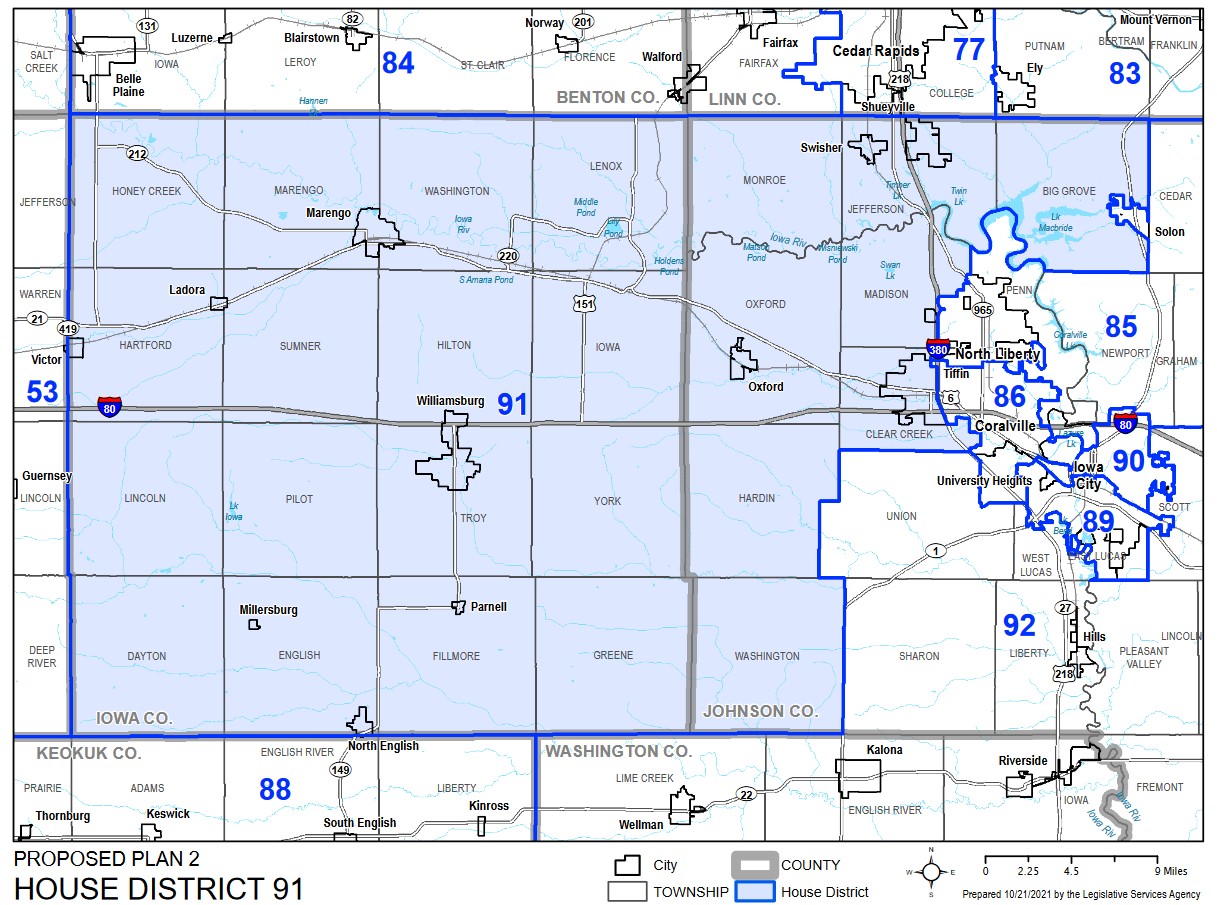
I’m waiting to see if someone announces their candidacy for Iowa House District 91, newly created by the Iowa legislature during our post-U.S. Census, decennial redistricting. I’ll say what I’m thinking: electing a Democrat in this district will be difficult. Most of the geography is rural, and 10,757 of 16,506 registered D/R/NP voters live in Iowa County which is even more rural than the Johnson County portion of the district.

The Iowa legislature finalized new districts on Nov. 4, 2021. It was late this year because of the delay in the census. There is no incumbent representative, so it is an open seat. Three months have gone by and no Democrat jumped into the race. Maybe they realize how difficult winning here will be. Maybe they feel there is plenty of time. I’ve been asking around and there might be a person evaluating whether to run as a Democrat. Maybe not. It’s not a good sign.

That’s not to say a Democrat can’t win. The right Democratic candidate with the right connections and ability to relate to Republicans and No Party voters can get elected. In the related Iowa Senate District 46, there is a Democratic and a Republican incumbent who are expected to face off in the November election. Democratic Senator Kevin Kinney is well familiar with getting elected in rural geography and should he run, could aid the House District 91 candidate. We don’t have an official candidate in either race yet.

The January breakdown of voter registrations in Iowa County was 2,481-D, 4,565-R and 3,711-NP. In Johnson County it was 2,760-D, 1,271-R and 1,718-NP. As has been the case in rural elections during the previous 10 years, how no preference voters vote will determine the results. Rural no preference voters lean Republican. My current precinct went Republican across the board in 2020 and is expected to do so again without a strong Democratic candidate. We paid a price for the retirement of Dave Loebsack who won every race in my precinct.

The precinct caucuses are scheduled for Feb. 7, and that is traditionally the time when new candidates speak. In Johnson County we decided to hold a virtual caucus, so that makes it easier for candidates to contact people throughout the county. We’ll see if someone announces.

In the meanwhile, there is not a lot to do in this race but wait and see.

Categories
Living in Society

Don’t Tell Us What to Read

Morning Reading for $1.25

I got my first library card in 1959 and have been reading ever since. When I was young, teachers kept an eye on my reading and made their opinions known. If they didn’t like a particular book, I read it at home where my parents supervised me.

My first conflict was in eighth grade over a book written by Ian Fleming, one of the 007 series. The priest saw I had it and confiscated it because of Bond’s interaction with women. I discussed it with my parents and eventually bought another copy from my allowance.

In high school I heard about J.D. Salinger’s book Catcher in the Rye and wanted to read it. It was prohibited and unavailable in the school library. I read that one too. I managed the conflicts between teachers and my reading.

What I can’t abide is the state legislature regulating which books should be allowed in schools. This decision should be between teachers, librarians, and parents. The claim parents don’t know what books are in schools seems bogus. If the legislature wants to do something, fund on-line access to card catalogues throughout the state. We don’t need lawmakers telling us what to read.

~ First published on Jan. 22, 2022 in the Cedar Rapids Gazette

Categories
Living in Society

Miller-Meeks Didn’t Support the Military

Mariannette Miller-Meeks on the Iowa State Fair Political Soapbox on Aug. 13, 2010. Photo credit: Wikimedia Commons.

Representative Mariannette Miller-Meeks should be consistent about where she stands on support for the military. On Jan. 12, she voted against expanding eligibility for educational benefits to our National Guard and Army Reserves in the Guard and Reserve GI Bill Parity Act of 2021.

In June, Miller-Meeks said, “I can think of no better way to help those transitioning from our military than by giving them access to the benefits they have earned.” She gushed on her congressional website how she voted in favor of four bills to help our military members.

Which is it congresswoman? Are you for or against supporting the military with improved benefits?

I’m weary of hearing her military resume because while she used the GI bill for her own education, leveling the playing field between National Guard/Reservists and active-duty personnel is something she can’t abide.

I may have missed some fine print right wing politicians find objectionable, yet the big picture is Miller-Meeks voted against a bill to help men and women in uniform.

Our military personnel deserve our thanks on behalf of a grateful nation. But no, Miller-Meeks couldn’t provide it.

~ First published in The Daily Iowan and also in other local newspapers

Categories
Living in Society

Funding Public Schools

Officer Writing a Letter by Gerard ter Borch. Photo Credit – Philadelphia Museum of Art.

Government should be in the business of funding public schools so that every child has access to a world class education. In her condition of the state address, Governor Kim Reynolds explained how much money state government was contributing to public schools. Everything was fine until school choice came up.

“But for some families, the school district doesn’t fit their values or meet the needs of their child,” Reynolds said, pivoting to school choice.

If parents want or need school choice, they should be able to find an alternative. At the same time, it is not government’s job to fund every parent’s dream education for their child. That’s where Republicans and I differ.

In the 1960s, compulsory school standards caused a problem in Oelwein. The school superintendent required Amish children to attend public school and they refused. Democratic Governor Harold Hughes intervened to request a moratorium on compulsory education for the Amish and defused the situation. In 1967 the legislature passed a law exempting the Amish from compulsory education and school standards based on their religious affiliation.

What is going on today is nothing like that. Public schools struggle with inadequate funding and we are talking about more money for private schools?

My member of congress, Mariannette Miller-Meeks is in sync with the governor and has adopted a D.C.-based approach to school choice.

In an editorial in the Independent Advocate, Miller-Meeks wrote, “Not every school is right for every student; thus, it is imperative that we give families the choice to send their child to the school that works best for them.”

Miller-Meeks introduced The Choice Act in the U.S. House. The Choice Act “would allow parents to be in control of their children’s education by expanding school choice programs and by creating greater awareness of different types of programs,” she wrote. The Choice Act takes us the wrong direction.

What is the limit on school choice? How much should the federal government be involved paying for school choice?

Public schools exist for a reason, to make the best use of tax dollars to provide quality education for all children. School choice as Reynolds and Miller-Meeks frame it is counter productive to good public schools.

Categories
Living in Society

Congressional Survey Responses – January 2022

Portion of mailer from Congresswoman Mariannette Miller-Meeks.

My member of congress sent a couple of official mailings since she was elected to the U.S. House of Representatives. They are purported to be government business, yet any such outreach is obviously also political. These questions seem intended to frame political discussion going into the midterm election. I’m not going to reply in this format, yet I will submit my answers via message on the Miller-Meeks official website. Here are the questions and my answers.

What are your thoughts on the issues at our southern border?

Enable the Biden-Harris administration to manage border crossings along with the border state governors.

Should government be more involved in our health care system?

This is not a simple answer. Yes, regulation is needed, and as long a people can’t get access to care for any reason, there is not enough regulation and government support. At the same time, health care providers need to be able to make a living and I agree with the Obama administration in passing the Patient Protection and Affordable Care Act that there is a role for for-profit health care providers and their employees. Since the federal government created all veterans, it continues to be needed to regulate and improve the care system for active military personnel, veterans, and their families. I fully support the Biden-Harris administration’s efforts to manage the current global pandemic of the coronavirus.

Do you believe reducing federal regulations and red tape are more likely to 1. create jobs and improve our businesses, 2. allow corporations to harm employees and consumers or 3. other?

See previous question for my thoughts about government regulation of the health care industry. Since the government has been captured by undue influence from corporations that provide healthcare, and industry capture already harms employees and consumers, the best course of action is to reform campaign financing and reduce the ability for healthcare corporations to donate to members of congress and political action committees in order to influence governance.

How should Congress tackle our $29 trillion debt?

Of the suggested answers, raising taxes on the wealthiest Americans is first priority and overdue. The Trump tax cuts should be reversed as quickly and completely as possible as they drive a significant portion of the debt. In addition, the Congress needs to audit the military budget, which has seemed for some time to be out of control and enriched beyond the country’s national security needs. Why would the Congress approve a higher budget than the Biden-Harris administration requested? They shouldn’t. The Social Security Administration is self-funded and has a plan for when it begins to run out of money in 2034, namely, reducing benefits. Any debt reduction plan should include shoring up the protections for our seniors and disabled after 2034. We shouldn’t wait until then to start working on it.

Which issue should be Congress’ top priority right now?

If we don’t address the environment, the country we have now won’t exist. Mitigating both the causes and effects of the climate crisis should be the Congress’ top priority.

Should federal control and funding of education be reduced?

The states have proven incapable of providing racial equity in education, so there is a role for the federal government and funds are required. All federal funding of home schooling, charter schools, private schools, religious schools, and any school not defined as a public school should be phased out with a rapid off ramp for federal funding. This should be a discussion, not a mandate. The Choice Act takes us in the wrong direction.

Categories
Reviews

Book Review: Peril

Bob Woodward and Robert Costa. Photo Credit – The Guardian

The effort to disrupt the Electoral College vote counting at the U.S. Capitol on Jan. 6, 2021 was appalling. It was made worse by the fact a sitting U.S. president, in order to overturn a legitimate election and cling desperately to power, organized, led and encouraged a mob. When events turned deadly, the president failed to call off the demonstrators in a timely manner. By any definition, what happened that day was insurrection.

Peril by Bob Woodward and Robert Costa is the first draft of historical narrative of events leading to that day and its aftermath during the first months of the Biden-Harris administration. The authors interviewed more than 200 people for the book and it reads like history. It’s not that. It is more like an extended newspaper article. Discovery of new aspects of the events leading to Jan. 6 have been released almost daily. The pace of new information is expected to accelerate in 2022. This book is what we have now to provide an overview of what happened.

To the extent Peril recounts what happened, it is useful the way a newspaper article is useful. It left me wanting to know more. It is neither the best written political book, nor does it provide meaningful insights. Its narrative is believable yet incomplete.

The good news about Peril is that it took less than 48 hours to read. Combined with our first winter storm and in between snow removal, cooking, and indoor work, it made an engaging companion. There will be better books written about Jan. 6 once the United States House Select Committee on the January 6 Attack finishes its work. For the time being, Peril can accompany us on the journey to determine what happened and what a voter can do to remedy the causes of this doleful day.

As an American the need for action is obvious. Reading Peril is an efficient way to get caught up after the end of year holidays. What comes next is an open question.

Categories
Living in Society

Start with the Schools

Big Grove Township School #1

Republicans in the Iowa legislature are best to start with the schools. That is, choke funding, limit collective bargaining with union employees, restrict local control during a pandemic, and control the curriculum, especially as it pertains to racial equity. If Republicans don’t do these things, as children become educated they will vote them out of office when they get their first chance.

Public education is the largest line item in the Iowa annual budget approved by the legislature. How the legislature and governor handle education determines to a large extent whether Iowa is a desirable place to live. Republicans would like to significantly reduce the influence of public schools and their budget priorities show it. Issues with the Republican plan for Iowa’s schools are obvious.

  • There are not enough substitute teachers to fill in for sick and quarantined employees.
  • The Davenport school district cancelled school this week because of a shortage of bus drivers. Other districts did too.
  • Parents of students with disabilities can’t find paraeducators.
  • The legislature plans additional state control over compliance with CDC guidelines regarding vaccines in schools: not just COVID-19 vaccines, but the science of immunization as well.
  • Discussion of centralized control of school curricula is not finished. Legislators want to mandate a peculiar history of the United States be taught and are willing to legislate what that is. Efforts to teach racial equity are expected to be hobbled.
  • The legislature encourages use of public funds for private schools.

This Republican malarkey is far from over. In a Jan. 2 Washington Post article, Laura Meckler wrote, “The GOP’s case (in the midterm elections) will center on displeasure over pandemic-driven restrictions, including school closures and mask mandates, as well as the racial equity work underway in thousands of districts. … What’s clear is that the pressure on schools on both fronts will intensify.”

In this context, the Cedar Rapids Gazette reported Republicans in the Iowa Legislature are seeking a way to eliminate state income tax. Flush with one-time money, Republicans are looking for ways to spend it. They have the individual income tax in the crosshairs.

“It’s appropriate to call it a moon shot because you’d have to live on the moon to think that it was a good idea,” House Minority Leader Jennifer Konfrst told the Gazette. “It’s a political ploy, it’s a starting point, it’s a moon shot and it would have huge ramifications in the state one way or another for everyday Iowans. It is an extreme proposal to say the least.”

Education is the foundation of what makes living in Iowa a valued experience. Legislators should start with the schools, yet when we look at what Republicans have done, reasonable people scratch their heads and say, “Not like that.”

If readers have not done so, it is time to engage in what the legislature does in the second session of the 89th General Assembly beginning Jan. 10. It is also time to get to work to elect Democrats during the midterm elections. Republican control of our government has been a disaster. Just take a look at public schools.

~ Written for Blog for Iowa