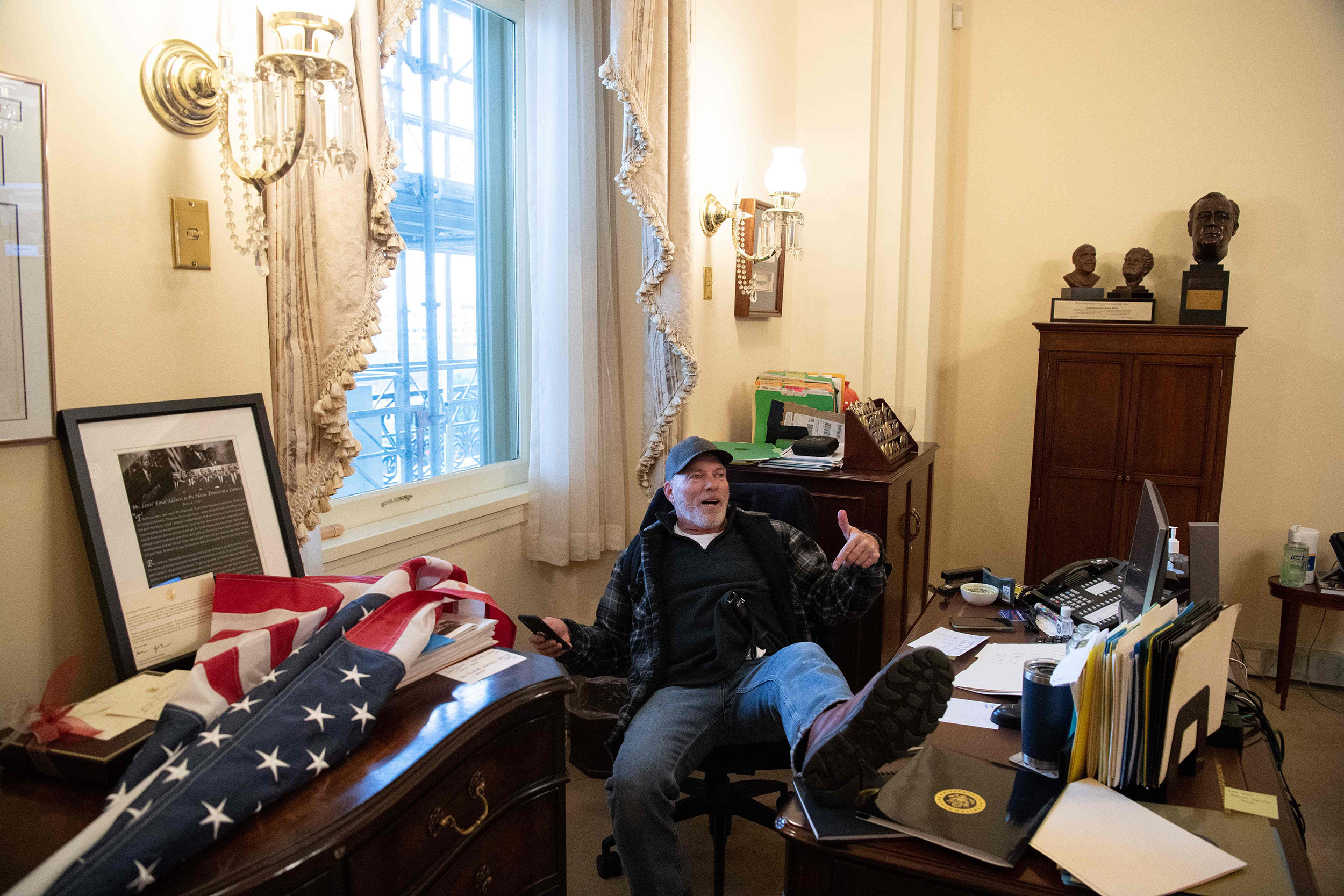
Insurrectionist occupying House Speaker Nancy Pelosi’s office on Jan. 6, 2021.
Lost among 15 ballots for Speaker of the U.S. House of Representatives this week was news that during the second half of 2022 inflation dropped to near the two percent targeted by the Federal Reserve. Chill on inflation, Republicans. Biden has got the runaway economy your party made well in hand. Combine more normal inflation with the lowest unemployment rate since 1969, and robust jobs growth, the administration should be honking its own horn.
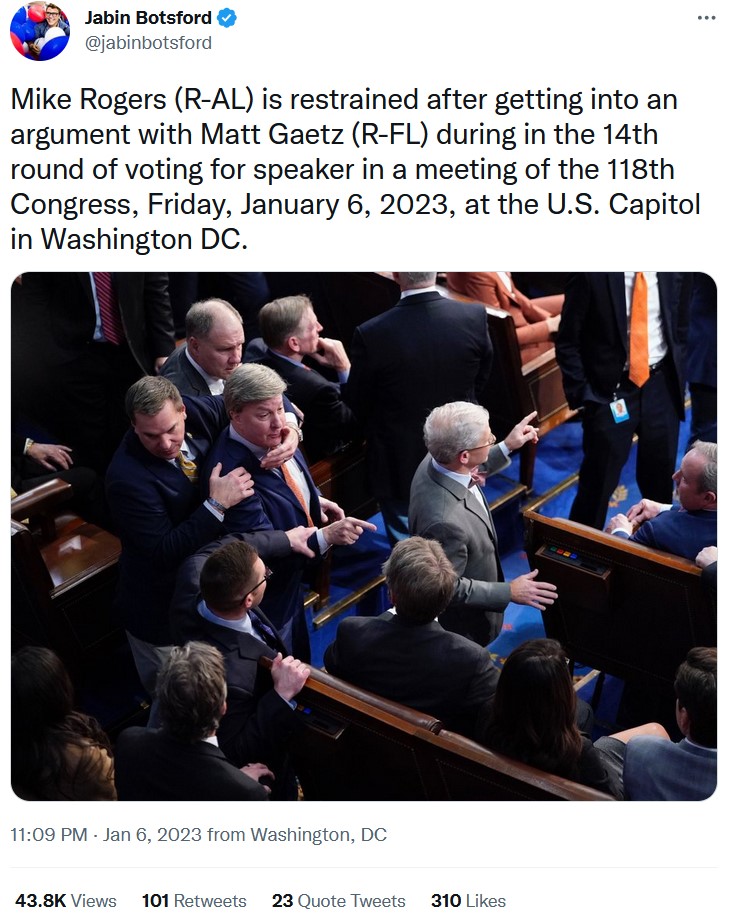
Be assured, the news media is ignoring this positive story. Reporters find the drama and tussles during the speaker votes to be of more interest. Tension among Republicans mounted during voting:
During the final ballot, every Republican got to yes for Kevin McCarthy as House Speaker. We don’t know the extent of concessions McCarthy made to get those votes. We do know there are uncertain waters in our future. Now is the time for Democrats to stay the course.
I will say this about Jan. 6, 2021: American society has bred and indoctrinated some of the dumbest people around. I understand what “Hang Mike Pence” and “Stop the Steal” mean. While repulsive and opposed to our constitutional legacy, the ask was at least coherent: reinstate Donald Trump as president.
As the U.S. House of Representatives elects a speaker for the 118th Congress, we are exposed to all manner of malarkey, including the statement from a U.S. Representative-elect from Georgia that former House Speaker Paul Ryan refused to implement MAGA policy and that’s why he was removed. For some reason, I believe electing a Democratic majority to the U.S. House in 2018, followed by the swearing in of Nancy Pelosi as speaker, was the reason… but what do I know.
House Republicans will do everything possible to make us forget about Jan. 6, 2021. Whether you are a Republican, Democrat, or something else, the nation’s best interests are served by remembering that day, determining what happened, and telling the truth about it. People who broke the law should be brought to justice. Whether we are too dumb as a society to do that is an open question.
Polling place, Saint Mary’s Catholic Church, Nov. 8, 2022.
After the shellacking Iowa Democrats took in the midterms, I haven’t had much to say about politics. When the Rules and Bylaws Committee of the Democratic National Committee excluded Iowa as an early presidential preference state, it was just one more layer. I’m ready for what’s next.
I’m over all the politics and don’t have a seat at the table where Iowa Democrats will determine their future. I have extensive political experience rendered moot by the changes. It seems unlikely I will ever again engage as deeply in politics as I have. As we say by the lake, there are bigger fish to fry.
I’m focused on conserving resources, avoiding having to go back to work, and writing. It’s time to plant onions indoors, and place the second order of garden seeds. I look forward to spring.
I met Arnie Alpert from American Friends Service Committee, New Hampshire at a conference in Washington, D.C. Friday he wrote about the possibility of New Hampshire losing its first in the nation primary status. Alpert raised an important part of my argument against first in the nation caucuses in Iowa.
Another under-noted impact is that when the Primary comes to town, it sucks the oxygen out of other political dynamics. Grassroots groups lose their members to the campaigns for months on end. The few local political reporters who are left turn their attention from Main Street and the State House to the excitement of the national horse race. Reporters, activists, and other spectators watch it like the Kentucky Derby. And the substantive issues discussed by the candidates receive scant attention compared to who’s ahead and who’s behind.
Iowa Democrats could do better without the millstone of the caucuses chained around our necks. Whether that will be the state party’s focus is an open question.
The sky spit snow yesterday, not enough to stick. The refuse hauler changed the pickup schedule from Friday to Thursday, creating an extra weekend day, or so it seems. In the final autumn days we know winter will soon set in. With a crazy climate we don’t know whether or not we’ll need the snow blower, or whether we will have another record low temperature that shakes the house foundation. What I know is winter will seem longer than it is.
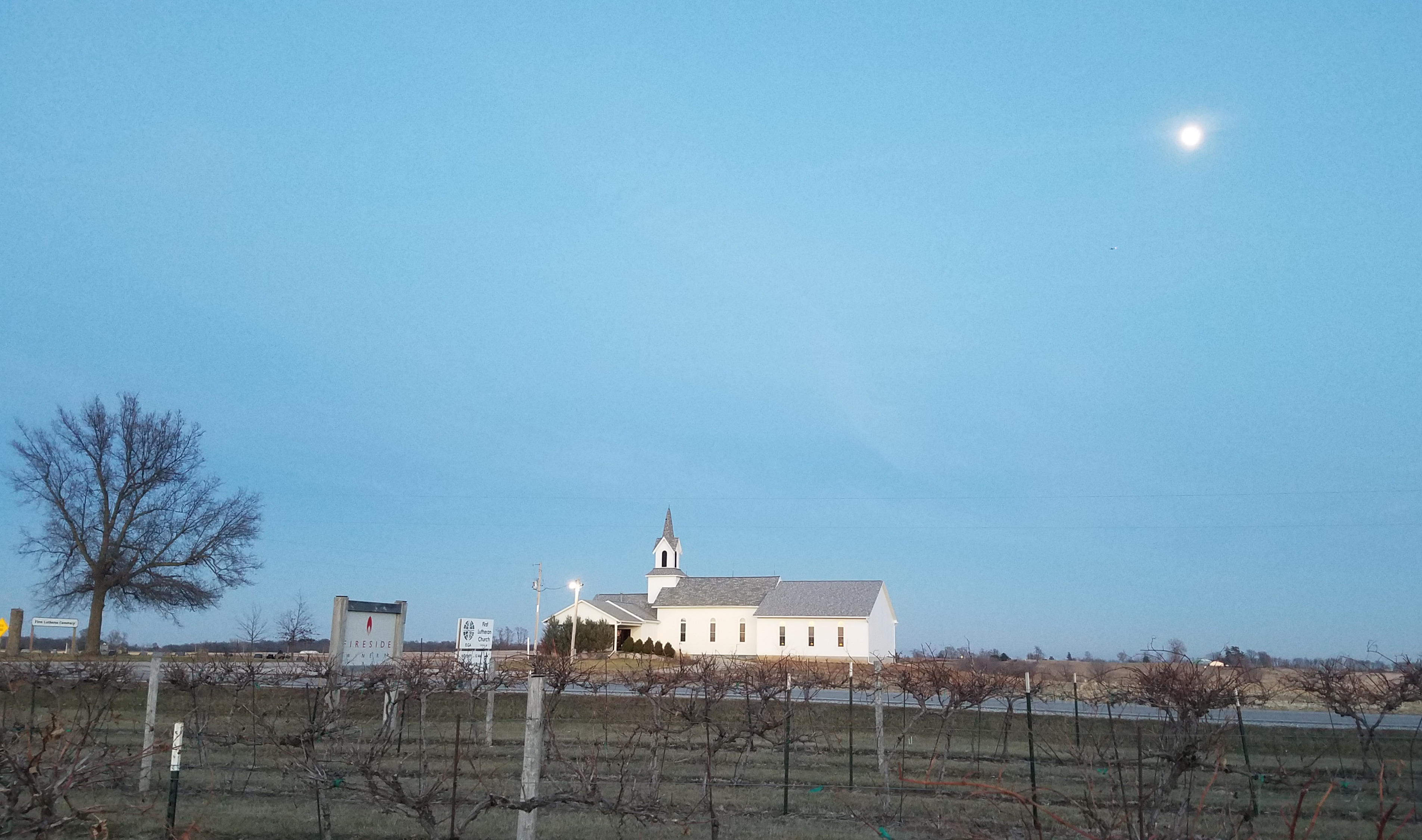
First Lutheran Church with moon rise near Marengo, Iowa.
It took 42 minutes to reach Fireside Winery near Marengo where a group of political friends gathered for the first time since the midterm elections. Among topics discussed were the value of pedicures, local spa experiences, and nail salons. We talked about the election as well.
It was a long drive to get there, yet also important to stay engaged. Iowa County has half the votes in my Iowa House District.
In 2016, before redistricting, our current Republican state representative ran unopposed. In 2024 we may run a candidate again in the new district, although the strength of the Republican’s win was such it may discourage Democratic candidates considering a run. It only makes sense to run to win.
It was good to be among people with common interests. I refrained from drinking any wine at the gathering as I have given up drinking alcohol and driving. It turns out conversation is just as good without it. Drunken me would likely have rejected conversation about getting a pedicure. Now I’m considering getting one.
Fall colors along the long, mostly straight road from Ely Blacktop to the Highway 151 junction are captivating. Most row crops are in the bin with shades of yellow and brown dominating fields. Leaves on deciduous trees have mostly fallen. Traffic was light. It was a good afternoon to appreciate a long drive.
Yesterday the Rules and Bylaws Committee of the Democratic National Committee voted to advance a series of first in the nation states for the 2024 presidential nominating calendar. Iowa was not one of them. The plan includes South Carolina first, followed by New Hampshire and Nevada the following week, then Georgia, then Michigan. The plan is expected to be approved by the DNC early next year.
If one didn’t know Iowa was to be booted from the early states, they have not been paying attention.
Iowa and New Hampshire, both of which have state laws requiring them to go first, are considering next steps. If either state chooses to disregard DNC and changes the schedule, there are penalties, including losing delegates at the Democratic National Convention. Delegates are the whole point of the nominating process. There may be state penalties for failure to go first, but let’s face it, any state could pass such a law and who would enforce it? What will happen next in Iowa is presently unknown.
In 1968, the Democratic National Convention was a disaster in several ways.
Outside the convention hall, anti-war demonstrators protesting the Vietnam War roamed Chicago streets. The Chicago police department, under the direction of Mayor Richard J. Daly, used force in an attempt to maintain control.
During the evening of Aug. 28, 1968, with the police riot in full swing on Michigan Avenue in front of the Democratic party’s convention headquarters, the Conrad Hilton hotel, television networks broadcast live as the anti-war protesters began the now-iconic chant “The whole world is watching.”
1968 Democratic National Convention protests, Wikipedia.
At home, I saw televised news reports from Michigan Avenue. A friend was inside the Conrad Hilton with Harold Hughes who ran for president that year. He hoped the nomination of Hubert Humphrey, in a smoke filled room away from the convention, was something that would never again happen. South Dakota Senator George McGovern was assigned the task of re-designing the nominating calendar and process, which he did. We have been operating under the McGovern plan ever since.
Most Americans of voting age participate in presidential politics. Here is a brief summary of my memories. Consider it my farewell gift to the Iowa caucus.
Harry Truman: I was 13 months old when Harry Truman left office. I have no living memory of his administration.
Dwight D. Eisenhower: Our family didn’t like having a Republican president yet were thankful for his plan to build the Interstate Highway System. I recall talking about how it was designed so that military vehicles hauling missiles could travel under the roads and bridges that crossed the Interstates. We didn’t like Eisenhower yet accepted that his credentials during World War II yielded a competent chief executive.
John F. Kennedy: Father worked on the Kennedy campaign and shared some of that with me. If there was a Camelot, I’m over that now. I wrote previously about this. Click here to read that post.
Lyndon Baines Johnson: I stuffed envelopes for the 1964 Johnson campaign at the Democratic office in downtown Davenport. I came to expect that all elections would be like the Johnson landslide. I was young.
Hubert Humphrey: Based on conversations with my father, I felt the Humphrey nomination was tainted. Partly, I didn’t understand how the convention got so out of hand. I resented the corruption evident in Chicago Mayor Daly. Richard Nixon won in 1968.
George McGovern: My main memory of McGovern’s campaign was a rally before election day at the University of Iowa Pentacrest. I don’t remember if I voted. I wrote more extensively about the 1972 election here. Richard Nixon won reelection.
Jimmy Carter: I was in between finishing Officer Candidate School at Fort Benning, Georgia and traveling to my first assignment in Mainz, Germany during the 1976 presidential election. After Nixon’s resignation in disgrace, I literally didn’t care who was elected president that year.
Ted Kennedy: Turns out I didn’t care for Jimmy Carter enough to support him for a second term. I caucused for Ted Kennedy in Davenport and he wasn’t viable. I declined to join my union friends with the Carter group and went home.
George McGovern: My spouse and I caucused for George McGovern in 1984. We attended a forum in Des Moines where he, Walter Mondale, Jesse Jackson, Fritz Hollings and others appeared. At the precinct caucus, I joined the platform committee and was selected to go to the county convention as a McGovern delegate. It was my first taste of Johnson County politics.
Michael Dukakis: We lived in Lake County, Indiana in 1988. I remember saying to myself during the June primary election, “Who’s bright idea was running Dukakis?” He lost to George H.W. Bush.
Bill Clinton: Still in Indiana in 1992, I supported Bill Clinton. I took our daughter into the voting booth so she could press Clinton’s name on the touch-screen voting device for me. I didn’t devote a lot of time to Clinton’s campaign or to politics. Back in Iowa for the 1996 election, I continued to be inactive in politics. I judged Clinton could be nominated without my help and didn’t attend the precinct caucus. Clinton won Iowa 50.26 percent to Robert Dole’s 39.92 percent.
Al Gore: I skipped the caucuses in 1996 as I believed Al Gore would win the nomination without me. He did, and as we know, the U.S. Supreme Court stopped ballot counting in Florida during the general election, giving the win to George W. Bush.
John Kerry: I quickly came to believe the George W. Bush administration was the worst. In the first days after the Sept. 11, 2001 terrorist attack, I rallied around the president. It didn’t last long. I wrote about my transition here. All three in our family attended the 2004 caucus in Big Grove Precinct together and caucused for John Kerry. I helped run the caucus as secretary that cycle. I joined the Democratic central committee again and worked on the Kerry campaign. I also decided that after his performance in the Whitewater controversy, long-time U.S. Representative Jim Leach had to go. In 2006 we elected Dave Loebsack to the Congress.
John Edwards: Despite all the negativity that came out about John Edwards after his last presidential campaign, I have no regrets having worked to make him the Democratic nominee in 2008. I spent time with him, his wife Elizabeth, and their children. This precinct caucus was the best attended in my almost 30 years living in Big Grove Township — about 260 people. I served as caucus secretary again and it was challenging to make a count. There wasn’t enough room in the school cafeteria and some of the voters stretched out into the hallway. I recall Edwards had a contingent from the care center in wheelchairs and on gurneys. In the end, Hillary Clinton and John Edwards tied and Clinton won the coin toss. Barack Obama got the most delegates and won the general election.
Barack Obama: During the 2012 precinct caucuses I led two precincts other than my own: Cedar and Graham. The caucus began with live video of Obama, then we broke into precinct groups. Noone was willing to lead the caucus among the eight people in each of two precincts. I convinced a friend to be secretary. Obama’s reelection was not a given yet his campaign was thorough enough to win a second term.
Hillary Clinton: I led the Clinton delegation to the 2016 precinct caucus. We had so many delegates we could send some to the Martin O’Malley group to make them viable and deprive Bernie Sanders of a delegate. I decided being a Clinton leader took precedence over running the caucus. It was a good decision. As we know now, Clinton won the nomination and lost the general.
Elizabeth Warren: I led my own caucus for the second time in 2020, supporting Elizabeth Warren for the nomination. I was well organized and the process proceeded smoothly. We split our four delegates with one each to Warren, Amy Klobuchar, Pete Buttigieg and Joe Biden. Biden placed fourth in Iowa. It wasn’t until South Carolina that the Biden train started to roll out of the station. Buttigieg won Iowa by a small margin yet any momentum was halted by a computer failure in the application we used to report our results. This disaster was likely a prime catalyst for removing Iowa from early in the nominating process this week.
Joe Biden: Joe Biden hasn’t announced whether he will run for president in 2024. One assumes he is in good health and will live long enough to serve a second term. If the DNC is successful in removing Iowa from the early states, as it appears they will be, presidential politics will be a lot different in Iowa. I hope it will be better.
Our county Democratic party held the first central committee meeting after the 2020 midterms on Dec. 1. I wouldn’t describe it as positive. It was a meeting without hope.
As expected, candidates for the Iowa legislature with districts contained within county boundaries won. So did the statewide Democratic candidates, yet only in Johnson County. Democrats, as has been widely reported, lost all statewide races except state auditor.
Someone on the first district central committee reported there is a concern among central committee members about a lack of leadership from the Iowa Democratic Party. Not sure if we are at “heads will roll” stage.
Locally, we raised a lot of money, yet failed to give it to candidates before the election. We had $32,000 in the bank after election day, a mortal sin. Could that have made a difference in some of the races we lost? We’ll never know.
County chair Ed Cranston said we had a goal of creating a 35,000 vote margin for Democrats in the county election. Our U.S. Senate candidate Michael Franken got a margin of 27,130. Cranston acknowledged a need to determine why we fell so far short of our goal. All we know at this point is no preference voters were neither adequately targeted, nor did they turn out in needed numbers. Numbers are being crunched, he said.
A former county party chair made a motion to move toward in-person meetings in January and February. About two dozen people participated in the Dec. 1 meeting via Zoom. The motion was voted down as committee members recognized the value of enabling as many people as possible to participate in the rebuilding process. In my one minute speech against the motion, I said it was discriminatory against disabled persons to suggest members must show up in person. The motion was a form of ableism, I said. Most of those participating via Zoom voted against the motion.
The central committee in a large county like ours has become less relevant to the political process. Whether we meet in hybrid form, in person, or virtually, no one has any good ideas about what needs to be done going forward. Emphasis on “good.”
This cycle we lacked a state coordinated campaign and didn’t know what to do with that freedom. With yesterday’s leak from the Biden team that the president was recommending early states be comprised of South Carolina, Georgia, New Hampshire, Nevada, and Michigan, Iowa will be even more isolated if that holds. That’s not all bad. It would be better if we had a plan for political life after the caucuses.
That’s right. The reality of the Iowa caucus is it’s over.
Last night the Biden administration hosted President of France Emmanuel Jean-Michel Frédéric Macron in its first state dinner. I hope no one got sick with all the fancy food. I mean, regular people don’t eat lobster and such like that. On the plus side, Biden held only one state dinner since the inauguration. Now back to work for the president and for the rest of us trying to stay relevant. The party is over.
What went wrong for Democrats in the 2022 midterm election? A lot. How do we fix it? The first reaction, and I believe the wrong one, is to throw the bums out.
I like Ross Wilburn, Iowa Democratic Party chairman and have since he was the Iowa City mayor. I agree with the idea that if he can’t perform as state party chair — and the lack of Democratic wins during the recent election cycle makes a case that he can’t — we should replace him. There are three parts to this and they don’t lead us there.
First, Democratic core activists like the groups with which I associate were very busy with political work for a year before the November election. Whatever analysis we or others might make about the mechanics of the campaign (Vote Builder, money, coordinated campaign, messaging) it doesn’t detract from the fact our core active Democrats were busy working to get our candidates elected.
Second, the state central committee, which elects the party chair, is increasingly irrelevant. Our last days of glory were in 2006 and 2008. It has been a long, dry season ever since. The biggest change in the state central committee has been the rise of Bernie Sanders supporters who wanted to change everything for the better. They won their elections to the central committee, yet I’m not seeing change we need. The last two cycles have really rotted. Maybe they should be replaced as well.
Third, the problem in replacing folks on the state central committee, and how they organized the 2020 and 2022 cycles particularly, is millennials and Gen-Z voters are not stepping up to help campaigns the way my generation was accustomed to doing. I noted in a previous post, contrary to the national trend, they were the ones who found reasons not to vote on Nov. 8. Instead, they are packing their bags and leaving the state permanently. This is part of a broader dynamic. Changing members of the central committee can be fine, yet it doesn’t address the brain drain ongoing in Iowa. This is an unrecognized, real-world consequence that costs the party. People who leave the state to better themselves seem most often to be, if not always, Democratic voters.
A Republican strength is it targets young Iowans who attend community college, get married, raise a traditional family, and settle down close to where they were born. The culture of this is stifling, yet some folks in those generations thrive in it, have multiple children, and buy McMansions to withdraw into church, school and family. For the most part, they are not Democrats.
Making do in this bleak Iowa cultural landscape seems unlikely for young people who have more ambition and are willing to trade what they know for a chance at something better. They will leave the state and never look back.
I’m not sure changing the party chair addresses this core problem. That’s why I’m not anxious for major changes in the state central committee.
For a minute, let’s go into the Wayback Machine. After Wilburn was elected in 2021, The Des Moines Register reported,
Wilburn said he would begin the party’s rebuilding efforts by creating a three-election-cycle strategic roadmap; improving candidate and local leadership development; working to become a better asset to county parties and other constituency groups; and improving the party’s use of data.
State Rep. Ross Wilburn elected to lead Iowa Democratic Party as chairman by Brianne Pfannenstiel, Des Moines Register, Jan. 23, 2021.
What of that plan? To my knowledge, that was the only public mention of it. On its face, it’s one cycle down and two to go. From my perch, candidate development seemed very good. There were great candidates fielded, like Kevin Kinney, who didn’t win their elections. This part was successful, even if the results were disappointing.
I’m not sure how the state party became a better asset to county parties. Here in Johnson County, we had freedom to structure a campaign the way we wanted. It appeared we had enough paid staff and resources to conduct operations. Statewide candidates were frequently present. We weren’t successful in the most Democratic County, yet there should be valuable lessons to learn. The biggest lesson should be found in answering the question why did we fall about 4,700 votes short of our 32,000 Democratic margin goal?
As far as improving the party’s use of data, all I heard as election day approached was that we were focused on turning out likely Democratic voters who previously voted only in presidential years. We had the data to target those folks, yet not enough of them voted. As I have written, my precinct turnout, among Democrats and Republicans was significantly less than 2018 and 2020. Part of that is erosion of Democratic registrations yet turnout in both parties was down. Three cycles equals six years, so hopefully the state central committee is busy analyzing data to figure out what went wrong during the first two.
During previous election cycles, I wrote my analysis of the election quickly, soon after the polls closed and results were known. It seems essential we take our time this cycle to examine the results carefully and thoroughly. I plan to live in Iowa for a long time, and would like to see more Democratic wins. 2023 will be the first time I’ve had a Republican state senator since we moved here in 1993.
Things have been better when Democrats had a say in our governance. We are a distance from that being the case again. During the Thanksgiving holiday weekend, part of the celebration has been coming to terms with that reality.
Big Grove Precinct polling place at the Catholic Church.
Computers for the poll workers were set up below a large crucifix on the wall of Saint Mary’s Church. It was as if Jesus and I (the certified Democratic poll watcher) were keeping an eye on the proceedings. There was no controversy during election day activities. From news accounts, that appears to have been true across the state. When issues arose, the election system addressed them. It was a statewide Republican sweep, with a few exceptions, and that was that.
756 voters cast a ballot under Jesus’ watchful eye. As was expected, more Republicans cast a ballot at the polls on election day with Chuck Grassley receiving 478 votes and challenger Michael Franken 274 in our room. (In my previous post I tallied the main results). Voters have spoken, and that, too, is that.
Father worked as an organizer on the 1960 election of John F. Kennedy. I watched him complete mimeographed sheets with a generic grid for our block printed on it. He recorded the names and voting preferences for each property. When he finished our block, he got a clean sheet from the union hall to start another. Richard Nixon won Iowa that cycle.
I remember us discussing living in a Republican state with a Democratic president. It was a non-issue because we were part of a country that had 50 states after Alaska and Hawaii had been admitted to the union the previous year. JFK was our president, too, he said.
I didn’t understand in 1960, and don’t understand now, how voters could pick candidates that don’t hold similar values and would vote against their best interests. Maybe people have been dumbed down. Iowa is not known for having a lot of deep thinkers. According to a recent article by Samuel Stebbins, Iowa ranks among the least educated states. That has to be part of it yet is not the whole story.
Iowans are conditioned to accept a wide range of outrageous things and such socialization or indoctrination is a key reason for Iowa Republican successes this election cycle. How they got there goes back to the rise of right wing talk radio and FOX. The socialized modern Republican is a primary cause of the infection of social discourse. It feeds upon itself. More liberal people either don’t want to engage in this discourse or don’t have to. Living in a progressive or liberal bubble isn’t good either.
Toward the end of election day, some Republicans hung around the entrance to the polling place. I listened to them chatting after they voted. Most were not aware of any framework, just that their peers can carry on a certain conversation with which they agree. Politics was hardly mentioned even though there we were at the polling place. The subject of conversation did not matter as much as the fact of it. This behavior, of setting existential reality aside to focus on something else, is essential to Republican dominance in modern society.
As film maker Jen Senko pointed out in her book and movie, The Brainwashing of My Dad, this conditioning is reversible if we know how to do it. For my part, I don’t enjoy getting into conversations where participants recount what happened last night while they were getting ready for sleep with the television tuned to FOX News. If we are serious about changing society for the better, people like me don’t need to consume right wing talk radio and television. However, we have to enter into more of these types of conversations. In doing so we become part of the community. I believe our differences will be tolerated in civil conversations and that is better than not being heard at all.
There is a lot to say about the 2022 midterms. There is nothing else to say. I’m moving on to more productive ground as this plot needs to lie fallow for a while. We’ll see what tomorrow brings.
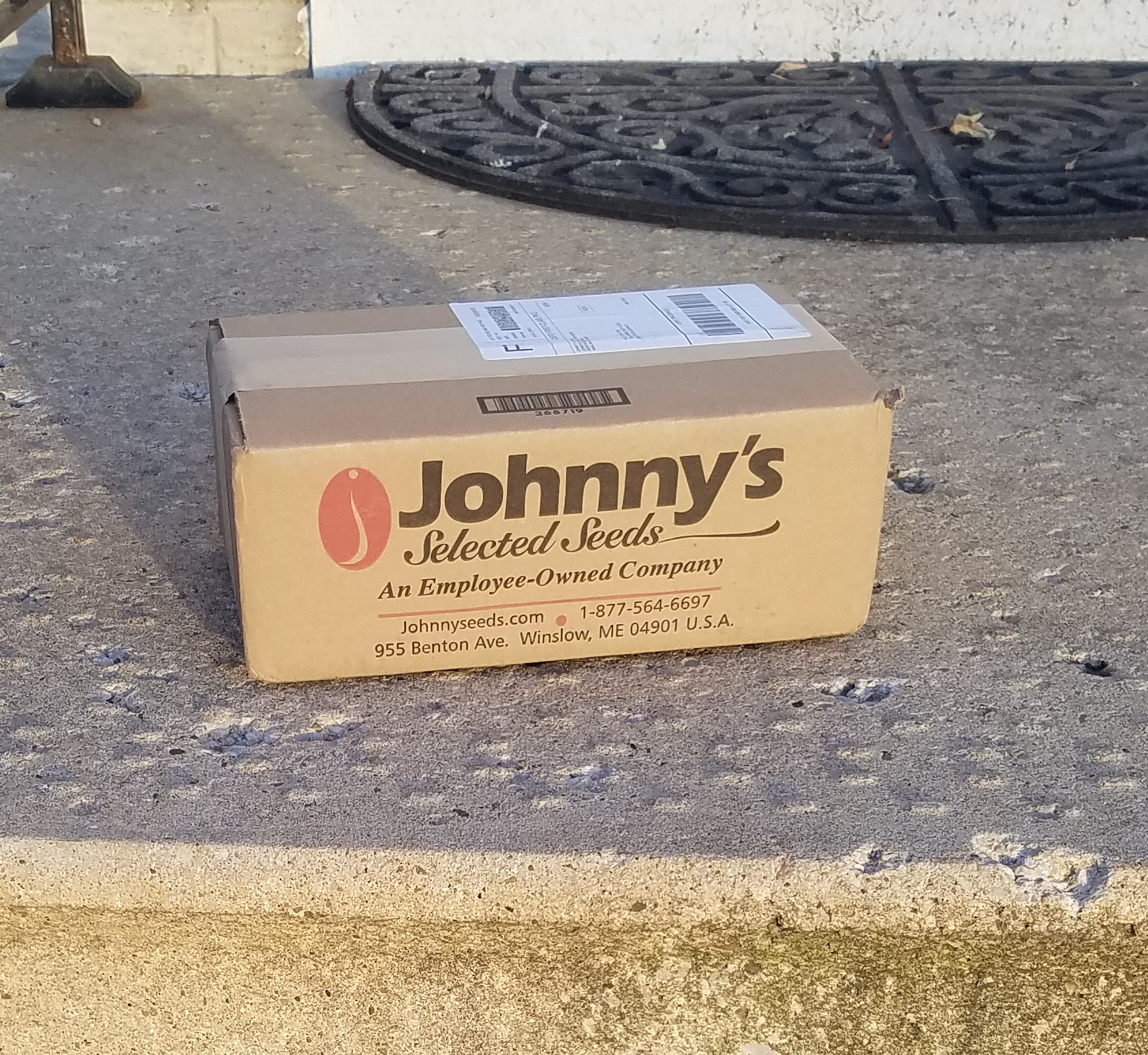
Seeds went on sale at Johnny’s Selected Seeds and I placed a typical fall vegetable seed order. The cost savings were important, although I’m more anxious to get started with next year’s garden. I labeled packets with the gardening year of their intended use and filed them away. Apparently I decided to grow a lot of Romaine lettuce and got 1,000 pelleted Monte Carlo seeds.
Wednesday was a punk day with negative feedback from the election coming in via all media.
The preliminary results for Big Grove Township are that Republicans swept all the top races. Voter turnout in both parties was much less than in 2020. Chuck Grassley beat Michael Franken 563-473; Mariannette Miller-Meeks beat Christina Bohannan 565-473; Kim Reynolds beat Deidre DeJear 570-434; Dawn Driscoll beat Kevin Kinney 529-503; and Brad Sherman beat Elle Wyant 574-442.
In the county supervisor race, votes were split among five candidates as follows: Phil Hemingway – 580, Jammie Bradshaw – 537; Jon Green – 422; V. Fixmer-Oraiz – 351; and Erick Heick – 34.
Public Measure 1, adding language about Second Amendment rights to the Iowa Constitution, was approved here 562-436.
County-wide, Democrats won all of these races except House District 91, and Public Measure 1 failed.
The best result of the last few days was receiving my first order of garden seeds. Politics has been a disappointment the last few years. I plan to stick to gardening in 2023.
Lunar Eclipse on Nov. 8, 2022 taken with my mobile device.
Election day began with a total lunar eclipse at 4:16 a.m. I’ll refrain from obvious puns and wise-cracks. This election should be serious business.
Before the polls open, I’m not hopeful of turnout. Democratic early voting in our county is running behind the results in 2018 and 2020. According to former county party chair Brian Flaherty, Democrats need to turn out voters on election day at 128 percent of what we did in the 2018 gubernatorial race. Based my Sunday door knocks, too many people are blowing off this year’s election, making achievement of that election-day turnout goal more difficult. Mine was a small sample of voters, so maybe the broader trend is different. It is young, married people on my list — millennials and Gen-Z — who are not planning to vote.
This cycle my engagement with the campaigns changed. I found a home with the Kevin Kinney campaign because unlike the two decades of previous contests, the race to represent our precinct in the Iowa Senate was highly competitive. It is one of the most expensive political campaigns for a statehouse seat in the state. It seems clear the Democrat is the better candidate and the campaign is knocking doors until there are no more to knock. They also have a paid campaign manager, which makes a big difference in accessibility, professionalism, and flexibility. In the past, I aligned with the House candidate for campaign activities. This cycle our candidate, Elle Wyant, is running a less conventional campaign, which made it a bit difficult to plug in. The usual political activists in Big Grove did what they could to support her. We remain optimistic that Kinney can win his race. We should know tonight, although it will likely be close.
I began writing political letters to the editor about our congresswoman Mariannette Miller-Meeks in March 2021 after Rita Hart withdrew her election contest. My letters have been regular until my final one appeared last Thursday. I have written on topics other than the congressional race, yet the focus after the nominating period has been on electing Christina Bohannan to the Congress. In every political poll, Republican Mariannette Miller-Meeks held the lead. This race will be determined by turnout. Bohannan’s name recognition has not been good on the doors, even among people who said they plan to vote for Democrats. The only poll that matters is the one today after the polls close.
Other things I did during the campaign include attending the Iowa County central committee meetings, donating what I could afford to candidates, placing campaign signs at home and in our area, discussing the ballot with friends and family, attending a couple of events, and holding one event at the library. I was more active than I thought I would be.
The eclipse is ongoing as I hit the publish button and head upstairs to shower. I signed up as a poll watcher after no one else in our precinct did. It is going to be a long day. I’m hoping for a quiet day in which I can get a lot of reading done. To conserve battery life, I’ll keep my mobile device mostly turned off.
If you are reading this and haven’t voted, the polls are open Nov. 8 until 8 p.m. in Iowa: go vote.





 Journey Home
You must be logged in to post a comment.