Some days I wish the 45th President would settle into retirement and fade away. That doesn’t seem likely. There is, however, a strong case that Trump is disqualified from being on the ballot because of his engagement in the insurrection of Jan. 6, 2021. Dean Obeidallah presents a case for action in a recent substack post.
Last week, two prominent conservative scholars, William Baude of the University of Chicago and Michael Stokes Paulsen of the University of St Thomas, made a compelling case that Trump is disqualified from holding office in article published in the University of Pennsylvania Law Review. And just a few days ago, conservative former federal court of appeals judge J. Michael Luttig and famed Harvard Law constitutional professor Laurence Tribe penned an article for The Atlantic titled, “The Constitution Prohibits Trump From Ever Being President Again.” These two distinguished jurists reached the same conclusion that Trump had “engaged in insurrection” and is barred from ever serving in federal office again by way of the US Constitution.
I filed a complaint to disqualify Trump from the ballot and so should you! by Dean Obeidallah, Aug. 23, 2023.
Read Obeidallah’s full article here. Then consider copying and pasting the following email to Iowa Secretary of State Paul Pate at sos@sos.iowa.gov. Feel free to edit the email to meet your needs. If you do send the email, I expect your will feel better.
Dear Secretary of State Pate,
I’m writing to your offices urging a formal review of whether Donald Trump is barred from the ballot in Iowa by way of Section 3 of the 14th Amendment. That Amendment disqualifies from the ballot any person who “shall have engaged” in an “insurrection.” For such a disqualification, there is no requirement that Trump or any person be first convicted of any crime—as the Congressional Research Service notes.
In addition, last year after a trial in New Mexico, a judge ruled that Jan 6 was an “insurrection” within the meaning of the 14th Amendment and that Otero County Commissioner Couy Griffin was removed from office and disqualified from the ballot for “engaging” in that attack. Donald Trump’s actions– as detailed in the final report of the “Select Committee to Investigate the January 6th Attack”—far exceed the actions of Griffin in terms of “engaging” in the Jan 6 insurrection. While that New Mexico ruling is not binding in this state, it is persuasive in its reasoning and I urge your offices to read it.
Finally, conservative legal scholars have recently penned articles reaching the conclusion that given Trump’s conduct, the US Constitution does in fact bar Trump from the ballot.
As the US Constitution mandates, no one should be permitted to be on the ballot who has engaged in an insurrection. The time to review if Trump has done just that and is barred from the ballot is now—well before the 2024 election.
Thank you for considering this issue that is vitally important to protecting our Republic.
After the Aug. 17, 2023 town hall meeting in Shueyville, State Representative Amy Nielsen provided the following information to help stay current with what the Iowa House Democrats are doing:
Official Legislative Website and Subscribe to Newsletter:
The United States is a country where we constantly balance security and liberty. During my youth, we were taught to believe that a large nuclear weapons arsenal, with a triad of land-based missiles, aircraft-dropped gravity bombs, and submarines would deter the Soviet Union from attacking us. When the attacks of Sept. 11, 2001 happened, we shifted to a concern that a small group of terrorists had brought havoc on the country by bombing three locations with hijacked aircraft and could do it again. We subsequently gave unprecedented authority to the President to manage our security.
While it seems unlikely that one of the nuclear armed states would initiate an attack with nuclear weapons in the sort term future, the reality of ease a terrorist group has of constructing a single nuclear weapon with fissile materials collected from across the globe is as present as ever. Osama Bin Laden notably consulted with nuclear engineers at his last residence in Abbottabad, Pakistan. Terrorists have said they would use nuclear weapons if they could get the materials to make them and likely would. In the United States, we are free as long as we defend against this possibility.
What are Iowans doing to protect us? On Monday, Aug. 21, the governor’s office issued a press release saying Governor Kim Reynolds had joined four other governors at Eagle Pass, Texas to “ban together to secure border. The typo/misspelling aside, Reynolds had serious intent:
Texas is ground zero, front and center of the border crisis,” said Governor Reynolds… “On day 1 of the Biden Administration, they reversed policies that protect the sovereignty of this country and its citizens. Iowa is located at the intersection of two major interstates, and it is a pathway for Mexican cartels and humans traffickers in the Midwest.
Governors Reynolds, Abbott, Pillen, Stitt and Noem Ban Together To Secure Border, Office of the Iowa Governor, Aug. 21, 2023.
During this brief moment of grandstanding, the Republican governors seem to have forgotten the Biden administration has been working on the causes of illegal immigration, almost since day one. Vice President Harris has been charged with determining what can be done with the governments of Mexico, Honduras, Guatemala, El Salvador, and others as people in those countries, including children and families, fled in record numbers. Migration from the region has spiked due to a web of factors, including poverty, corruption, racism, disease, natural disasters and gang violence, according to the Los Angeles Times. Governor Reynolds didn’t mention or acknowledge what the administration is doing because her trip was more about winning the 2024 election by scaring the electorate.
Let’s not forget that drug dealers won’t be stopped by improved security across the southern border. They have the resources, staffing, and technology to create innovative solutions to deliver their wares to the United States, including submersible ocean-going vessels, and aircraft that don’t touch land until they arrive in country. Republicans belied the complexity of dealing with threats from Mexico and Central America at their Eagle Pass photo opportunity. They distract us from other, more realistic threats to our security and liberty. They are going to have to do something other than point an accusing finger at the president to be credible.
Among our biggest threats to security are proliferation of assault-style weapons. There are droughts, derechos, tornadoes and heat waves made worse by climate change. The threat of terrorists securing enough fissile material to make a nuclear bomb, continues to be an issue. What about all these threats to our security? The governors did not mention them at Eagle Pass and more’s the pity. It is time to band together with fellow Democrats to ouster the governor when she is up for reelection in 2026.
In the meanwhile, to get involved with Iowa Democrats, click on this link.
Mariannette Miller-Meeks at the Iowa State Fair, Aug. 13, 2010. Photo credit – Wikimedia Commons.
Can Democrat Christina Bohannan beat Republican Mariannette Miller-Meeks during the second contest between them in 2024? One can only hope… and do everything possible to see that she does. Going into her sixth campaign for the Congress, Miller-Meeks has become a wing-nut institution. Iowans deserve better.
When Miller-Meeks first ran against Congressman Dave Loebsack in 2008 she got shellacked 57.2 percent to 35.4 percent. In 2010, Republicans regained lost ground in Iowa, yet Loebsack beat Miller-Meeks for the second time, 51.0 to 45.9 percent. In 2014, Miller-Meeks lost to Loebsack for the third time 52.5 to 47.4 percent. As many of us recall, when Dave Loebsack retired in 2020, Miller-Meeks beat Rita Hart by six votes. After decennial redistricting, she was re-elected in 2022, without moving into the district, defeating Christina Bohannan 53.4 to 46.6 percent. Iowa began turning deep red in 2010 and while it took Miller-Meeks a while to get going, she followed the trend.
I met Miller-Meeks at a 2008 parade in Johnson County. Costumed as a physician, she circulated among people along the parade route next to her “ambulance.” Good times. During one parade, I had a conversation with her about abortion, the constant conservative issue since Roe v. Wade was decided. “It’s settled law,’ she said. “So that is that,” I said to myself. We now know she jumped on the Dobbs bandwagon when it overturned Roe.
Where to begin with wing nut Republican Mariannette Miller-Meeks (R-IA01)? As a Member of Congress she has learned the double-speak of Washington politicians. These days it is hard to separate truth from hyperbole from outright misrepresentation. She didn’t always used to be this way.
When Terry Branstad was elected governor in 2010, he appointed Miller-Meeks as director of the Iowa Department of Public Health. I wrote a couple of posts after her appointment, including this paragraph:
Where Iowa’s public health is likely to suffer under a (Miller-Meeks) directorship is in developing an understanding of the relationship between Iowa’s agricultural and energy systems with public health. In “Iowa Coal & Health: A Preliminary Mapping Study” by McCue, Deaton, Nost and Rachow the authors point to inadequate collection of data in Iowa regarding adverse health events. While the IDPH does collect data used in the study, the quality of data was a constant source of criticism by geographers who collaborated on the project who were familiar with similar data in other states. It seems unlikely that MMM will invest in data collection improvements despite affirmation of support for the methods of scientific inquiry during her congressional campaign. At the same time, as a proponent of nuclear power to control toxic emissions from coal fired power plants and concentrated animal feeding operations in the state, she is expected to kick the ball down the road for the decades it would take to bring adequate megawatts of nuclear energy on line.
MMM and the Iowa Department of Public Health, Blog for Iowa, Dec. 11, 2010.
12 years later, my position was vindicated. Her views regarding energy in the Iowa economy haven’t changed but her messaging has.
In an Aug. 17 column in the Solon Economist, she bashed what she called “President Biden’s radical energy policies.”
For two years, Americans suffered the consequences of President Biden’s reckless and misguided energy policies. Low to middle-income hard-working families are bearing the brunt of Biden’s all-out war on domestic fuel production which led to record inflation, weakened our national security, and constrained American energy production. House Republicans passed H.R. 1, the Lower Energy Costs Act, the first pro-energy permitting reform in 40 years, to empower our producers to deliver the affordable and reliable energy that our country needs to thrive.
Following through on our commitment to America by Mariannette Miller Meeks, The Solon Economist, Aug. 17, 2023.
Where to start with this paragraph of malarkey? In the first place, The U.S. House passed H.R. 1, The Lower Energy Costs Act with only four Democratic votes. It was hardly bipartisan. Perhaps the reason few Democrats voted for it is the bill fulfills a wish list for the fossil fuel industry, including the following:
The bill expedites the development, importation, and exportation of energy resources, including by
waiving environmental review requirements and other specified requirements under certain environmental laws,
eliminating certain restrictions on the import and export of oil and natural gas,
prohibiting the President from declaring a moratorium on the use of hydraulic fracturing (a type of process used to extract underground energy resources),
directing the Department of the Interior to conduct sales for the leasing of oil and gas resources on federal lands and waters as specified by the bill, and
limiting the authority of the President and executive agencies to restrict or delay the development of energy on federal land.
In addition, the bill reduces royalties for oil and gas development on federal land and eliminates charges on methane emissions.
It also eliminates a variety of funds, such as funds for energy efficiency improvements in buildings as well as the greenhouse gas reduction fund.
Miller-Meeks would undo progress made to reduce greenhouse gas emissions to support the fossil fuel industry. She would hobble efforts to produce the affordable, clean energy she purports to support.
Importantly, H.R. 1 went nowhere: It was not taken up by the Democratic U.S. Senate. It seems premature for Miller-Meeks to be doing a victory dance.
Miller-Meeks held a town hall meeting in Iowa City on Aug. 14. Tom Cook of Iowa City attended and had this report, published in the Cedar Rapids Gazette:
One can see how far out of touch Miller-Meeks is with Iowans by her description of the same event in her Aug. 20 newsletter to constituents.
I’m still waiting for her to listen to First District voters about energy policy. If she would listen, I’m skeptical of persuading her to break free from the influence of fossil fuel companies. She’s not listening to anyone but lobbyists in Washington D.C.
If you would like to help Christina Bohannan defeat this wing nut, sign up on the website located here.
Like many of our readers, I traveled to Des Moines and Washington, D.C. to advocate for issues. I remember visiting Congressman Dave Loebsack in Washington, shortly after his 2006 election to the Congress with a list of a dozen issues to cover. It was quickly clear which issues most interested him. Because I had gotten to know him during his 2006 campaign, he patiently listened to them all.
Issues-based politics has become a bane to normal political life. People have issues. I have issues with most of them. The Aug. 17 People Over Politics Town Hall Meeting in Shueyville got a burr under my saddle over issues.
Iowa House Democrats surveyed the electorate and developed four issues which most voters, regardless of party affiliation, could support: lower costs for Iowans, supporting Iowa’s public schools, protecting reproductive freedom, and legalizing marijuana. The idea was to use these issues as a wedge to convince more voters to elect a Democrat in a conservative district. State Representatives Amy Nielsen and Elinor Levin did a good job of presenting the premise and walking us through the issues.
“What about water quality?” asked one attendee.
“What about climate change?” asked another.
“What about CO2 pipelines and eminent domain being used by private companies to secure right of way for them?” said someone else.
The representatives gave measured responses to each of these questions, explaining that water quality and climate change, as issues, don’t move voters. With CO2 pipelines and eminent domain issues, both parties are divided in the response. All are important to the future of Iowans. The important part, from my perspective, is moving voters to support a less conservative house or senate candidate. According to the survey, these issues are not particularly useful in doing that.
State Representative Chuck Isenhart asserted on X, “Not being on the list (of four) shouldn’t mean that we don’t talk about them at all.” I agree. I devoted much time in my life to addressing the climate crisis. As much as I want to both elect a Democrat to my house district, and solve the climate crisis, they are different types of endeavors. A basic characteristic of debate over issues is that when one talks about one issue, others are excluded. To win back conservative districts, we need to focus on parts of the Democratic agenda that have broader appeal.
There are multiple ways to cover issues with voters. In the best of circumstances, a canvasser can have a conversation with a voter that leads to a constructive discussion of more than the big four. One has to go beyond them to secure a commitment. If anything, the issues most Iowans can support will be an effective beginning place.
The trouble I have with issues that surfaced in Shueyville is some of the activists lost perspective of a larger strategy. If one comes to politics only when we want something, that is, as a single issue voter, we haven’t differentiated ourselves from many Republicans. We need to win some seats currently held by Republicans. To do that we need to find and focus on common ground that exists, like those four issues the House Democrats identified.
In my experience, abortion is a tough one for compromise. People hold strong positions for or against access to abortion. While the survey shows more than half of Iowans liked the protections of Roe Vs. Wade, for many voters supporting reproductive rights is a deal breaker. Once those voters are identified, it’s time to shut the conversation down, make a note, and move on to the next contact. Single issue voters are unlikely to yield.
A person can get tired of their issues not being addressed by government. Waiting for action is never good. That will continue for Democrats as long as Republicans hold the trifecta. House Democrats are offering a potential path forward.
The numbers vary among different legislators and political activists, yet somewhere between 65,000 and 90,000 registered Iowa Democrats did not vote in 2022. It seems like an easy problem to solve. Reach out to those voters, the ones that still live in the state or district, and encourage them to vote. Easy-peasy lemon-squeezy… done before you know it. It surely will make a difference!
Not so fast!
While a good number of political activists swear that in-person contact — at people’s homes or by telephone — is the most effective way to get voters to vote, Democratic activists who attended the Aug. 17 People over Politics town-hall meeting in Shueyville were skeptical. One activist, who was critical of the Iowa Democratic Party, said “door knocking doesn’t work,” based on his personal experience. I spent time at the doors during State Senator Kevin Kinney’s 2020 campaign and must admit that between people not being home, having already voted, and living complicated lives, door knocking wasn’t the best use of my time in a campaign. All the same, what else is there to do?
On Sunday, Aug. 20, about 50 political activists gathered in Iowa City for training in how to canvass in the No Off-Years campaign designed to begin talking to voters now and gain commitments to vote in November 2024. Johnson County, the Iowa City-Coralville area particularly, has a different set of challenges to address with a high density of Democrats. The goal is to match or beat the Iowa Secretary of State’s 2020 voter turnout percentage of 74.0 percent in the county (86 percent of active voters). Statewide the election had 76.0 percent turnout (81.2 percent of active). In this usage, “to canvass” refers to a lot of door-knocking. The county party laid out the plan to address infrequent voters in an Aug. 22, email:
Our GOTV team begins canvassing on September 10. We will go out on six separate dates in September and October. We will be talking to Democrats who are “inactive” or who vote infrequently as well as liberal to moderate “no party” voters, and learning what issues are of importance to them and their families. This information will be very helpful in understanding how to best appeal to No Party voters whose top issues align with Democratic values.
Email from Johnson County Democrats, Aug. 22, 2023.
If people are not motivated to vote and door knocking and telephone calls don’t work to get them out, what is the approach activists should use to get ready for November 2024? An answer to this question is above the pay grade for most volunteers. Right or wrong, the assumption, at least in Johnson County, is that door knocking does work, so full steam ahead. That may not work as well in districts like House District 91 where Democrats are not concentrated in a few areas, and the Republican won the state house race in Johnson County and district-wide.
I am in the “door knocking is one tool in the organizer’s kitbag” camp on the spectrum of how to win voters over and get them to the polls. The main trouble with political door-knocking is in places like Johnson County, a substantial, machine-like organization is created to contact voters and use a specific script when they do. Door-knocking and telephone calling is scheduled in shifts where the volunteer has little control over which voters are contacted, or why they were chosen for attention. One has to have faith in the system that the masterminds of developing canvass lists know what they are doing. The recent lack of success Iowa Democrats experienced hasn’t instilled such faith.
Let’s get back to the basics. In 1964 John F. Kennedy lost Iowa yet his constituents were hard at work trying to make a difference. I watched my father do his voter contact planning and it was not complicated. 1). Pick up a mimeographed page with a generic city block printed on it from the union local. 2). Learn the names, addresses, and phone numbers of every voter on the block and add them to the form. 3). Meet with neighbors and ask if they would vote for JFK and how certain they were. 4). Make a note on the sheet. 5). Follow up when the election got closer. It all sounds so simple. A person was in charge of a geographic turf, gathered needed information on all voters, and engaged them to get out those voting for JFK.
Obama used a similar system in 2008, although his campaign provided names, addresses and contact information. Our neighborhood organizer had a paper list of every voter in their turf and worked them until they knew where each person stood on voting for Obama, and if they weren’t, whether they were persuadable. Unlike JFK, Obama won Iowa that election and in 2012 as well. It was the in-person localized contact that made a difference during the Obama campaign. So what happened?
Data heads took over voter targeting and the voter contact operation by managing a voter database comprised of available voter information.
With the rise in campaign technology beginning with the Howard Dean campaign in 2004, how campaigns were conducted changed. Obama brought the technology of campaigns together and we had an edge on Republicans. That didn’t last long.
How Do Iowa Democrats Proceed? Journey Home, Aug. 10, 2023.
Working from a voter database instead of from a neighborhood has its merits. When there aren’t enough volunteers, it can prioritize which voters get contacted. For Democrats, that is usually people who don’t vote consistently or meet certain demographic profiles like age, sex and area of residence. Under the “we don’t have enough volunteers so the party will pick which voters to contact” method, volunteers can be disenfranchised. Some of this dissatisfaction surfaced at the meeting in Shueyville.
It seems a bit much to ask Democratic activists to have blind faith that the party and its data heads know what they are doing. Democratic support for candidates in Iowa degraded beginning with the 2010 election, culminating with the 2016 election when Republicans gained a legislative trifecta. While the Israelites were made to wander in the wilderness for forty years for their disobedience and lack of belief, let’s hope it doesn’t take Iowa Democrats that long to get with the program. 40 years of Republicans in charge could be hella bad.
Don’t like door knocking and phone calling? Stop complaining and do something else that makes a difference. Something like taking ownership of your neighborhood and maximizing how many votes can be produced for your candidates. The Iowa Democratic Party must determine how to better empower this kind of activism.
To get involved, click on the Iowa Democratic Party website.
One of the issues discussed at an Aug. 17 meeting in Shueyville, with representatives of the Iowa House Democrats, was registering high school students to vote. There are processes and conflicts in doing so within some school districts. To hear attendees tell about it, it was a struggle.
State Representative Elinor Levin nodded when I mentioned House Minority Leader Jennifer Konfrst had been promoting Iowa High School Democrats as an organizing tool. Never heard of it? It is a national organization for Democratic high school students with state and local chapters.
High School Democrats of America empowers and encourages students to take on an active role in the fight for Democratic victories across the country. In addition to fostering civil discourse among those with opposing viewpoints, HSDA provides a platform for members to impact the political process in a substantive way and make their voices heard on a national level.
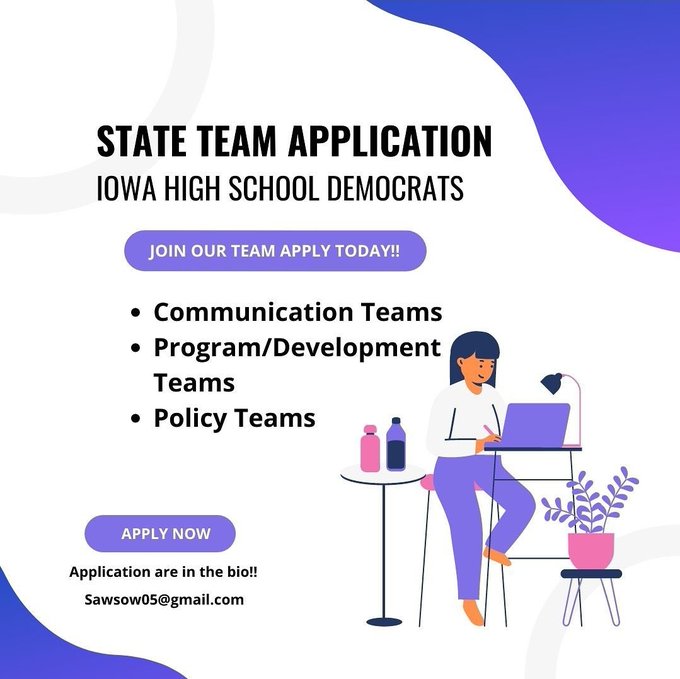
Iowa High School Democrats State Team
The purpose of Iowa High School Democrats is to cultivate democratic values in the state of Iowa. By advocating for democratic beliefs and getting democratic leaders elected to office. It is comprised of the following teams:
Communications Team:
Our talented Communications Team will harness the power of social media to craft engaging and relatable posts. By doing so, we aim to effectively address the critical issues that profoundly impact today’s youth. Our team members are dedicated to ensuring that our messages resonate with authenticity and relevance, enabling us to connect with our audience on a deeper level. We are here to also to support the democratic leaders in Iowa.
Program/Development Team:
Our passionate Program/Development Team combines their research skills with a genuine commitment to advancing our youth organization. They work tirelessly to enrich our curricula by providing a wealth of additional resources to our members. Together, we explore innovative ways to expand Iowa High School Democrats, including the exciting development of school chapters. With their creative brainstorming sessions, our team is continuously striving to take our organization to new heights.
Policy Team:
At the heart of our organization, the Policy Team diligently stays informed about various laws and emerging issues. Their dedication allows us to collaborate closely with the Communications Team, ensuring that the information we share remains relevant and impactful. Our Policy Team is committed to making a positive impact through their research and collaborative efforts.
The group is just getting started. For more information, or to join, contact the founder at Sawsow05@gmail.com.
On Thursday, Aug. 17, the Iowa House Democrats People Over Politics tour of conservative districts came to House District 91. About 20 people, all residents of the district, attended the town hall-style meeting at the Shueyville Community Center. About all we had in common was that we were Democrats who held a deep dislike for our Republican State Representative Brad Sherman.
The 90-minute session was mostly an airing of grievances as State Representatives Amy Nielsen, who previously represented Shueyville, and Elinor Levin from Iowa City moderated the discussion. Until now, there had been few gatherings of Democrats in the district. It was a great opportunity to hear from Democratic representatives about what’s happened at the statehouse, ask questions about the legislative session, and express our legislative priorities.
People Over Politics was the Iowa House Democrats response to increasing extremism among majority Republicans. After surveying the electorate, Democrats distilled four issues about which most Iowans (not just Democrats) can agree. Following are the four key issues from their website:
Lower Costs for Iowans
Too many Iowans are still struggling to make ends meet today. Their wages simply aren’t keeping up with the rising costs of healthcare, food costs, child care, and utility bills. While we recognize the state legislature cannot control all the ups and downs of the national economy, we can take action to help lower costs and reduce living expenses for Iowans.
Here is how we put more money in the pockets of Iowans:
Expand access to affordable child care. Lower taxes for working families instead of more handouts to big corporations. Create more affordable housing options. Expand the use of renewable energy to lower gas prices and utility costs as well as create good jobs.
Supporting Iowa’s Public Schools
For generations, Iowans have counted on great public schools to educate our kids and be the heart of communities large and small. But we’ve lost ground and our public school kids are losing out and teachers are leaving the classroom.
Here is how we renew our commitment to great public schools:
Fully fund public schools to keep up with rising costs and guarantee every kid in every zip code gets a great education. Raise pay for educators and give them a seat at the table. Stop the Governor’s private school voucher plan to ensure public money is used to help public school.
Protecting Reproductive Freedom
Everyone deserves the right to make their own health care decisions, especially when it comes to reproductive care and abortion. Lawmakers have no place interfering in someone else’s decisions about when to start a family. A majority of Iowans support reproductive freedom and believe that private health care decisions belong between an individual, their family, and their doctor.
Here is how we will protect the reproductive freedom of Iowans:
Stop the Governor and Iowa Republican ban on all abortion. Guarantee reproductive freedom by putting it in Iowa’s Constitution. Expand access to reproductive health care across Iowa.
Legalizing Marijuana
It’s time. A majority of adult Iowans support legalizing marijuana for recreational use. Legalizing marijuana for adult use will keep Iowans safe, stop our tax dollars from going to neighboring states, improve the quality of life for Iowans suffering from chronic illnesses, and stop wasting state resources to unfairly punish Iowans
Here is how we can do the right thing and keep Iowans safe, while moving Iowa’s future forward:
Regulate a safe product that Iowans already use Use new tax revenue to invest in education and local communities. Save taxpayer dollars and stop clogging up our courts and prison system with non-violent offenders. Fixing Iowa’s broken medicinal cannabis program to help those undergoing cancer treatment, and others with chronic conditions like epilepsy, deserve access to improve their quality of life.
Iowa House Democrats People Over Politics website.
Iowans are tired of their representatives playing politics in the statehouse instead of listening to their constituents. Brad Sherman is one of the worst in that regard. The grievances of the group covered a broad span of topics. While a single meeting among voters won’t accomplish much. The hope is it is the beginning of an organizing process that will provide an opportunity to replace radical conservatives currently representing us.
To learn more, visit the Iowa House Democrats People Over Politics website, found here.
The Mason City and Urbandale school districts have both been in the news because of their efforts to comply with the new Iowa law which restricts what school children can read in class or in the school library. While this is a specific initiative driven by a small number of conservative groups, it seems appropriate to ask what should adults be reading? I submit it is books like Michael Beschloss’ 2018 history Presidents of War.
Presidents of War is a history of the use of presidential power conducting our nation’s wars beginning with the War of 1812 through the Vietnam War. Beschloss points out repeatedly our war presidents did not closely follow the intention of the framers of the constitution or the words in the document. They took liberties to accomplish their various objectives, some of which were needed, some political, some deceptive, and some flat-out ill-advised. Even the revered Franklin Delano Roosevelt weighed political considerations in his conduct of World War II.
In his review on Gates Notes, Bill Gates brought home why the book is important:
The richest insights for me came from the fact that the book’s broad scope lets you draw important cross-cutting lessons about presidential leadership…
[…]
Beschloss didn’t unearth much new material about any of these wars. But looking at each president and each conflict with a similar lens is what makes the book a worthwhile read.
The barrage of misinformation and outright lies in our daily lives is non-stop. The technique is to drop a factoid, then pivot to an argument that has a political or commercial point to make. The point often isn’t rational or based on the asserted fact. It is hard to believe folks will summarize the complexity of World War II , or any of our wars, in a brief social media post to perpetrate a lie. Yet they do. We should be able to agree to leave World War II out of the pitch to buy life insurance. If we can’t, society has bigger problems.
Beschloss spent more than a decade writing this book. In the acknowledgements he wrote parts of the book were 40 years in the making. The reason to read Presidents of War is it equips us to deal with misrepresentations and lies in social intercourse. “Those that fail to learn from history are doomed to repeat it,” Winston Churchill said in a 1948 speech in the House of Commons. By presenting historical truth in the book, Beschloss enables us to call foul when someone misrepresents it.
In our political discourse, we spend a lot of time assessing our presidents. Presidents of War, and others like it, give us incontrovertible information about which presidents messed up and which didn’t. We should consult such information before blurting things out about Joe Biden, Donald Trump, and others like a loose cannon.
One aspect of Michael Beschloss’ package is he is active on social media and a historical consultant to news organizations. Room Rater consistently gives him a 10/10 for his presentation of self in video commentary. I mean, those are not really credentials we used to consider. As a historian, he became a participant in popular culture and this contributes to the book being readable and understandable. Presidents of War demonstrates proficiency in historiography as well as being relatable.
School boards are banning books and that makes it important for parents to be active readers. If you wanted to start reading again, or just need a good next book, President of War would be a great starting place.
I’m running for Congress against Republican Mariannette Miller-Meeks. In a moment I’ll ask you to endorse my campaign, but first I want to tell you why I’m running for Congress:
When I think about why I want to represent Iowa’s 1st district, I think of my dad. Dad worked construction – and I can’t think of anyone who worked harder. But when my dad got sick, we almost lost everything, staying afloat thanks to Social Security and Medicare benefits.
My dad isn’t alone. The Iowans I know value hard work, but they’re struggling under the weight of rising health care costs and lower pay. I’m running because Iowans like my dad deserve dignity.
My opponent, Republican Mariannette Miller-Meeks, puts her extremist agenda above everyday Iowans. She blames rising health care costs on seniors using their hard-earned Medicare benefits, she supports a national abortion ban with no exceptions, and she stands with the big pharmaceutical companies over Iowa’s working families who are struggling to afford drugs. That’s unacceptable.
In 2022, we came just short of what we needed to win this race, but my dad didn’t raise me to back down – not when our communities are at stake.





 Journey Home

You must be logged in to post a comment.