Categories
Environment

After COP 28 Keep On The Sunny Side

Dubai, UAE site of COP 28 – Photo by Aleksandar Pasaric on Pexels.com

I met with State Senator Joe Bolkcom before he retired to discuss ways to mitigate the effects of climate change. He told me something important as we finished our conversation. “Join a group and get active,” he said. What does that mean?

With a challenge so big it involves all of the populated regions of the globe, one person’s impact is not as useful as when we work with others to solve the climate crisis. As we face its challenges, it is important for our own sanity to feel like we contribute to solutions as individuals. Actions like reducing gasoline use, reducing natural gas use, reducing electricity use, eating less meat and dairy, and growing some of our own food are all important. These actions matter, yet what matters more is what we, as a society, do collectively. That was Bolkcom’s point.

On Dec. 13, 2023, delegates to the 28th Conference of the Parties (COP 28) agreed to transition away from fossil fuels. This despite heavy lobbying from delegates representing fossil fuel interests to do nothing.

Nearly 200 countries struck a breakthrough climate agreement Wednesday, calling for a transition away from fossil fuels in an unprecedented deal that targets the greatest contributors to the planet’s warming. The deal came swiftly — with no discussion or objection — in a packed room in Dubai following two weeks of negotiations and rising contention. It is the first time a global climate deal has specifically called to curb the use of fossil fuels.

Countries clinch unprecedented deal to transition away from fossil fuels, Washington Post, Dec. 13, 2023.

Is the cup half full or half empty? Citizens engaged in solving the climate crisis should take the positive which this agreement represents even though it falls short of our aspirations.

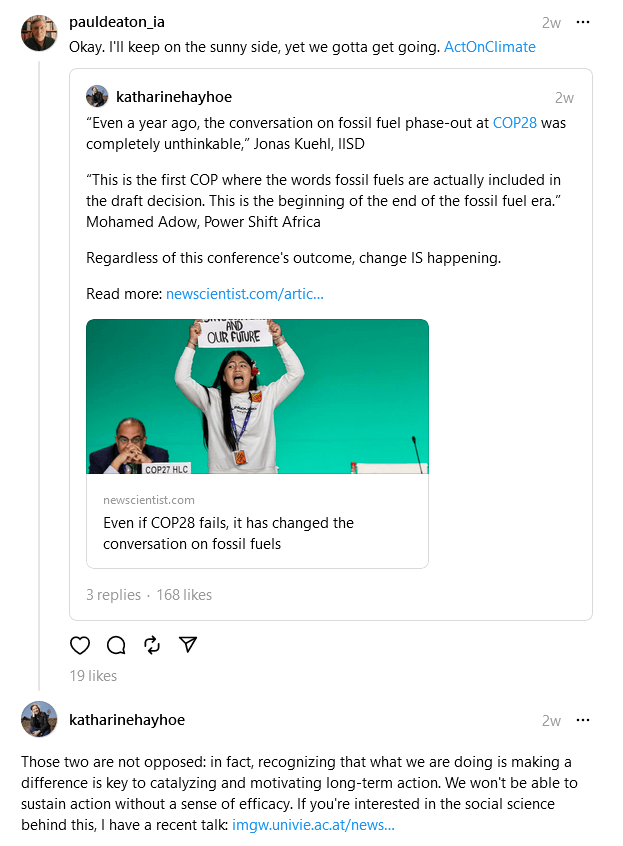
When I activated an account on Threads, one of the first accounts I followed was climate scientist Katharine Hayhoe who is active on that platform. We had this exchange about COP 28, in which I quote-posted her report from COP 28:

As Hayhoe said in the talk referenced above (Here is a link), the challenge is to move from worried to activated. It is not only possible, it is imperative that advocates for solving the climate crisis do so.

Back to my question, is the cup half full or half empty when progress toward transitioning from fossil fuels saw such resistance at COP 28?

Senator Sheldon Whitehouse (D-RI) said after COP 28 closed, “A small, self-interested minority of states cannot be allowed to block the progress necessary to put our entire planet on a path to climate safety.”

2023 was a disastrous year for our climate. We experienced the hottest year on record and the extended Iowa drought impacted corn and soybean yields. Rivers and lakes began to dry up. What gets overlooked is that just as the climate crisis seems to get worse, actions to tackle the problem are ramping up. There were environmental wins out of COP 28:

  • The cost of solar power has fallen by around 90% and wind by 70% in the past decade.
  • The majority of new energy capacity being added in the U.S. and globally is solar, wind, and battery storage; these renewables already account for nearly 14% of the U.S. energy production and 12% worldwide.
  • Electric vehicles are becoming cheaper and more attractive. For the first time, more than one million EVs have been sold in the United States in a calendar year.
  • At COP28, delegates took a historic step in establishing a loss and damage fund, the latest development in a three-decades-long fight to have wealthy, high-emitting countries compensate vulnerable, developing ones for the harms of climate change.

For more positive news, read Katarina Zimmer’s complete article on Atmos.

Despite its shortcomings, COP 28 marked a major step forward for the environmental movement. For the first time ever, a COP agreement explicitly acknowledges the main culprit responsible for the climate crisis is fossil fuels. While the agreement falls short of what many of us wanted, it still reflects progress in a decades long struggle to address the climate crisis. We should keep on the sunny side and build on this progress by finding other, like-minded people and getting active.

Categories
Environment

COP 28 and Beyond

Photo by Laura Penwell on Pexels.com

Ahead of Joe Biden and Xi Jinping’s Nov. 15 meeting at the Asia-Pacific Economic Cooperation conference in San Francisco, the parties pledged to strengthen their cooperation on climate change. The U.S. State Department released a statement detailing areas of agreement. Both presidents pointed to the importance of the upcoming Conference of the Parties (COP 28) that begins Nov. 30, in Dubai, United Arab Emirates.

The luster has gone off the Conference of the Parties, as hundreds of fossil fuel lobbyists participate as delegates to impede progress toward conference goals of eliminating use of fossil fuels. Biden and Jinping’s mentioning COP was important to regenerate interest. Their agreement on climate change was significant, yet hardly noticed in major media.

Members of the Climate Reality Leadership Corps, part of The Climate Reality Project founded by former Vice President Al Gore to address the climate crisis, seeks three outcomes of COP 28.

During a year of record-breaking temperatures and climate disasters, we cannot afford to stay silent. We must ensure that global leaders convening in Dubai hear our demands for an agreement at COP 28 to: 

  1. Phase out fossil fuel emissions and stop funding fossil fuel projects.
  2. Increase funding for climate solutions in countries that need it most.
  3. Reform future COP processes so fossil fuel interests can’t block progress. 
Email from The Climate Reality Project, Nov. 14, 2023.

Fossil fuel interests are fighting any and every advance that leads to a true net-zero economy. My Congresswoman Mariannette Miller-Meeks (R-IA01) has taken the fossil fuel companies’ positions and attended COP 26 and COP 27. In a newsletter earlier this year, she wrote:

Americans have suffered the consequences of reckless and misguided energy policy. From day one of his administration, President Biden has waged an all-out war on American fossil fuel production that has contributed to record inflation and weakened our national security.

Miller-Meeks Weekly Script, April 16, 2023.

Miller-Meeks couldn’t be more wrong. The Washington Post recently called out people like her regarding the so-called war on fossil fuels:

Former vice president Mike Pence framed the issue in one of the presidential debates: “On day one, Joe Biden declared a war on energy, which was no surprise, because when Joe Biden ran for president, he said he was going to end fossil fuels, and they’ve been working overtime to do that ever since.”

It sounds just awful. But I have good news for Republicans: U.S. fossil fuel exploitation is pretty much booming. Here are a few stats from this supposed war’s front lines:

  • After plummeting early in the pandemic, U.S. crude oil production has been climbing and is now back near record highs. That’s according to data released by the U.S. Energy Information Administration. The agency also projects that oil production will hit new all-time highs next year.
  • U.S. natural gas production has also been hovering around record highs.
  • To date, the Biden administration has approved slightly more permits for oil and gas drilling on public lands than the Trump administration had over the same periods of their respective presidencies, according to Texas A&M professor Eric Lewis. (My Post colleague Harry Stevens has previously covered this in depth.)
  • If “energy independence” means exporting more than you import, we’ve achieved it in spades. The United States has been exporting more crude oil and petroleum products than it imports for 22 straight months now, far longer than was the case under Trump.
Washington Post, A ‘war on American energy’? So why is oil production near record highs? by Catherine Rampell, Oct. 3, 2023.

When fossil fuel interests and Republicans who parrot their talking points focus on the so-called war on fossil fuels, it distracts society from pursuing solutions to the climate crisis. There are viable solutions to ridding the world of man-made greenhouse gas emissions caused by burning fossil fuels without compromising our quality of life. They distract us because distraction is a time-tested method of furthering their interests while seeking to avoid blame for causing the the climate crisis.

As society races toward exceeding the 1.5 degree Celsius limit in increasing global temperatures since the pre-industrial era, it seems increasingly evident we will wait until it is too late to take action. While Biden and Xi call our attention to COP 28, it seems doubtful the conference will accomplish what is needed. The United Nations Framework Convention on Climate Change is all we currently have to address the climate crisis as a global society. Individual countries doing so is not enough. We’ll see if delegates get serious this December. I am hopeful they will.

Categories
Environment

The Climate Crisis Remains

Lake Macbride drying around the edges on Sept. 17, 2023 due to an extended drought.

Contrary to what letters in this newspaper reported, the climate crisis remains. It is a crisis. It is peculiar to our time since the Industrial Revolution. Readers of the Gazette should know about it.

Media stories covering the impact of a changing climate continue to appear: Canadian wildfires, heated ocean temperatures off the Florida coast, abnormal melting sea ice, Hurricane Hilary in California, Maui wildfires, the Midwestern drought… you know the list. It is as if the Gazette was live blogging the end times with the Four Horsemen of the Apocalypse nearby.

Our community is at risk due to the changing climate. Our family conserves water from our public well on the Silurian Aquifer because it is faltering with increased usage. A deep and extended drought means surface waters have not been able to recharge the aquifer to meet demand. The water supply is not endless.

Society should do something to avoid the worst effects of climate change. Here’s the rub. People enjoy current life in society, and we don’t want to change, even when inconvenienced by extreme weather.

Environmental activism seems unlikely to solve the climate crisis. All the talk about climate change distracts us from the fundamental problem: the effect of unmitigated capitalist growth ravaging the resources and systems of the earth and its atmosphere.

Maybe we should forget about the climate crisis to focus on what matters more: conserving Earth’s resources for future generations. I’m on board.

Published on Sept. 21, 2023 in the Cedar Rapids Gazette.

Categories
Environment

Live Blogging The End Times

With Al Gore and company in Chicago, August 2013

The climate crisis remains with us. A series of news articles reported stresses on Earth to which climate change contributed or caused: Canadian wildfires, heated ocean temperatures off the coast of Florida, the failure of a generation of Emperor Penguin fledglings to survive because of melting sea ice, Hurricane Hilary in California, Maui wildfires, and others come across our news feeds like we are live blogging the end times. Climate change made each of these disasters worse. These stories are likely the tip of the iceberg.

I don’t need a news feed to know our community is at risk due to climate change. Our subdivision is conserving water on our public well because the Silurian Aquifer is faltering with increased usage. A deep and extended drought, combined with a lack of rainfall means surface waters have not been able to recharge the aquifer to keep up with water demand. I don’t mind conserving water. There is not an endless supply. It’s worse when generational expectations are not met.

Local environmental activists continue to remind us there is a climate crisis and the time for action to mitigate its worst effects is now. It will take all of us to address the climate crisis, especially our elected officials.

Here’s the rub. People enjoy our current life in society so much we don’t want to change it, even when inconvenienced by the impact of the climate crisis. Even when the inconvenience takes the form of the current extended drought and we don’t have access to the same amount of water coming from our faucet we did a few months ago.

In his 2017 book, Confessions of a Recovering Environmentalist and other Essays, Paul Kingsnorth captured this notion:

For most of my twenties, I had put a lot of my energy into environmental activism, because I thought that activism could save, or at least change the world. By 2008 I had stopped believing this. Now I felt that resistance was futile, at least on the grand, global scale on which I’d always assumed it would occur. I knew what was already up in the atmosphere and in the oceans, working its way through the mysterious connections of the living Earth, beginning to change everything. I saw that the momentum of the human machine — all its cogs and wheels, its production and consumption, the way it turned nature into money and called the process growth — was not going to be turned around now. Most people didn’t want it to be, they were enjoying it.

Confessions of a Recovering Environmentalist and other Essays, Paul Kingsnorth.

Kirkpatrick Sale lays bare the connection between climate and society in a recent issue of Counterpunch, “All the talk about ‘climate change’ directs the world’s attention away from what is the real central problem: the effect of unmitigated capitalist growth ravaging the resources and systems of the earth and its atmosphere.”

They both make a point.

I can’t recall how many times I heard Al Gore mention the pollution we dump into the atmosphere. “Every day we’re continuing to pump 162 million tons of global warming pollution, greenhouse gas emissions, into the atmosphere, as if the atmosphere was an open sewer,” Gore said everywhere during the last ten years. While some of this is caused naturally, most of it is a result of humans, that is, the unmitigated capitalist growth and exploitation of resources and systems Sale mentioned.

I joined the Climate Reality Project in August 2013 in Chicago. Gore’s training came at a time I needed it. I had just retired from my big job in 2009, and had seen the film, An Inconvenient Truth. I intended to work on climate change during my retirement years. Gore explained the impact of greenhouse gases on the atmosphere and oceans in clear, concise terms. The training was more than useful. There are now 50,000 trained climate activists like me. It may not be enough.

The issue mostly omitted during discussion of climate change is how it permeates everything in society. In Iowa there is no going back to the way the land and water was before the Black Hawk War in 1832. The environment has been completely re-worked to accommodate what is now conventional farming. We take what has become known as industrial agriculture for granted.

Are we living in the end times? I don’t know, and don’t believe we can know. What is known is there are solutions to the climate crisis if only we would apply them to the problem. This can be done without major disruption to our way of life.

If you are interested in a just and sustainable future that addresses the climate crisis, visit The Climate Reality Project at this website.

Categories
Environment

Trapped by Our Lack of Learning

Vegetable harvest on July 25, 2023.

Smoke was everywhere on Tuesday. The aroma was distinct, constant, and originated in Canadian wildfires. The haze was not bad, yet the smell filled the air. Smoke was a constant reminder of how little we progressed in our advocacy to do something about the climate crisis. Our lack of education, in the need to address the climate crisis, covers us like a shroud.

June was the hottest month on Earth since we began keeping records. July looks to be worse. I tried to function with outdoor ambient temperatures in the low nineties. Functioning meant using air conditioning to mitigate the heat most of the day.

The world just sweltered through its hottest June in the 174-year global climate record. 

Additionally, Earth’s ocean surface temperature anomaly — which indicates how much warmer or cooler temperatures are from the long-term average — were the highest ever recorded, according to scientists from NOAA’s National Centers for Environmental Information.

National Oceanic and Atmospheric Administration, July 13, 2023.

I don’t mean to slight the efforts of teachers, many of whom I know to be decent people. Yet, the fact is too many young people arriving to power in the 2020s don’t understand the reasoned need to act on our deteriorating climate. While we recognize a long procession of extreme weather events and conditions, we view them as a live blog of the end times over which we have no control. How did we get to this place?

In part, with electronic communications and social media, we are more aware of the pockets of culture that reject common sense to pursue tribal interests. They receive undue amplification. A reader of history knows this segment of the population has been present for multiple millennia. More than “pocket,” though, the amplification in social media presents an idea there is an organized movement. I’d call it the “know-nothing movement” yet that term has already been used. It’s not that people are dumb. It’s that they don’t know how uneducated they are. There is a name for this: the Dunning Kruger effect.

The Dunning–Kruger effect is a cognitive bias whereby people with low ability, expertise, or experience regarding a type of task or area of knowledge tend to overestimate their ability or knowledge.

Wikipedia

I am part of the Climate Reality Project whose mission includes:

We train and mobilize people worldwide with four global campaigns to unlock transformational change this decade and help us reach true net-zero by 2050 – the point where global warming can stop in as little as three-to-five years and the Earth begins to heal.

The Climate Reality Project website.

The Climate Reality plan is to reduce emissions, call out greenwashing, end financial support for using fossil fuels, and support international cooperation using the Conference of the Parties framework that brought us the Paris Agreement on climate. There is hope these things can be accomplished, according to former Vice President Al Gore last night. None of it will be easy. The fact that we need organizations like Climate Reality and others to educate, lobby and advocate for action to address the climate crisis is a sign of how far our education system has deteriorated. These topics should be front and center in our schools and in career development for students coming up. There are many obstacles to training the coming generation of Americans to take up the climate crisis as a main stage endeavor.

We do what we can. The trouble is we don’t always realize how much potential we possess to address the climate crisis. Its time to figure that out.

Categories
Environment

Hazy Summer Days

Lake Macbride State Park covered in a thin haze of smoke from Canadian wildland fires, June 28, 2023.

On Tuesday, June 27, there were 66 wildland fires being tracked across parts of Ontario Province in Canada. As a result, smoke and particulate matter is spreading over much of the United States, and across the Atlantic Ocean to multiple European countries. It has rendered the air quality “very unhealthy.” What is there to do at this point but monitor our local air quality and moderate our time and activities outdoors? The underlying science and human behavior which favor conditions for the fires have been ignored so long, we transitioned to a mode of acceptance and now focus on coping with the disaster.

At least the scenery on the state park trail is nice.

I got into something while working in the yard. I believe the ailment is contact dermatitis and the little spot where I got it itches constantly. I put some ointment on it a couple times a day and should be fine after two to four weeks, according to the Mayo Clinic. I don’t know what I contacted, although I found some nettles out by the composter. I harvested the nettles and hung them in the garage to dry. There is a cup of nettle tea in my future.

The garden is really coming in. The freezer and refrigerator are almost full. I am much closer to the garden this year than previously. I never fail to marvel at what it can produce. For now, life on Earth is pretty good, despite the contact dermatitis.

Categories
Environment

Earth Day 2023

Trail walking at Lake Macbride State Park on April 21, 2023.

There is an official Earth Day website which indicates how far the observance has come since 1970. In addition, there are proclamations by governing bodies, festivals supporting “Mother Earth,” and oil and gas companies touting their actions to capture CO2 emissions and recycle plastics. I’m not sure any of this helps reduce the impact of humans on our shared environment, yet it may be better than a stick in the eye.

Exploitation of the environment has been basic to civilization, especially in the settling of North America. In the early days, North America was about land speculation and extraction of wealth from the so-called “newly discovered” place. It began with production of sugar, rice, cotton, tobacco and indigo, which required cheap land and abundant labor in the form of slaves or indigent white folks forced to migrate from Britain. We had and continue to operate an extractive economy supporting exports and consumers. Few want to give up their handheld mobile device or other modern conveniences to help save the planet, so the extraction part of the economy may grow along with the burgeoning population. By 2100 there are projected to be 10.4 billion people on our blue-green sphere, according to the United Nations.

People should do more to improve the environment than what each of us can do individually. It seems obvious that everyone: every business, organization, government, and individual must pull together to solve the climate crisis. Importantly, our political system must take the lead in climate action, regardless of the political outlook of individual elected officials. This holds true in authoritarian regimes where there are no elected representatives. When I wrote “everyone,” that’s what I meant.

What should we do? That’s an easy answer: support large scale, organized actions that will make a difference. If regulators say we should reduce CO2 emissions in new automotive products, then support it. If the Gulf of Mexico dead zones are a problem, then regulate the chemicals and processes that dump into the Mississippi River watershed. If our air is polluted by emissions from coal and natural gas-powered electricity generation, then convert to wind and solar. Solutions exist to clean up our air, water and land pollution. There are processes to develop new and better solutions to the climate crisis.

Every day I do something small to help mitigate the worst effects of the climate crisis. I reduce water usage, adjust the thermostat a few degrees, turn off lights when not in a room, and minimize the amount of driving I do in our personal vehicle. Every day is Earth Day in our home, so the annual remembrance is not that important to me. What matters more is finding common ground to enable more solutions, reduce pollution, and clean up our land, air and water.

Spend a few minutes reading the Earth Day website, located here. Then talk to someone you know about how important it is we take action today to rescue our much abused planet and make a livable home for our civilization going forward. It could make our lives better in the process.

Categories
Sustainability

Onion Planting 2023

Onion plot 2023.

It was 64 degrees at 3 a.m. Saturday morning. That’s weird.

A gardener contends with weather, so temperature anomalies come with the work. The vegetables I plant in my Midwestern garden have a wide range of tolerance to climate, moisture and light. They have been bred and propagated because of those qualities.

Potatoes and onions should be safe to plant now, and I did. I direct seeded spinach when putting in the onion sets. Garlic is doing fine after being uncovered from winter. There are many apple and pear blossoms in the early formation stage. Pollinators are already abundant, seeking the early purple flowers and dandelions in the lawn. The greenhouse is packed with seedlings. What could be wrong?

Regardless of weird weather, Spring has arrived and it would be difficult not to feel a part of it. I can see leaves on deciduous trees bud and burst into foliage in front of me. All is well in the garden, or at least as good as it gets.

What will weird weather mean this growing season? I don’t know. I am, however, both concerned, and getting used to it. The overall trend does not look good.

If you aren’t following Bill McKibben on the climate crisis, you likely should be. In yesterday’s edition of his substack, The Crucial Years, he wrote,

This week’s Fort Lauderdale rainstorm was, on the one hand, an utter freak of nature (storms ‘trained’ on the same small geography for hours on end, dropping 25 inches of rain in seven hours; the previous record for all of April was 19 inches) and on the other hand utterly predictable. Every degree Celsius that we warm the planet means the atmosphere holds more water vapor; as native Floridian and ace environmental reporter Dinah Voyles Pulver pointed out, “with temperatures in the Gulf running 3 to 4 degrees above normal recently, that’s at least 15% more rainfall piled up on top of a ‘normal’ storm.”

Get ready for far more of it; there are myriad scattered signs that we’re about to go into a phase of particularly steep climbs in global temperature. They’re likely to reach impressive new global records—and that’s certain to produce havoc we’ve not seen before.

The Crucial Years, We’re in for a stretch of heavy climate by Bill McKibben, April 15, 2023.

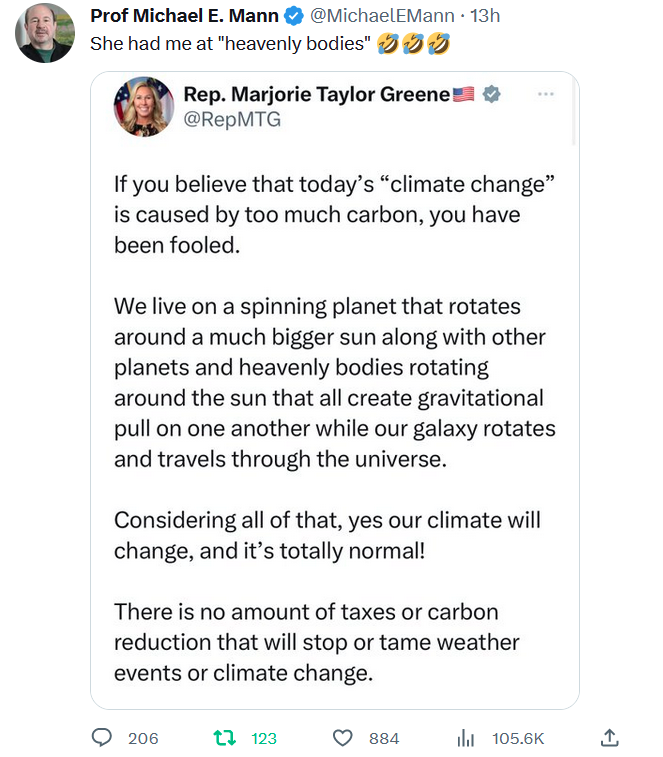
McKibben is not one to use hyperbole. He must realize the downside of doing so. In social media, instead of seeing McKibben’s work promoted, the right-wing spokesmodel for all things cultural was getting attention. Even climatologist and geophysicist Michael Mann snarked about the Georgia congresswoman’s comments.

It is getting difficult to follow the scientific discussion of the climate crisis. Partly, major news media find it too dull a subject for headlines. Partly, the right-wing media noise machine drowns out serious topics in public discourse. Yet we notice temperature anomalies when they happen, and wonder for how long we can go on the way we are.

While we wonder, we’ll need onions, apples and spinach.

Categories
Environment

Getting Beyond Coal

Move UI Beyond Coal, near Jessup Hall on the University of Iowa Pentacrest. Photo by the Author on Nov. 16, 2011.

In 2019, the University of Iowa signed a 50-year contract for a consortium of private companies to operate their coal-fired power plant and more. They should have phased out the coal plant and initiated a plan to transition to alternatives to provide the electricity and steam required. No one was listening to any of the advocates for shuttering the plant. They hadn’t been listening for years. It was an inside deal in an increasingly less than transparent state government.

In return for a $1.2 billion cash payment to fund an endowment, the university assumed different responsibilities regarding the facility. The consortium attorneys contend they didn’t understand their role and did not meet contractual obligations, according to the lawsuit. For Pete’s sake, not even three years in and there is a lawsuit? Shaking my head.

In November 2011, there was a demonstration at Jessup Hall on the University of Iowa Pentacrest urging then president Sally Mason to cease operation of the coal-fired power plant. We delivered a petition to her office. There were speeches on the steps of Jessup Hall. I gave a speech, among others.

Our deeds that day fell on deaf ears.

I remember when mass mobilizations and demonstrations could accomplish positive things in society. The best example was in 1974 when we drove Richard Nixon to resign from office as president. Those days are no more.

Instead of making social progress, big money politics of a wealthy consortium wielded their power to make more money. Filing a lawsuit is just part of the deal, even if the details over which they are suing should have been clarified well before a signature was inked.

Because the state, and the board of regents, is involved, taxpayers will ultimately pay for the suit. That’s not the future we had hoped for when we advocated for the University of Iowa to go beyond coal.

Categories
Environment

Eschewing Avocados

Avocado from Mexico.

It is my minority opinion that avocados should be avoided in the United States. Don’t buy them, don’t eat them. The fruit has become popular, and because of it, Mexican growers can’t keep up with demand. This creates a problem.

To meet surging demand in the U.S., farmers in Mexico have cut down swaths of forest in the western state of Michoacán, one of the most important ecosystems in the country. By some estimates, as many as 20,000 acres of forest — the area of more than 15,000 American football fields — are cut down each year and replaced with avocado plantations. The rapid expansion of orchards will threaten forests in Mexico for years to come.

The bad news about your avocado habit by Benji Jones, Vox, Feb. 13, 2022.

Dishes like guacamole, avocado toast and smoothies taste delicious. Refined oil from the fruit is popular among foodies and nutritionists because of its unsaturated fats. By one estimate, sports fans eat through 105 million pounds of avocados on Super Bowl Sunday. The deforestation problem is directly related to such consumer demand.

The immediate catalyst for this post was a project to reduce my cookbook collection. I found many recipes for guacamole and felt we needed a reminder to moderate consumption and address the deforestation their popularity causes. I can hear long-time readers asking, “Didn’t you cover this before?” Yes, I did in the post titled, “Can Hipsters Stomach the Truth about Avocados from Mexico?” Not much has changed.

What can consumers do about deforestation which creates high-margin avocado plantations? Solutions are complicated. Ecosystem Marketplace outlines some of the challenges here. In the meanwhile, go light on the guacamole and avocado toast, and find another oil for cooking.

It is something we can do to contribute to efforts to solve the climate crisis.