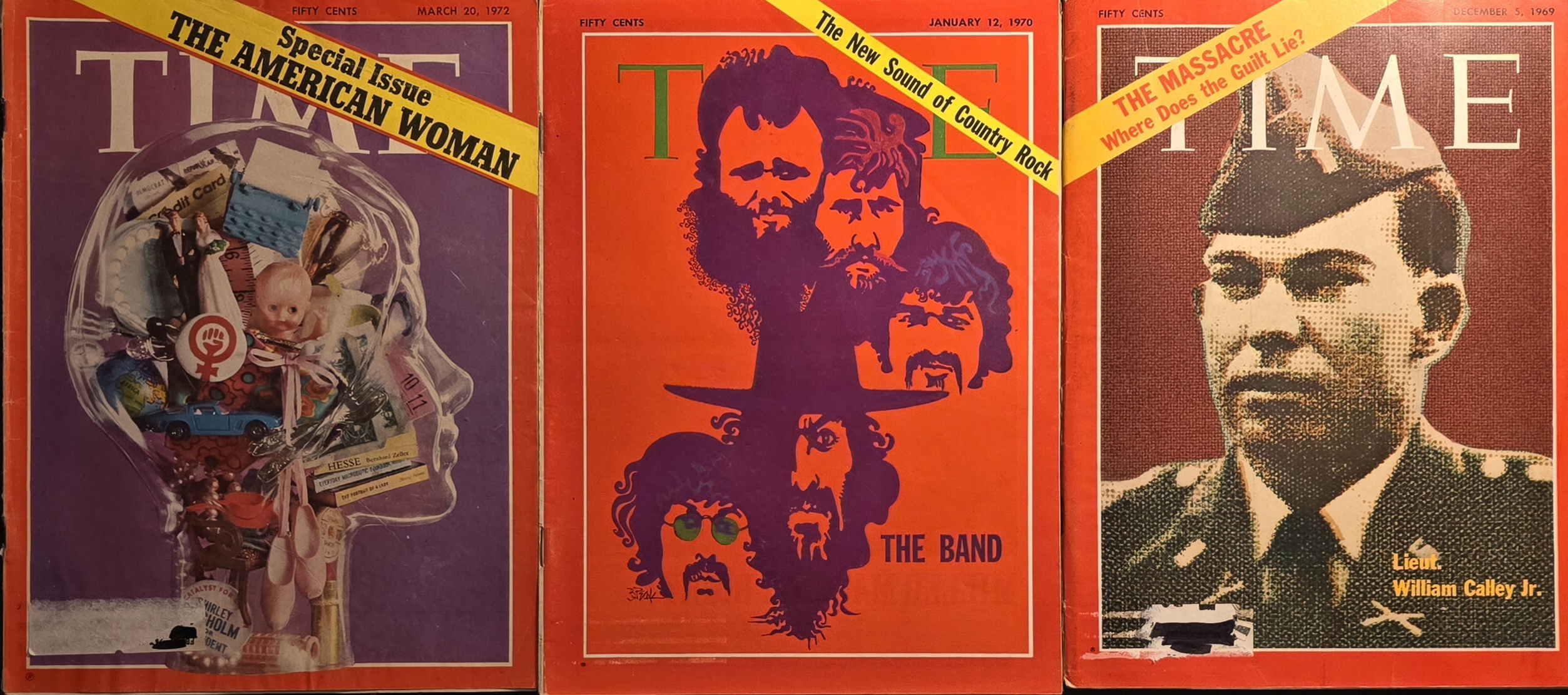
The mover’s box was quite heavy as I pulled it from the stack. Inside were mostly Time magazines from 1968 until 1972. At first they were addressed to Mother, and when I left for university, the mailing labels had my name. Teenager me thought the subscription would go on forever.
I divided them into two stacks: one in which I had some interest, and another in which I didn’t. I have interest in too many of them, so that stack will be divided again. The endgame is to pick a dozen issues to put in my trunk of souvenirs from that part of my life. I don’t want to repeat the two hours of sorting I invested on Friday by culling them again at some future date.
There were two distinct aspects of my K-12 and university education: what I learned from teachers in school and what I learned from the mass media, including television, radio, newspapers and magazines. Time had a peculiar view of national culture.
In the March 20, 1972 special issue on “The American Woman,” editors asked riveting questions such as, “What is it like to be Jacqueline Onassis?” and “How did Pat Nixon keep her cool while knocking back all those 120-proof mao-tai toasts in China?” It also provided updates on the failing marriage of Tiny Tim and Miss Vicki, Julia Child cooking at the Smithsonian Institution, and how French actress Catherine Deneuve expressed being liberated.
The issue reported, “As often as not, the New Woman was a masculine fantasy.” Leave it to Time to define women in terms of how men view them. There was the obligatory (for Time) image of Hugh Hefner with two women in short shorts.
One of the photographs in the cover story was of “Girls awaiting Miss Teen-age contest call in Houma, LA.” Beauty pageants have changed in recent times, yet they have not gone away. By Time’s depiction, the “new woman” was not so new, after all.
Somehow I survived having a subscription to Time. I’m certain I leafed through each issue as it arrived in the mailbox. I will likely get upset over the coverage of the other two issues in the photo: The story of The Band because Time reportage was part of the establishment and therefore suspect. The story of William Calley because they gave him the attention of two covers when he should have been in prison. I likely want those reactions. That’s why I kept the artifacts in the first place.
I knew I had these back issues of Time. I did not look for them even a single time in writing my memoir of the period. Like other media of the day, it was background noise shaping me in ways I did not understand. To the extent they reported on a “national culture,” Time failed. They were responsible for creating an environment where Ronald Reagan could thrive, and ultimately responsible for the election of Donald Trump as president. As Heather Cox Richardson wrote in her Dec. 12, newsletter, about the president’s recent speech, “It seemed to mark an end for the Reagan Revolution whose ideology Trump has pushed to its brutish conclusion.”
Most of my issues of Time are bound for recycling. In retrospect it was a subscription I should have canceled before I did.
 Journey Home
One reply on “Old Subscriptions”
Old magazines can be so interesting! In my childhood home, I remember mostly Life and Look magazines. More recently, I have collected a few vintage copies with articles or pictures that interest me now and probably did not back then.
LikeLiked by 1 person