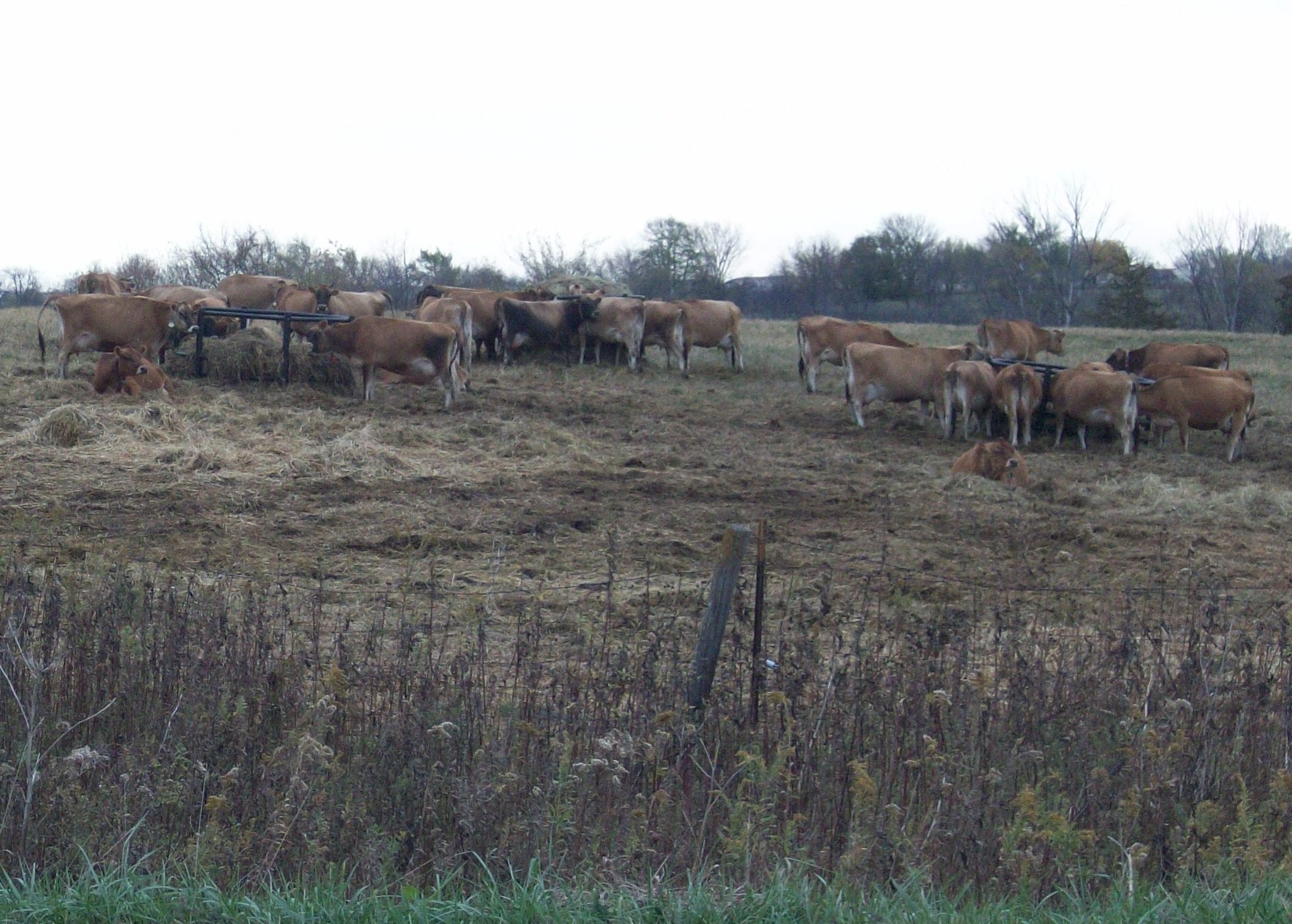
We, as a society, should be eating less meat. Why? Producing meat is an inefficient way to make food. Much of our agricultural production goes to animal feed where most calories are wasted because animals have lives to live. For example, for every 100 calories a cow eats, it produces three calories in meat. It’s not much better for sheep, dairy, pigs and chickens. Not only is meat-production inefficient, it requires a lot of land: half of the world’s habitable land is used for agriculture. Three quarters of that is used for livestock. (In Iowa, half the corn crop is used to manufacture ethanol). Add it all together — greenhouse gas emissions, land use, water consumption, and air and water pollution — and there is a strong case for meeting human nutritional needs other than from livestock.
R. Buckminster Fuller was the first person I read who said there is enough food produced in the world to feed everyone comfortably. He canceled the notion there wasn’t enough. What nature couldn’t provide, science would, he said, in the form of improved fertilizers, plant genetics, better land use, and distribution and packaging. Where we are each day is a beginning point for the rest of our lives. Each generation develops new insights into what makes our world work and how to improve it, including food production and distribution. Humanity is fraught with potential to feed ourselves.
“Man is a complex of patterns, or processes,” Fuller wrote in I Seem To Be A Verb. “We speak of our circulatory system, our respiratory system, our digestive system, and so it goes. Man is not weight. He isn’t the vegetables he eats, for example, because he’ll eat seven tons of vegetables in his life. He is the result of his own pattern integrity.” Understanding our “pattern integrity” and how it relates to the physical world is a key challenge of agriculture. It is also a source of planetary degradation because of how we pursue agriculture, especially through livestock culture.
Hannah Ritchie points out in her book, Not the End of the World: How We Can Be the First Generation to Build a Sustainable World, “Our battle with agriculture has been centered around one thing: having enough nutrients in the soil at the right time.” During the early 20th Century, German chemists Fritz Haber and Carl Bosch developed what is called the Haber-Bosch process which converts nitrogen and hydrogen into ammonia which can be used as fertilizer. The advances in plant genetics developed by Norman Borlaug are well known. Between Haber, Bosch and Borlaug, they created the Green Revolution which enhanced food production three-fold from historical levels. This is the kind of science to which Fuller referred.
Changing how we live regarding agriculture is about more than personal choices. I have no regrets choosing a mostly ovo-lacto vegetarian diet beginning in the 1980s. In the early period, there was no strict line between meat culture and vegetarianism. I did not eat meat at home, and when I was out, especially with business clients or close family, I sometimes did. It was a non-issue. I guess you would call 1980s me a casual vegetarian.
As I age, I have less interest in eating meat: partly because it is expensive to buy, and mostly because it has no viable role in the cuisine I developed in our kitchen-garden. The issue with personal choices is they are not scalable to a level where it would make make a significant change in land-use policy. It would take a lot of people leveraging the power of the pocketbook to turn things around regarding consumption of meat and associated environmental degradation.
When addressing global environmental problems we can lose hope because of their scale. By identifying a big part of the problem has been livestock and meat production, we have something tangible to grasp, something within our control. By reducing consumption of meat we contribute to a solution to our environmental crisis. There is something good in that.
 Journey Home
One reply on “Why Eat Less Meat?”
I like the taste of pork and chicken less and beef isn’t very healthy so I’m with you on this one. Plus, all it takes is driving near a CAFO to make meat unpalatable.
LikeLiked by 1 person