Categories
Living in Society

Drake University Democratic Debate

Drake University Photo Credit Cedar Rapids Gazette

The winner in last night’s debate at Drake University’s Sheslow Auditorium was the American people as Hillary Clinton, Martin O’Malley and Bernie Sanders discussed, and actually debated issues that matter. This is in sharp contrast with the multi-level Republican debates.

Only 700 people had tickets to attend, so I closed the door of my study, put on my headphones and shut down all browsers except the CBS live stream. I took notes using Microsoft Outlook.

It is ironic that Twitter, a debate co-sponsor, was pretty useless once the questioning began. With an avalanche of more than a thousand Tweets per minute, it was more than a person could comprehend, let alone participate effectively in. I opted to listen to the actual debate.

From here, the race is between Clinton and Sanders. Martin O’Malley had his last chance to gain traction in the race, and he whiffed.

One of O’Malley’s campaign taglines is “new leadership.” He failed to demonstrate it last night. When directly asked about his lack of experience in international affairs, O’Malley dodged the question. He won’t break loose from low polling numbers by dodging key questions. Without more support, he lacks a path to win any of the four early states.

As noted previously, it is hard to find fault with O’Malley’s core positions. The trouble is with his narrative. His style of using personal anecdotes, pointing to what he did in Maryland, is part of the reason he isn’t getting traction despite solid Democratic policy positions. O’Malley says the country needs new leadership, but doesn’t provide meaningful evidence to back up his assertion he has that capacity.

Then there were two.

There is a lot to like about both Clinton and Sanders. As with the results of a single poll, there is not as much meaning in a single debate performance as some supporters assert. At the same time, Clinton is the better debater and it showed.

Clinton’s response to the question about her campaign contributions from Wall Street demonstrated her mastery of the debate form. She began with a curious statement about needing to “do more” to regulate Wall Street. She didn’t say the words, but essentially lit the fuse for Sanders and O’Malley to go off on their position of re-instating Glass Steagall. Clinton’s position is re-instating Glass Steagall is not enough, and she was able to frame the discussion on her terms.

Reforming Wall Street and reducing the influence of money in politics is Sanders’ signature issue. It appeared Clinton got Sanders’ goat because he brought Glass Steagall up in the next question even though it wasn’t the topic. As long as there is money in politics (which there will be forever) and presidents appoint financiers from Goldman Sachs and J. P. Morgan Chase to key positions in their administration (which Sanders said he would not do), the appearance of impropriety will exist. Clinton didn’t shake this completely, but defended herself well in the debate.

The other topic where Clinton was able to frame the debate to her advantage was about increasing the minimum wage. Sanders and O’Malley support the Democratic party platform plank to raise minimum wage to $15 per hour. Clinton supports $12 per hour.

In asking the question, Kathie Obradovich of the Des Moines Register gave framing favorable to Clinton, mentioning the concerns of Alan Krueger over raising the minimum wage to $15 per hour. Insiders would have known Clinton’s deviation from the party platform and that her position is partly a response to Krueger. As Clinton pointed out during the debate, Nobel Prize winning economist Paul Krugman agrees with her. While both Sanders and O’Malley piled on Clinton, she maintained the upper hand on this topic.

A couple of people remarked in social media about Sanders’ increasing hoarseness during the two hours. I was reminded of John Kerry having the same issue with losing his voice on the trail in 2004. Kerry made the decision to send running mate John Edwards to an event in Cedar Rapids so he could save his voice for an upcoming debate. It’s insider baseball, but as I listened to Sanders I thought he should have backed off some of his events the previous day to save his vocal chords. He was able to adequately speak, but the hoarseness was a distraction. Clinton was not without fault in this regard. She sounded like she needed a drink of water as her laughter cackled across the stage after her competitors said things she must have thought were outrageous.

Tony Leys of the Des Moines Register made this comment on Twitter:

Some don’t want to hear it, but the Democratic primary debates are about Iowa, New Hampshire, South Carolina and Nevada period. While Sanders’ reference to bloated spending on the nuclear weapons complex may provide traction in New Hampshire, Clinton was the only candidate to use the reality of Terry Branstad’s Iowa effectively.

There are two more national debates before the Feb. 1 Iowa caucuses.
Categories
Living in Society

Hillary and the Narrative

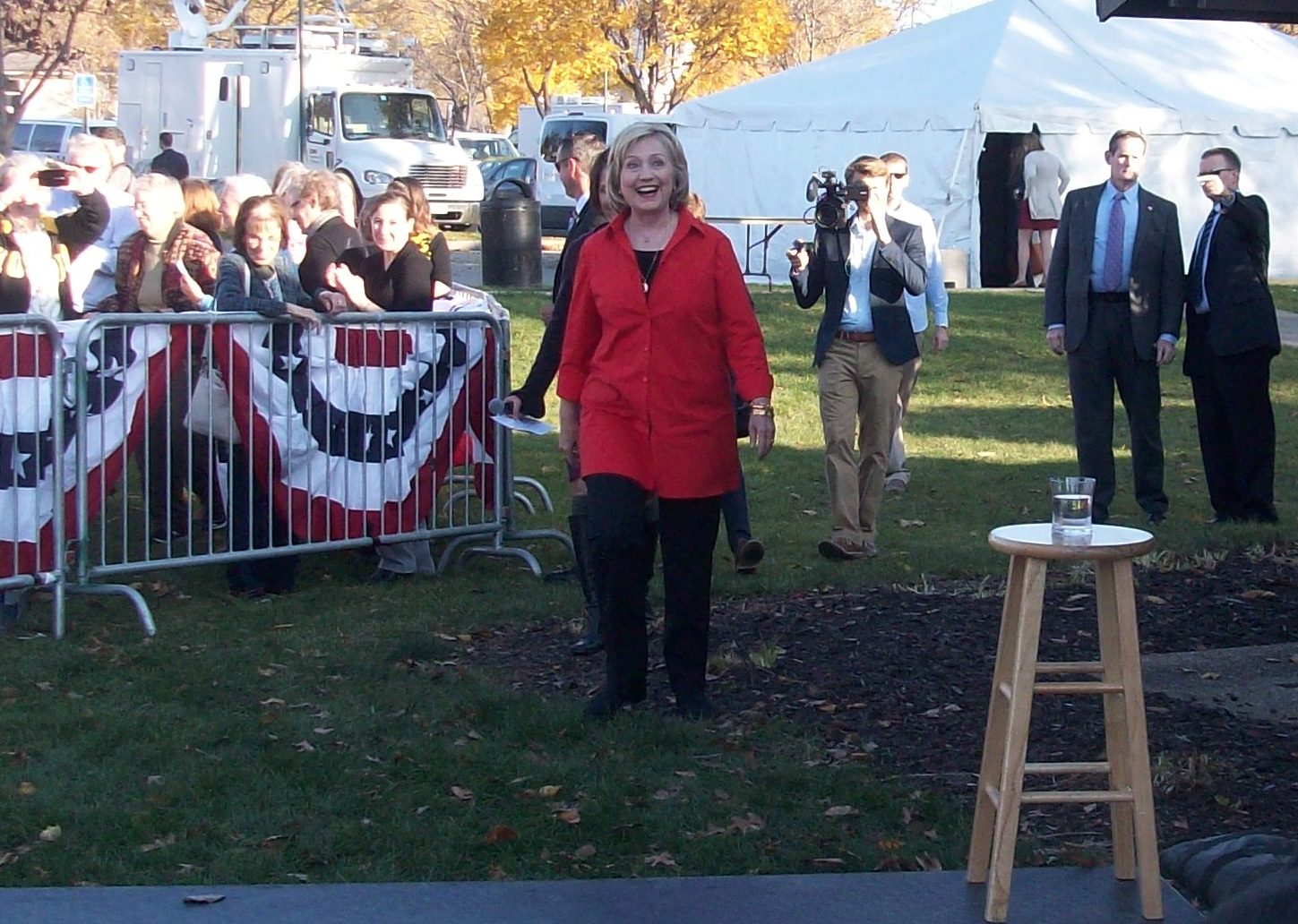
Hillary Clinton Walking to the Stage at S.T. Morrison Park, Coralville, Iowa
Hillary Clinton Walking to the Stage at S.T. Morrison Park, Coralville, Iowa, Nov. 3, 2015

CORALVILLE — Hillary Clinton held a town hall meeting in S.T. Morrison Park on Tuesday with more than 500 people in attendance, according to event organizers.

After a brief speech, she called on audience members, taking 13 questions covering a wide range of international and domestic issues.

Her command of the current political scene and experience with politics at the highest level was on display. For the wonkier among us the exchange was welcome.

If voters could set aside preconceptions formed since Clinton was first lady of Arkansas, she would be the clear choice to lead our country for four or eight years. Whether caucus goers will give her that chance remains uncertain despite her continuous lead in the polls since she declared her candidacy April 12. Supporters I spoke with in queue to enter the seating area seemed likely to turn out for her despite minor grievances with Clinton and her campaign.

Johnson County is the strongest liberal center in Iowa, and according to New York Times correspondent Amy Chozik, “Sanders Country.” Her narrative is as follows:

On Tuesday, Mrs. Clinton plans to answer Iowans’ questions at two town-hall-style events in Coralville, near Iowa City, and Grinnell, another university town. Both are known as Bernie Sanders country because of the devoted liberal college students who have been intrigued by his candidacy, but Mrs. Clinton, feeling emboldened, will seek to make inroads in the areas to talk about her plans to lift middle-class incomes.

The trouble is the narrative doesn’t reflect the complexity of the community. As John Deeth pointed out, Johnson County is different from the rest of Iowa. That difference is not only in its presidential politics, and the role of the student vote, but in Iowa City ballot initiatives like the 21 Bar Referendum; thrice failed county-wide efforts to gain approval of expanded jail capacity and a more secure courthouse facility; and the board of supervisors decision to raise the minimum wage coupled with the prompt rejection of the ordinance by some cities. I get that Ms. Chozik works on a deadline and has to keep it simple for her readers, but narratives that ignore the complexity of society in favor of pabulum-style writing should be an affront to people who know better.

Another problem with the narrative is depiction of Clinton as a poll-watcher feeling emboldened by the surge since mid October. This is ridiculous in light of the fact that one of Hillary’s key Iowa supporters is former Iowa Democratic Party chair Sue Dvorsky who lives in Coralville. Why wouldn’t one of Clinton’s biggest fans invite the candidate to the park where her husband, state senator Bob Dvorsky, has held his annual birthday party fund raiser?

While I appreciate that Chozik spends time in Iowa reporting on the run up to the caucus, and her stories do add value, corporate media narratives shaped the opinions of people with whom I queued before the event. They give people something to talk about, and there is already enough gossip in our community without the media adding more.

Not everyone likes the policy wonk Clinton was on Tuesday. People who live on the surface of what is happening in society, who don’t have the advantage of being physically close to a candidate like we can be in Iowa, get their information largely from mass media. On the playing field that is cable news, print or social media, and network news, one brief story is juxtaposed with another at a continuing and mind-numbing pace. It makes for a bitter soup of life. That Hillary Clinton knows policy inside out from personal experience makes her unique in the race. The media format and content as presented by many serves to distract viewers from that.

The Iowa caucuses are a blessing and a curse. Our first in the nation status enables almost anyone who wants to get up close and personal with a candidate who campaigns here. On the other hand, organizing people to caucus for a candidate can be an exercise in frustration, beginning with the fact that people don’t want to hang out for more than a couple of hours taking care of what most believe is irrelevant “party business.” The Democratic Party process excludes people as much as it welcomes.

Hillery Clinton in Coralville, Iowa, Nov. 3
Hillary Clinton in Coralville, Iowa, Nov. 3, 2015

My main challenge in attending the town hall was light. I wanted a few decent photos on my inexpensive Kodak camera as the sun would be setting when Clinton spoke. Sunset is still magical to me. I chose a seat west of the stage so the setting sun would be at my back. Of 200 shots, about six were keepers, including this one of Clinton with the sun illuminating her.

As writers, what we see and hear is influenced by who we are as much as by what is said and done by our subjects. Input is filtered and shaped by our biases, learning, and method of information collection, the way an anthropologist influences ethnographic interviews with questions asked. Hearing the entirety of what a candidate has to say at an event like Tuesday is pure Iowa. Or, as Sue Dvorsky posted on Facebook about the town hall, “The breadth of topics were a credit to our community, and answer the question ‘Why Iowa?’ And the depth of her responses answer the question ‘Why Hillary?'”