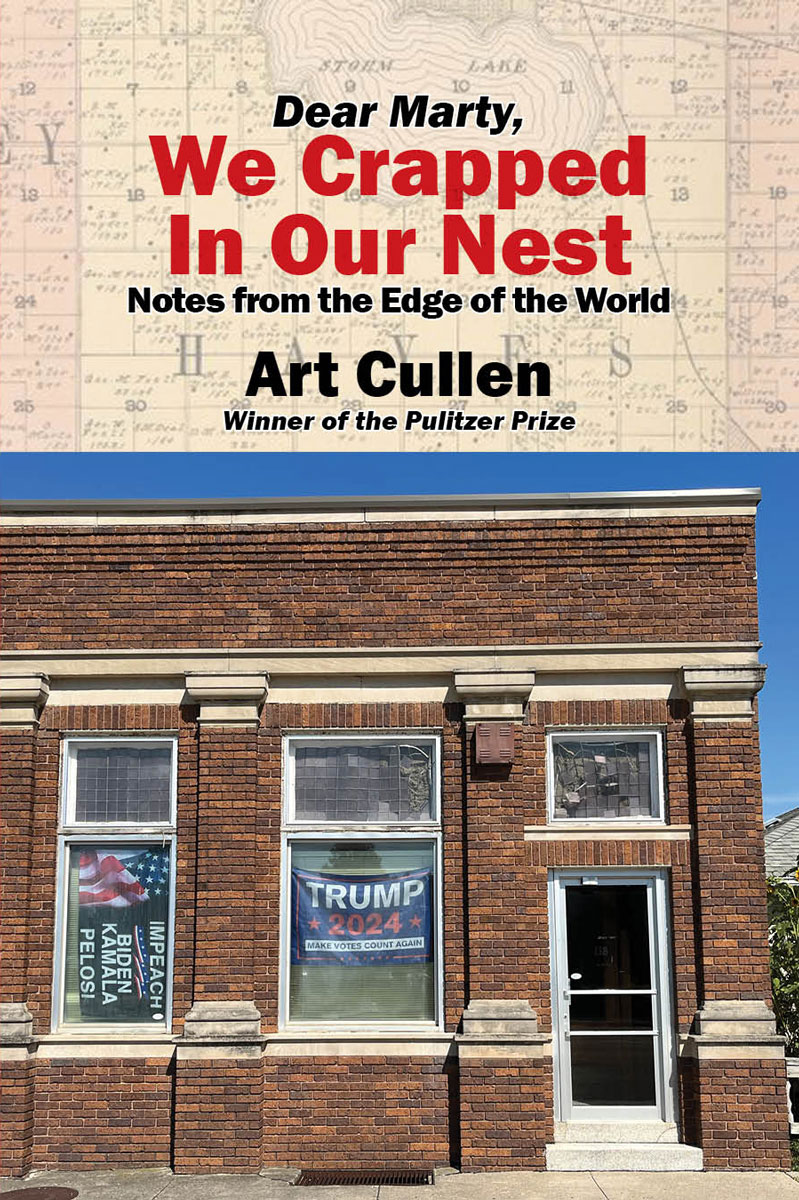
Art Cullen is the kind of writer I have to watch what I write about him in public. Chances are, unless the Good Lord takes him from us, I’ll run into him in some unforeseen context to experience consequences for writing anything too negative. Not that I would, Dear Marty, We Crapped in Our Nest: Notes from the Edge of the World is a well written narrative with a compelling story. Readers should buy a copy and read it.
I recognize many of the players, like Henry Wallace, Norman Borlaug, Fritz Haber, Carl Bosch, Frank Zybach, Aldo Leopold, Ricardo Salvador, and others. These men orbit the sun in an array of stories with which I was already familiar. Thanks to Cullen they were pulled together in a way that has me nodding in agreement. Even the politicians he mentions, Terry Branstad and Tom Vilsack particularly, make their planetary circle around the main theme of Iowa’s extractive agriculture. It’s not a particularly happy story, yet the confirmation bias I experienced created a positive afterglow that lasted the rest of the weekend as I finished the book.
What Dear Marty accomplished is an Iowa narrative, one of many out there, some of which are unknown. We need such narratives. They teach us how to live based on lessons learned or not learned from a tangible past and present. We need that as we live in a time when the U.S. Department of Agriculture set aside billions of dollars to pay for SNAP benefits in the event of a government shutdown. The government shut down, and Republicans refuse to use the money as intended. They instead politicized food insecure people to show they are in control. What are we, as a society, even doing here? I look forward to Cullen’s next column about things like this.
Cullen displays his skills as a newspaper writer in the book. That he could pull together this Iowa story can be attributed to research done to write weekly articles for his newspaper. He shared many of those articles in social media and I read them. This makes the story in the book familiar. It gave him a leg up on anyone else trying to write such an Iowa narrative.
The author makes a lot of sense in the chapter “Finding Center.” There are plenty of things we have in common with people in our neighborhoods, he said. We should just begin pursuing those common interests. This is such common sense, people are missing it. That or they are too busy working more hours, both paid and unpaid, and can’t take their noses up from the grindstone to catch a breath, much less engage in new things. I appreciate common sense. It’s value has diminished in the broader society.
This book reminded me of the late Donald Kaul’s How to Light a Water Heater and other War Stories. In it Kaul reprinted a bunch of his columns in a way that makes it look like they are in a newspaper. The difference between Washington D.C., where Kaul lived, and Spirit Lake is that Cullen actually used his columns to make something new and worth reading. Donald Kaul was no Art Cullen. Many of us are thankful the latter lives in Iowa.
 Journey Home
You must be logged in to post a comment.