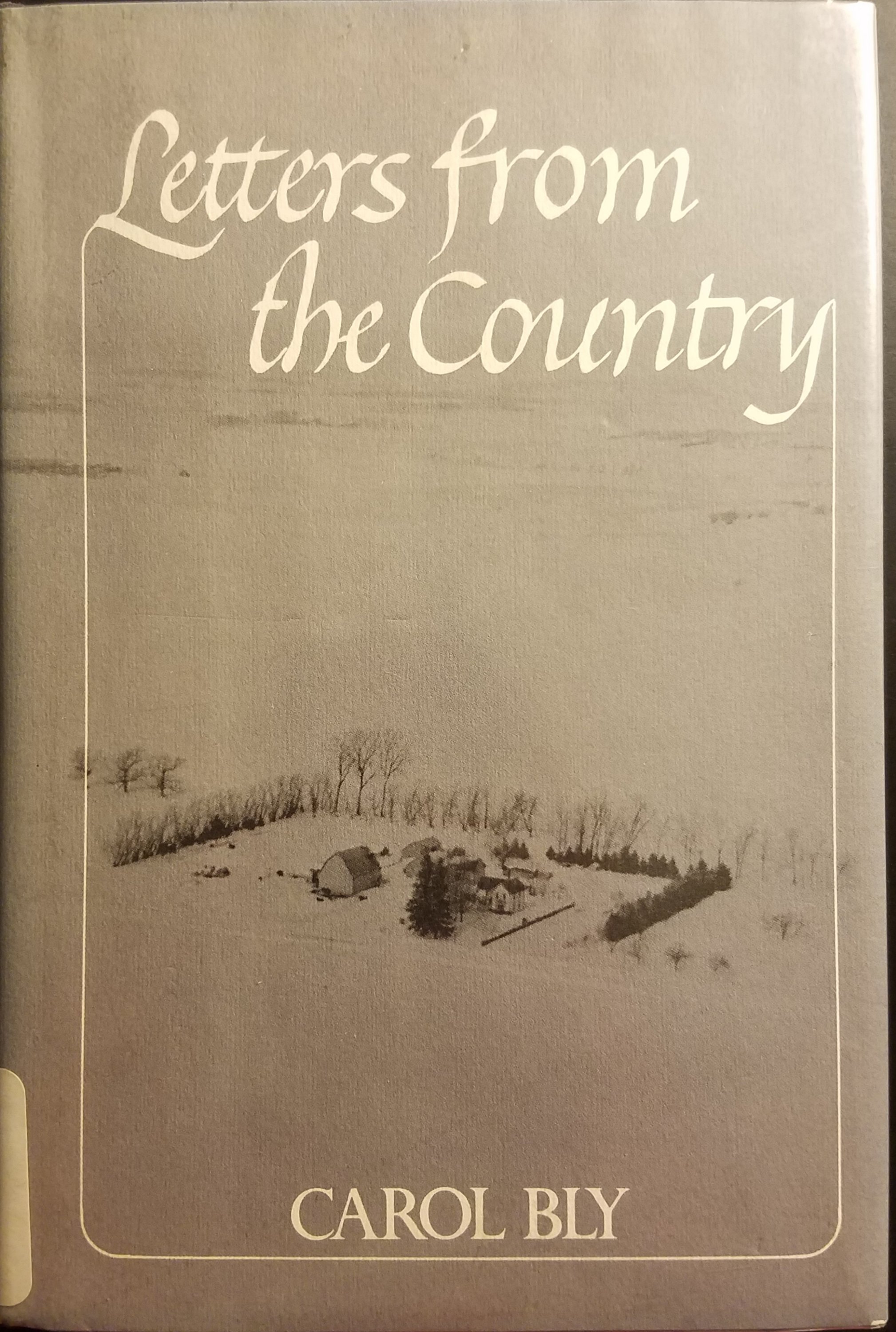
It was a long time getting to Letters from the Country by Carol Bly. My copy is a discard from the Lake County Indiana Public Library where I picked it up from a used book shelf. We moved back to Iowa in 1993, so the purchase was more than thirty years ago. Attracted by the idea of letters from southwestern Minnesota, where my family bought land from the railroad in 1883, the book failed to stand up to time when I recently read it. If its insights and comments were relevant when it was written in the 1970s, such relevance escapes the reader in a time of internet connections, processed food, sports utility vehicles, and 24/7 right wing talk radio.
There are some truths buried in this time capsule of a book, particularly about how rural people interact with each other. It is a learned protocol of avoiding difficult things in life. Things like problems that have complex solutions that are not obvious, or telling someone “thanks for sharing ” immediately after they spill their guts about something intensely personal that affected them greatly. Away from the distractions of large cities, there is a sense that people have to live with each other and therefore don’t tend to burn any bridge with someone they might see in the neighborhood, or at the convenience store, library, or American Legion. For the most part, this means avoiding talk about politics unless one knows the politics of everyone in the room.
People don’t take well to being told what to do or how to live their lives. Bly’s book is full of that and partly, it’s why it seems outdated. Times have changed. She writes about bringing intellectual pursuits from the city to rural areas, which is a noble idea. Today, folks just get into their SUV and drive to Chicago to see the latest exhibition at the Art Institute. Or they fly to New York to see what’s on Broadway. For the time being, arts and the humanities are taught in rural public schools. The annual cycle of K-12 school musical, dramatic, and literary productions are part of the fabric of rural society. The direction our politics is heading may remove these topics from curricula in the near future to focus on skills needed to get a job, raise children, and get along well enough to not rock the boat of social mores.
Some of the letters mention the frequency with which rural folk write their congressman. Not writing is a sign of a decent level of satisfaction in the community. That’s why, Bly wrote, rural folks don’t write that many letters. If current elected officials seem out of touch with reality, it’s not because they don’t know what’s going on with citizens. They choose to address their concerns while adding a layer of indoctrination in the new ways of a national conservative culture. Why talk about poor air and water quality — real problems in Iowa — when citizens can be scared by tales of bogeymen laden with fentanyl illegally crossing the border with Mexico. The latter pays a political premium.
I didn’t dislike Letters from the Country. I do want to say more than “thanks for sharing” to the author. What I will say is it is good to read Bly’s analysis of what’s wrong with country folk and their way of life. Maybe it just needs updating. That would be a fit project for someone to take as long as it is not me.
 Journey Home
2 replies on “Book Review: Letters from the Country”
Interesting to see Carol Bly mentioned. Back in the 70s I attended some events with her as a participant and me as a youngish next-to-nothing,* I recall one event she presented a provocative talk about the ideal goal of abolishing TV because of its pernicious effect on US culture. I think at that time I didn’t even own one (lack of funds), but because I was interested in the performance arts, her stance struck me as bookish distain at that part of culture combined with confusing the medium’s state at a point in time with its potential.** Left a sour taste in my mouth, and though I was an argumentative cuss then myself, I thought talking to a group of poets and literary writers in the 70s about TV being bad wasn’t exactly edge-lord material.
*Still am. Well not young, but…
**Years later long-form TV became the epic or novel equivalent for the performing arts, which it wasn’t then. I respect that, but I’ve concentrated on shorter literary forms.
LikeLiked by 1 person
You summarize some of my feelings. This book feels rooted in the pre-internet times and maybe that’s why some of her ideas fall flat today. In the effort to divide city and country folk, she is city oriented. The dominance of the internet as knowledge repository and communications platform is vaporizing that divide. She was soundly thumped in Goodreads reviews for being elitist. As a piece set in the 1970s, the book is not that bad. Thank for commenting.
LikeLike