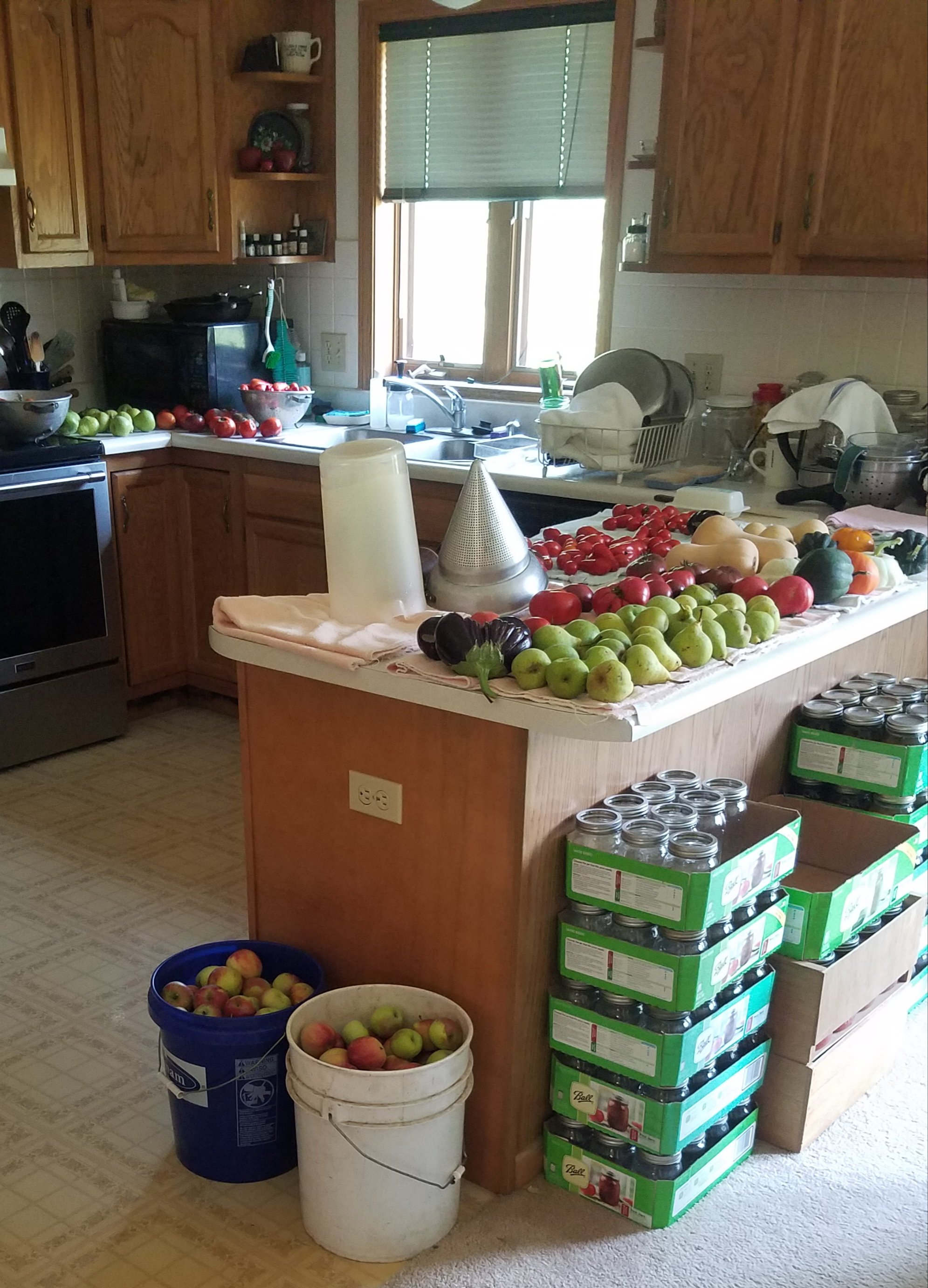
The orchard where I worked for eight seasons before the coronavirus pandemic has Red Haven peaches from the owner’s cousin in Michigan. They are among the best peaches I have yet eaten. I didn’t buy any this year because the pear tree we planted at our daughter’s high school graduation party is producing in abundance. Our pears are misshapen yet sit down and stand up sweet and delicious. I’ll save my peach buying for another season.
It is hard to keep up with the garden’s abundance. On the counter are tomatoes, pears, apples, squash, and eggplant waiting to be processed or cooked. In August, this could be a full time job. I truly want to can tomatoes for winter. Luckily, they have a reasonable shelf life and I can process them before spoilage. Half of the challenge in the kitchen is knowing what to process, how, and in what quantity.
Physical stamina is another thing. A person can stand at the counter slicing tomatoes for only so long without rest. I do it until my back gets sore and then stop and sit for a while. It extends the overall time to get things done. It also allows me to continue until the work is finished.
The way the harvest comes in makes for canning batches of two or three different items. I currently have apple sauce, tomato juice, diced tomatoes, and salsa verde ready to be processed in a single batch. We’ll see how the morning goes and whether there are enough tomatoes to make a complete batch. I know there are enough apples to make seven quarts of sauce for a single batch. Usage in cooking determines whether to put things in quart or pint jars. For example, tomato sauce is for pints, and whole tomatoes for quarts. Apple sauce is for quarts, apple butter for pints. Navigating through canning and food preservation is a learned skill.
Ten years ago, I preserved everything I could from the garden. That resulted in many extra jars of pickles, applesauce and apple butter. Unless there is a specific reason, I now limit my seasonal output to what we can use in a year or two. I do not see a future of canning pickles the way I did in 2016 when I generated 24 quart jars. Cucumbers are so abundant, I can make fresh refrigerator pickles that last for a year. The canned goods are tasty, but also too much when trying to process everything.
My cruciferous vegetable plot was an unmitigated success this year. I put up all my kale early in the spring and now pick fresh when I need it. Soon I’ll pick a couple crates for the food banks, but I don’t like to inundate them with kale. Same for chard and collards. We have frozen broccoli and cauliflower enough to last until spring. The broccoli plants are still producing small floret bunches.
When I’m busy in the kitchen, it is time for a batch of soup. The problem is the refrigerator and freezer are full, so there is no place to store a couple quarts of home made vegetable soup.
The rack of garlic is dry enough to process and clean. I’ll save the 25 biggest heads to break apart and plant as seeds in October and put the rest in a crate for storage on the lower level of the house. Because the garlic season lasts from October to July, I tend to forget about it. It is a mainstay in our kitchen where we use some almost every day.
There is no place I’d rather be than in our summer kitchen. When one grows a kitchen garden, meals are better and we engage in the process enough to forget our troubles. It’s where I’ll spend many of the coming days.
 Journey Home
You must be logged in to post a comment.