My aunt was born on Sept. 9, 1941, 13 years after my father and ten years before me. Because of that, she seems a generation apart from her three brothers. When my grandmother died, and grandfather was not around, her aunt and uncle adopted her. She is now the longest-living of her generation. Our last conversation was on Nov. 17, 2024.
While we visited her and other Virginia family when I was a kid, and once the summer after our marriage, we have the kind of relationship that can be described as “family.” That is, “family” in that peculiar Appalachian usage, where the word functions as a large, multigenerational, and deeply rooted support system spanning entire creek drainages or ridges for centuries.
My aunt and I only rarely exchange phone calls, letters, or emails. However, we do exchange them, indicating that family persists. In part, this is because her age is closer to mine, and she survives. When we talked or corresponded, we covered a lot of ground.
I told her of the letter I received from my grandfather’s second wife in Rock Island, Illinois and sent her a copy of it, along with the enclosed photo of Grandfather toward the end of his life. There was some discussion about how closely my aunt and I are related, with her finally saying she is a whole sister to my father. Previously, the discussion was that she was a half sister. The breakup of grandfather’s first marriage was a subject of speculation with my aunt’s second husband saying that he “heard talking” my grandmother would not take him back after prison. I can’t imagine hearing this kind of “talking” in today’s society. Grandmother died in August 1947.
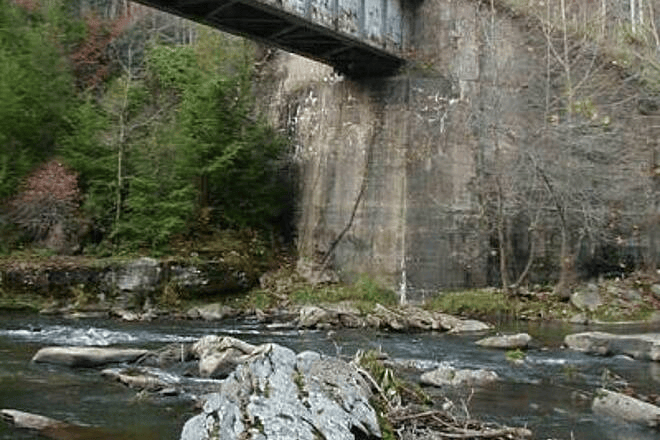
We started right off as is our custom, dispensing with any pleasantries. She began with the “dude hole.” There was a creek (likely the Guest River) that ran beside the railroad hauling coal out of the mountains. At one spot the water backed up and created a swimming hole, a.k.a. the dude hole. This was local appellation, not a geographical feature. My father and uncles would wait for the train, jump on board as it slowly made its way down the mountain, and then jump off into the dude hole. Sounds like fun.
I have very few stories about what Father’s life was like in Virginia before Grandfather was sent to prison. The only other is around a small collection of photographs of Father playing with the Salyer girls before World War II. These were the Salyers of the Salyer-Lee Chapter No. 1417 of the United Daughters of the Confederacy, named for Colonel Logan Henry Neal Salyer (commanding officer in the 50th Virginia Infantry whose recruits came mainly from Wise County) and General Robert E. Lee. We didn’t talk much about the Confederacy when I was growing up, although I bought a Confederate flag on a family trip to Gettysburg, Pennsylvania. Mother was skeptical of my gift shop purchase, but let me go ahead and get it in deference to Father’s Virginia heritage.
When researching my autobiography, I looked at the U.S. Census in Wise County:
In 1860, the last year the U.S. Census counted enslaved African Americans, a third of the population of Virginia was enslaved. In Wise County, 66 enslaved persons were counted along with 4,416 white ones. Family lore does not include much about slavery. I don’t recall ever talking about it. An Iowa Life by Paul Deaton
During our phone call, my aunt could recall no black people living in Wise County.
We covered things of interest to genealogists: where people lived, when they died, and where they are buried. I took notes, which I used to write this post. It is getting on time for another phone call.
You must be logged in to post a comment.