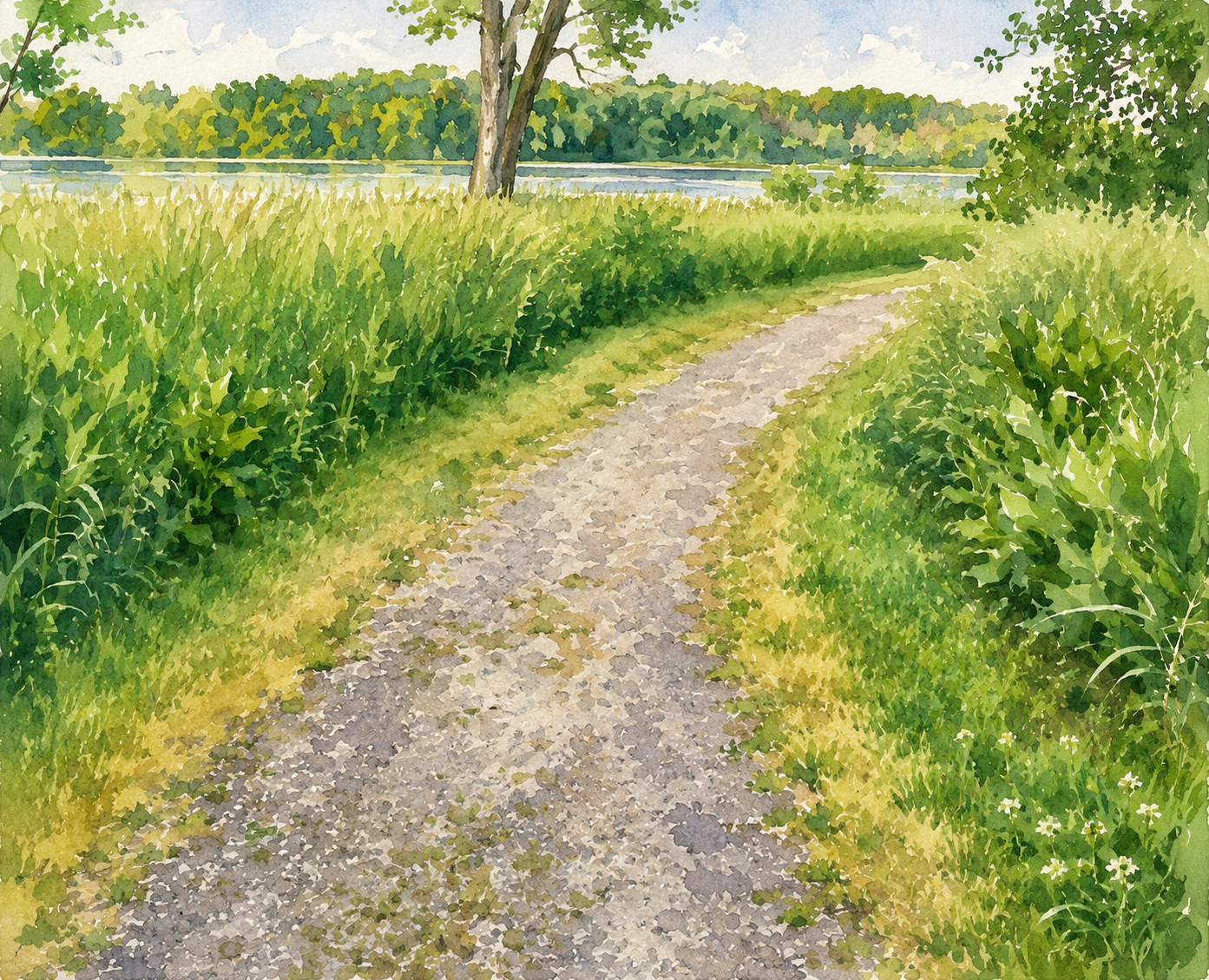

Friday after overnight and early morning rainfall I came across this common snapping turtle laying eggs next to the state park trail. This location was a few yards from the lake where the turtle spends most of its life. Because of all the foot and bicycle traffic, it is not the safest place for a clutch of turtle eggs to incubate. It takes from 9 to 18 weeks for hatchlings to emerge and head toward the water. A lot can happen in that time.
The common snapping turtle is not a legally protected, threatened, or endangered species in Iowa. That means anyone with a valid fishing license can hunt or trap them for resale or to make the local delicacy of turtle soup.
Female snapping turtles leave the water only occasionally, and nesting season, from May 15 to July 15, is an important time in their lives. After mating in spring, females travel overland in search of a suitable nesting site with loose soil and good sun exposure. This female found exactly that a few yards from the lake. After heavy rains softened the ground next to the trail it was easy to dig with her back feet. The female uses her hind feet to excavate a flask-shaped cavity several inches deep. She deposits between 20 and 40 eggs, although larger females may lay even more. After carefully covering the nest, she returns to the water and provides no further parental care. The eggs and hatchlings are left to survive on their own. This site is protected from vehicular traffic, yet predators such as raccoons, skunks, foxes, and opossums are abundant in the state park, and human disturbance from joggers, bicyclists and walkers is a threat.
The odds are stacked against a young snapping turtle. Predators common in the state park ecosystem, regularly locate and dig up nests. Even if the eggs hatch successfully, the tiny turtles face a perilous journey to the nearest wetland. Birds, fish, and mammals prey on hatchlings, and only a small percentage survive long enough to reach adulthood.
Despite their reputation, common snapping turtles play an important role in Iowa’s aquatic ecosystems. As opportunistic omnivores, they consume fish, insects, aquatic plants, carrion, and other food sources. By scavenging dead animals, they help recycle nutrients and keep waterways cleaner. Their presence is often a sign of a healthy wetland or lake ecosystem.
Common snapping turtles are among Iowa’s longest-lived reptiles. Individuals may survive for several decades, with some estimated to live 40 years or more in the wild. In captivity, some are known to reach 100 years. Because they mature slowly and depend on high adult survival rates, the loss of nesting females can have long-term impacts on local populations even when the species remains widespread and abundant.
For now, the eggs appear to be laid, and I plan to leave them alone. The next day the site didsn’t look like it was dug enough, but what do I know? I learned something about our environment and ecosystem in this discovery.
You must be logged in to post a comment.